
Mjölnir Rocket Engine: Revolutionizing Aerospace with 3D Printing, Sustainable Fuel, and Unmatched Performance
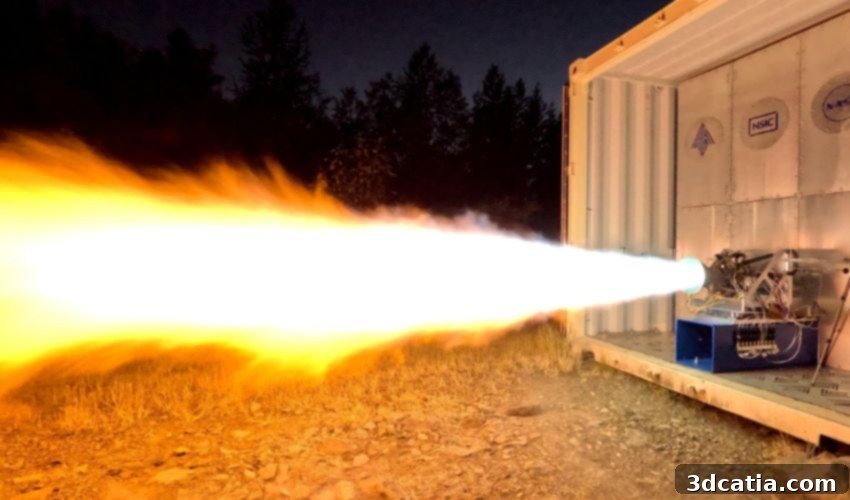
The name Mjölnir immediately conjures images of immense power, divine blessings, and unparalleled might – the legendary hammer wielded by Thor, the thunder god in Norse mythology. This iconic tool serves as both a devastating weapon capable of leveling mountains and an instrument to bestow good fortune. It is with this profound symbolism of robust capability and protective innovation that the Washington-based startup, New Frontier Aerospace (NFA), has aptly named its groundbreaking 3D-printed rocket engine. The Mjölnir rocket engine is currently making significant waves across the global aerospace industry, garnering widespread attention following a series of highly successful hot fire tests. These pivotal achievements not only signify a remarkable leap forward in propulsion technology but also underscore its vast potential for transformative applications in defense, commercial space exploration, and advanced aerospace endeavors.
According to New Frontier Aerospace, the Mjölnir is engineered to be the world’s most advanced compact pump-fed rocket engine. Its sophisticated design incorporates a full-flow staged combustion cycle, an exceptionally efficient architecture that positions Mjölnir as an ideal propulsion solution for the next generation of high-performance reusable rockets, cutting-edge hypersonic vehicles, and complex orbital transfer spacecraft. This engine is not merely a marvel of engineering; it also embodies a forward-thinking commitment to environmental stewardship. Designed with sustainability as a foundational principle, Mjölnir operates on clean liquid natural gas (LNG). Critically, when this LNG is sourced from bio-waste, the engine achieves a net carbon-negative footprint, powerfully highlighting NFA’s deep commitment to ecological responsibility and pioneering sustainable aerospace innovation. Beyond its fuel efficiency, Mjölnir is engineered for exceptional reusability, featuring deep throttling capabilities—the crucial ability of a rocket engine to significantly reduce its thrust output for controlled maneuvers—and straightforward start-and-stop mechanisms. These characteristics minimize operational costs, enhance mission flexibility, and extend the lifespan of the propulsion system. The Mjölnir engine is now available as a standalone product, offering customers a compelling, high-performance propulsion solution tailored for their diverse mission requirements, from Earth-bound hypersonic travel to deep space orbital transfers.
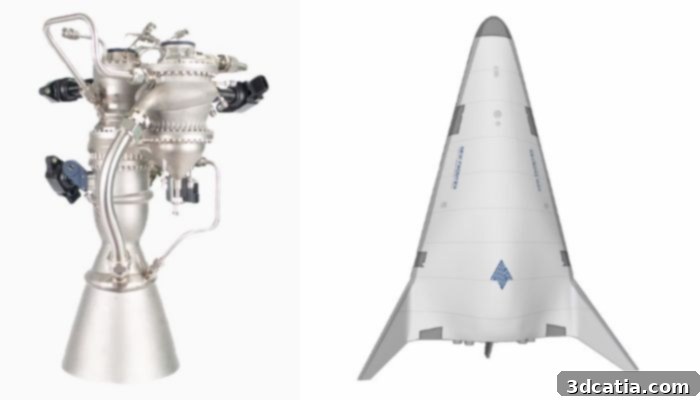
The 3D printed Mjölnir rocket engine (left) and NFA’s Intercontinental Rocket Liner (right)
The Indispensable Role of 3D Printing in Mjölnir‘s Advanced Design
The extraordinary development of the Mjölnir engine stands as a prime example of the transformative power of additive manufacturing, commonly known as 3D printing, within the aerospace sector. This cutting-edge technology has been absolutely instrumental in translating NFA’s ambitious and complex designs into tangible, high-performance hardware. For an advanced rocket engine like Mjölnir, 3D printing enables the creation of intricate internal geometries that are simply impossible or prohibitively expensive to produce using traditional manufacturing methods. This includes optimized cooling channels that manage extreme temperatures more effectively, advanced injector designs that enhance combustion efficiency, and the consolidation of multiple components into a single, unified part. Such consolidation dramatically reduces the overall part count, simplifying assembly, reducing potential points of failure, and ultimately slashing manufacturing lead times and costs. The ability to rapidly iterate on design concepts, produce functional prototypes with unprecedented speed, and transition quickly to production offers NFA a significant competitive advantage. This agility has been crucial in accelerating the journey from initial concept to successful hot fire tests and, ultimately, to readiness for flight. Furthermore, the precision and material efficiency inherent in 3D printing align seamlessly with NFA’s commitment to sustainability, minimizing waste during the manufacturing process and contributing to a more environmentally conscious approach to advanced rocket engine development. It allows for the use of high-performance alloys precisely where needed, optimizing weight and structural integrity.
Strategic Funding, Rigorous Validation, and NFA’s Pioneering Vision
The impressive journey of Mjölnir, from its conceptual design to its proven performance in a series of hot fire tests, received crucial early impetus from seed funding provided by National Security Innovation Capital (NSIC), an integral component of the Defense Innovation Unit. This vital initial investment underscored the strategic importance of NFA’s proprietary technology for national defense applications. Following this foundational support, the ongoing and successful engine test series, which has consistently delivered promising results, secured essential additional funding from NASA. This signifies the engine’s considerable potential for civilian space exploration, scientific research missions, and commercial space ventures. The consistent and robust performance demonstrated throughout these rigorous hot fire tests represents a monumental leap forward for New Frontier Aerospace. These trials meticulously validate the engine’s reliability, efficiency, and structural integrity under the extreme operating conditions characteristic of rocket propulsion, providing invaluable data and instilling high confidence in its readiness for operational flight. By consistently exceeding its performance metrics, NFA is not merely developing a new rocket engine; it is actively redefining the foundational landscape of aerospace propulsion, relentlessly pushing the boundaries of what is achievable in terms of power, thermal efficiency, operational versatility, and environmental responsibility.
Bill Bruner, the visionary CEO of New Frontier Aerospace, eloquently expressed the immense pride and enthusiasm shared by the entire organization regarding these significant milestones. He stated, “We are incredibly proud of the amazing team that painstakingly built this program and absolutely thrilled with the engine’s exceptional performance during this rigorous series of hot fire tests. Mjölnir’s compact design, unparalleled efficiency, and its unwavering commitment to clean fuel technology make it a true game-changer for both hypersonic flight applications and advanced space propulsion systems. This engine is strategically poised to power our ambitious roadmap, enabling us to achieve groundbreaking missions that will redefine possibilities, and critically, opening up entirely new capabilities and opportunities for our valued customers across commercial, defense, and scientific sectors.” Bruner’s statement encapsulates NFA’s overarching vision: to harness cutting-edge technologies like 3D printing and sustainable fuels to deliver propulsion solutions that are not only extraordinarily powerful but also economically viable and environmentally sound, addressing critical needs in both governmental and commercial aerospace markets.
Mjölnir In Flight: Enabling Next-Generation Air and Space Vehicles
The practical applications and future trajectory of the Mjölnir engine are already being meticulously charted, with key operational milestones rapidly approaching. In early 2026, Mjölnir is slated to provide the primary propulsion for NFA’s Pathfinder hypersonic Vertical Takeoff and Landing (VTOL) Unmanned Aerial System (UAS), empowering its inaugural hovering flight. NFA’s strategic and deliberate focus on VTOL technology is driven by one fundamental principle: to dramatically expand market access and enhance operational flexibility. Traditional runway-dependent aircraft, especially those designed for achieving supersonic and hypersonic speeds, face significant logistical and infrastructural limitations. While the United States boasts a robust network of over 6,000 improved heliports and more than 4,000 paved runways exceeding 1,000 meters in length, the number of paved runways longer than 1,500 meters, which are typically essential for high-speed, conventional takeoff and landing (CTOL) aircraft, dwindles to fewer than 2,000. This stark disparity severely restricts the operational scope and deployment agility of many advanced aircraft. By integrating VTOL capabilities, NFA’s Pathfinder, powered by Mjölnir, will effectively break free from these runway constraints, allowing it to operate from a vast, existing network of over 10,000 airports and heliports. This innovative approach dramatically opens the door to a broader range of flight opportunities, significantly enhancing rapid deployment, increasing mission versatility, and substantially reducing the logistical complexities typically associated with specialized ground infrastructure. The Pathfinder, propelled by the formidable Mjölnir, is poised to usher in a new era of agile, high-speed atmospheric flight, with profound implications for defense, reconnaissance, and rapid response.
Beyond its critical role in atmospheric flight, Mjölnir will also serve as the principal driving force behind NFA’s Bifröst High-Performance Cryogenic Orbit Transfer Spacecraft (OTS) by 2027. Aptly named after the mythical rainbow bridge connecting the realms, Bifröst is meticulously optimized for the burgeoning market of small satellites and designed to be highly compatible with NASA’s “Venture Class” launch vehicles. This exceptionally advanced OTS will leverage Mjölnir’s unmatched efficiency and deep throttling capabilities to perform rapid and precise orbital maneuvers. From a low Earth orbit (LEO) insertion, a 3,000 lb. gross weight Bifröst spacecraft will enable swift Hohmann transfers, capable of delivering substantial payloads to distant destinations with remarkable speed and accuracy. For instance, it can transport 400 lb. payloads to geostationary orbit (GEO), deploy 200 lbs. to virtually any location within cislunar space (the dynamic region between Earth and the Moon), or even propel 110 lbs. payloads towards ambitious deep space missions such as Venus transfer, Mars transfer, or achieving Earth escape velocity. This versatile and powerful technology holds immense promise, not only for NASA’s ambitious scientific and exploratory endeavors but also for a wide array of demanding commercial ventures and critical military projects requiring agile, high-capacity, and economically efficient space logistics.
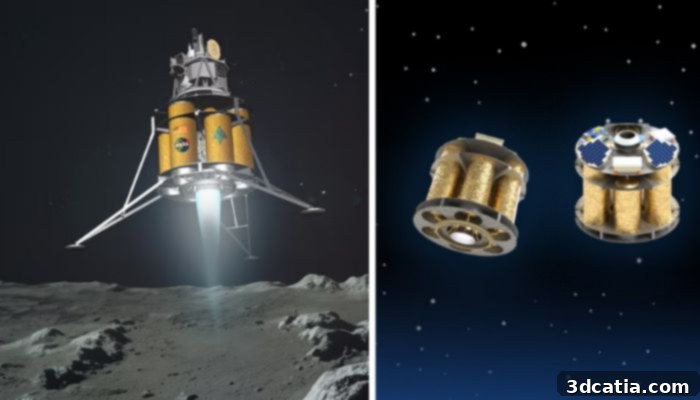
NFA’s Bifröst High-Performance Cryogenic Orbit Transfer Spacecraft
NFA’s Transformative Impact on the Future of Aerospace and Defense
The successful development and rigorous testing of the Mjölnir rocket engine represent a pivotal and exciting moment for New Frontier Aerospace and, by extension, for the broader aerospace and defense industries. By ingeniously combining cutting-edge 3D printing technology, sustainable propulsion utilizing clean liquid natural gas, and an intrinsically innovative engine design, NFA is directly addressing some of the most pressing and complex challenges inherent in modern space travel and hypersonic flight. The engine’s inherent reusability, its precise deep throttling capabilities, and its compact form factor collectively offer unprecedented operational flexibility, significant cost-effectiveness, and enhanced mission resilience for future endeavors. As New Frontier Aerospace continues to push the boundaries of what is possible with its ambitious Pathfinder VTOL UAS and the sophisticated Bifröst Orbit Transfer Spacecraft, the Mjölnir engine stands as an enduring testament to American innovation and engineering ingenuity. Its remarkable dual utility for both atmospheric and deep space applications firmly positions NFA as a key, transformative player in shaping the next generation of air and space vehicles. This pioneering work will enable more accessible, significantly more efficient, and environmentally responsible operations across a multitude of critical sectors. NFA’s unwavering commitment to continuous innovation ensures that it will continue to play a crucial, leading role in advancing human capabilities in both defense-oriented applications and peaceful space exploration for decades to come.
What are your thoughts on the groundbreaking Mjölnir rocket engine and its profound potential to redefine aerospace propulsion as we know it? We invite you to share your valuable insights and comments below, or engage with our community on our LinkedIn or Facebook pages. To stay truly abreast of the latest groundbreaking developments in 3D printing and the rapidly evolving field of aerospace innovation, don’t forget to sign up for our complimentary weekly Newsletter, ensuring you receive the freshest news directly to your inbox. You can also discover more compelling visual content, expert interviews, and in-depth analyses on our dedicated YouTube channel. For an even deeper dive into further 3D printing news specifically within the aerospace and defense sectors, we encourage you to visit our dedicated page HERE.
*All Photo Credits: New Frontier Aerospace