

Jacquard by Google: Revolutionizing Wearable Technology with Advanced 3D Printing
In a world increasingly driven by connectivity and seamless digital integration, Google’s Advanced Technology and Projects (ATAP) group has consistently pushed the boundaries of innovation. Their pioneering work has given rise to Jacquard by Google, a transformative wearable platform designed to embed interactive digital experiences directly into everyday objects. This ingenious system operates through a discreet physical tag and a companion app, leveraging cutting-edge manufacturing techniques, particularly Stratasys PolyJet technology. The decision to employ PolyJet was strategic, driven by its unparalleled versatility, superior material performance, rapid prototyping capabilities, and exceptional functional fidelity, all critical elements for developing sophisticated wearable devices. Furthermore, ATAP is now broadening its horizons, employing Stratasys’ Digital Anatomy technology to engineer specialized devices meticulously tailored for integration with the human body, signaling a new era for personalized technology.
The core of this innovation lies within the Jacquard Tag, a marvel of miniaturized engineering that can be extensively customized to sense and interpret specific user gestures. This capability allows the tag to act as an intuitive bridge between physical movement and digital command. Simple interactions, such as a brush of the hand or a tap on a garment, are seamlessly translated into actionable commands that are then communicated to the Jacquard app. The range of functions enabled by these gestures is remarkably diverse, empowering users to effortlessly control their digital lives. Whether it’s managing music playback, tracking athletic performance with precision, capturing photographs remotely, receiving discreet navigation cues, or getting important alerts without needing to reach for a phone, the Jacquard system offers a fluid and unobtrusive way to interact with technology.
A cornerstone of the Jacquard design philosophy is its commitment to discretion and aesthetic integration. Bryan Allen, technical program manager and ATAP Lab lead, emphasizes that the tag is engineered to “fit seamlessly into our aesthetic surroundings.” This means the technology isn’t meant to stand out; instead, it blends harmoniously into the fabric of daily life. This philosophy allows the Jacquard Tag to be incorporated into an extraordinarily wide array of products and garments, transforming ordinary items into intelligent, interactive devices. From the laces of a pair of trainers to the cuff of a jacket or a strap on a backpack, the potential for integration is vast, making smart technology truly ambient and accessible without compromising style or comfort. This approach elevates wearable tech from a visible gadget to an invisible, intuitive extension of the user.
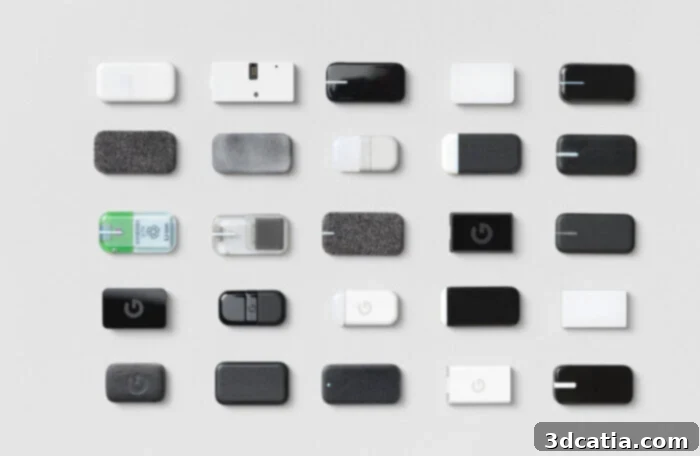
Design iterations of the Jacquard Tag 3D printed with Stratasys PolyJet technology.
Developing a project as intricate and revolutionary as Jacquard demanded the skillful integration of a diverse range of traditional and advanced additive manufacturing techniques. The Jacquard team’s strategic choice of Stratasys PolyJet technology was predicated on its unique capabilities, which addressed many of the inherent challenges in wearable device development. One of PolyJet’s most significant advantages is its exceptional versatility, which provided unparalleled flexibility during the design and development phases. This meant that modifications to the design, no matter how complex or how late in the production process, could be implemented with remarkable ease and speed. This agility dramatically accelerated iteration cycles, allowing ATAP to experiment and refine designs without the traditional bottlenecks associated with conventional manufacturing.
Beyond mere flexibility, PolyJet technology empowered the team to create truly functional multi-coloured and multi-material prototypes. This capability is paramount for wearables, where aesthetics, feel, and performance are equally important. By combining rigid and flexible materials, and vibrant colors, prototypes could accurately mimic the final product’s appearance and tactile qualities, enabling comprehensive testing and user feedback at an early stage. The ability to produce parts from flexible materials, such as rubber-like photopolymers, was crucial for creating components that are comfortable, durable, and conformable to the human body and various fabrics. Other notable benefits that solidified PolyJet as the technology of choice included its capacity for high-quality resolution, which ensures intricate details are faithfully reproduced, and a remarkably diverse range of compatible materials that cater to varied functional requirements. Furthermore, the impressive workflow capabilities, significantly enhanced by Stratasys’ KeyShot software, streamlined the entire design-to-prototype process. This synergy allowed the team to create high-fidelity, multi-material prototypes overnight, a dramatic acceleration compared to the weeks typically required by conventional methods, thereby propelling the project forward at an unprecedented pace.
The Jacquard initiative is merely one exemplary demonstration of the many impressive projects leveraging additive manufacturing within Google ATAP’s ambitious agenda. The group’s dedication to pioneering advancements extends beyond wearables, with a clear focus on enhancing functional material performance across various applications. In pursuit of these goals, ATAP continues to rely heavily on Stratasys technology, particularly for a groundbreaking project aimed at revolutionizing medical device development and surgical training. Utilizing Stratasys’ PolyJet-based Digital Anatomy 3D Printer, the team is capable of accurately replicating the complex appearance, texture, and responsiveness of human anatomy. This innovative approach allows for the creation of incredibly realistic anatomical models, which are invaluable for improving the rigorous testing protocols of medical devices. Simultaneously, these hyper-realistic models provide an unparalleled platform for the preparation and training of surgeons, offering a risk-free environment to practice intricate procedures. Bryan Allen underscored the profound implications of this technology, stating, “the closer replication of human body materials opens up entirely new avenues of exploration,” highlighting the transformative potential for both medical innovation and educational practices.
The Jacquard project stands as irrefutable evidence of additive manufacturing’s pivotal role as a powerful catalyst for innovation, driving progress across a multitude of industries. Its impact resonates far beyond wearable technology, serving as a significant driver in the ongoing Internet of Things (IoT) and Industry 4.0 revolutions. The ability of 3D printing to facilitate rapid prototyping, enable complex geometries, and offer mass customization capabilities aligns perfectly with the demands of these interconnected, smart, and highly adaptable industrial paradigms. It empowers designers and engineers to conceptualize, iterate, and produce innovative solutions with unprecedented speed and efficiency, fostering a culture of continuous improvement and disruptive innovation. Bryan Allen eloquently captured this forward momentum, remarking, “the future is coming a lot faster than we thought it would, and at Google ATAP, we’re building the capabilities for us to be able to predict what’s possible.” This sentiment underscores Google ATAP’s proactive approach to not just adapt to the future, but actively shape it through groundbreaking technologies like 3D printing, enabling the creation of devices and systems that redefine human-computer interaction and transform our daily lives.
As we look ahead, the trajectory of 3D printing continues to intersect with diverse technological advancements, promising an even more integrated and intuitive future. How do you envision 3D printing will further impact technology, particularly in areas like personalized wearables, advanced prosthetics, or even smart infrastructure? We invite you to share your thoughts and predictions in a comment below or join the conversation on our Facebook and Twitter pages! For the latest insights and news from the dynamic world of additive manufacturing, make sure to sign up for our free weekly Newsletter here, delivering the most relevant 3D printing updates straight to your inbox!