
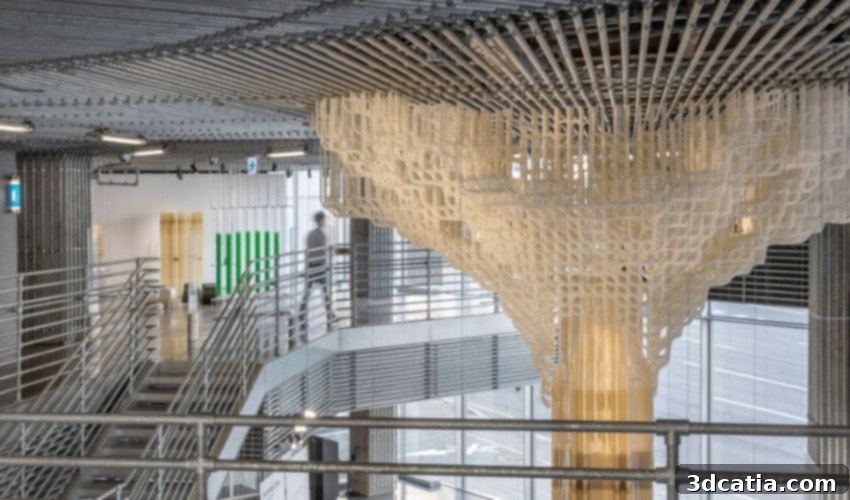
Habitat One: Pioneering Carbon-Neutral Cities with 3D Printed Algae Trees and Advanced Bio-Architecture
In an era defined by increasing environmental challenges, innovative technologies like additive manufacturing are emerging as crucial allies in our global efforts to preserve the planet’s diverse fauna and flora. From the reconstruction of vital marine ecosystems to the creation of sustainable materials, 3D printing offers unparalleled potential for ecological innovation. This advanced technology enables the production of complex, biomimetic structures and the utilization of novel, eco-friendly materials, pushing the boundaries of what’s possible in environmental conservation. Its ability to create intricate designs with minimal waste, using often recycled or biodegradable resources, positions it as a cornerstone of future sustainable development. Now, a groundbreaking new artificial nature project in Seoul, South Korea, further exemplifies this transformative power. This ambitious initiative centers around the creation of a remarkable tree, meticulously fabricated from algae-based biopolymers, showcased within an architectural model aptly named Habitat One.
Habitat One transcends the conventional boundaries of architectural design, presenting a visionary blueprint for an ecological and truly carbon-neutral city. Developed through a pioneering collaboration between the internationally acclaimed EcoLogicStudio and the innovative Hyundai Motor Company, this project was brought to life at Hyundai’s headquarters in Seoul. The architectural model serves as more than just a display; it’s a profound statement, designed to inspire and challenge perceptions, offering a tangible glimpse into what life could be like in a world where carbon emissions are not just reduced, but entirely neutralized. The very essence of Habitat One lies in its synergistic integration of cutting-edge technologies and sustainable principles. It ingeniously combines three distinct yet interconnected creations: two immersive, visionary Artificial Intelligence (AI) videos that explore future urban scenarios, a dedicated interactive Bio Lab, and the project’s unequivocal centerpiece, a breathtaking 3D printed sculpture known as Tree One.
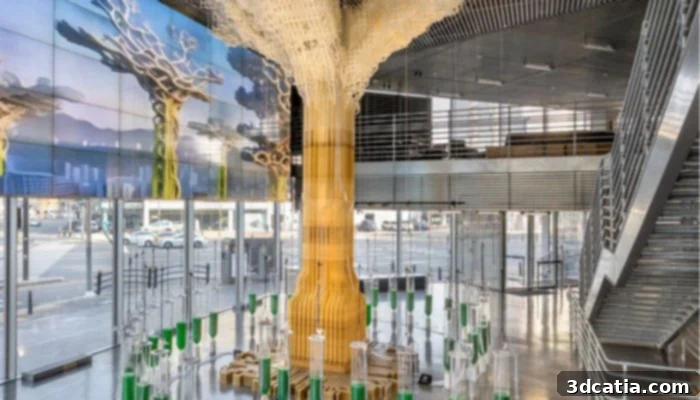
Tree One stands as the central element within the Habitat One exhibition, embodying the future of sustainable urban design.
Tree One, as its evocative name suggests, is an extraordinary 3D printed tree that goes beyond mere aesthetics; it is designed to be fully capable of photosynthesis, actively contributing to air purification and oxygen generation. This groundbreaking design is not just a technological marvel but a powerful symbol, crafted with the primary objective of bringing the core concepts of sustainable urban design to vivid life for all who visit the exhibition. Its very presence is intended to inspire a deeper understanding and appreciation for ecological innovation. The intricate structural design of Tree One is a testament to the power of biomimicry and computational architecture. It is based on an advanced computational program specifically developed to recognize, analyze, and recreate the nuanced, organic structure of real trees, translating these complex forms into a robust, functional column. This intelligent design process ensures both aesthetic harmony and structural integrity.
What truly sets Tree One apart is its revolutionary material composition. Its entire trunk is meticulously constructed from algae-derived biopolymers – a sustainable and renewable resource that significantly reduces the project’s environmental footprint. The inherent strength and stability of this bio-tree are masterfully achieved through its unique pleated shape, a design choice directly inspired by the highly efficient, fibrous trunks found in natural trees. This clever integration of natural principles into engineered design allows for optimal material usage and enhanced structural resilience. The fabrication process itself represents the pinnacle of modern manufacturing: Tree One was brought into existence through a precise robotic 3D printing process, ensuring unparalleled accuracy and the ability to create incredibly intricate details. The selection of materials was equally critical, emphasizing sustainability and environmental responsibility. These included natural algae and sage algae, alongside advanced bioplastics such as nonoilen, a 100% biodegradable filament, and eco PLA, further solidifying Tree One’s commitment to ecological principles from conception to creation. This blend of natural and cutting-edge synthetic materials ensures the tree’s functionality, durability, and eventual biodegradability, closing the loop on its life cycle in an environmentally conscious manner.
The immersive experience of Habitat One extends into the dedicated Bio Lab, an interactive space designed to educate and engage visitors on the science behind carbon-neutral living. Upon entering, guests are immediately greeted by the imposing PhotoSynthetica reactor wall. This marvel of bio-engineering is not merely a display; it’s a dynamic, living system that actively processes biomass and features an integrated collection system. The PhotoSynthetica wall is intelligently fed with essential nutrients derived from the “Biosphere” – a conceptual representation of natural organic processes – and, crucially, with pollutants harvested from the “Urbanesphere,” symbolizing urban waste streams. This symbiotic relationship demonstrates a circular economy in action, where waste is transformed into resources. Within the Bio Lab, visitors are afforded a rare opportunity to observe the intricate biopolymerization process in real-time. This live demonstration highlights how biological materials are synthesized, revealing the fundamental principles that underpin sustainable material production. Furthermore, the lab houses an extensive and meticulously curated catalog of biomaterial samples, showcasing the diversity and potential of nature-derived materials. Alongside these samples, large-scale 3D printed biodegradable products and prototypes are on display, offering a tangible vision of future applications in architecture, design, and manufacturing. An educational video provides deeper insights into the complex yet fascinating creation process of Tree One, enriching the visitor’s understanding of the project’s technical and ecological innovations.
The profound impact of the computational methodology developed for Tree One extends far beyond its singular design. This advanced algorithmic approach, which intelligently translates organic forms into structural designs, has been successfully adapted and expanded to create a range of other functional and aesthetic objects. For instance, the same underlying principles were utilized to design furniture pieces, such as ergonomically crafted stools, also featured prominently in the exhibition. This diversification showcases the remarkable versatility and adaptability of the computational design program, demonstrating its potential to influence a wide array of products and architectural elements. By exploring various forms and applications, the exhibition effectively illustrates the immense diversity and superior quality of design achievable through this innovative blend of technology and bio-inspiration. Each piece serves as a mini-case study, highlighting how sustainable practices can lead to both beautiful and highly functional outcomes, capable of shaping future urban landscapes and interior spaces. This holistic approach reinforces the vision of a carbon-neutral city, where every element, from a monumental tree to a simple stool, contributes to a cohesive and sustainable ecosystem. To delve deeper into the intricacies and broader vision of this pioneering project, additional information and detailed insights are available HERE.
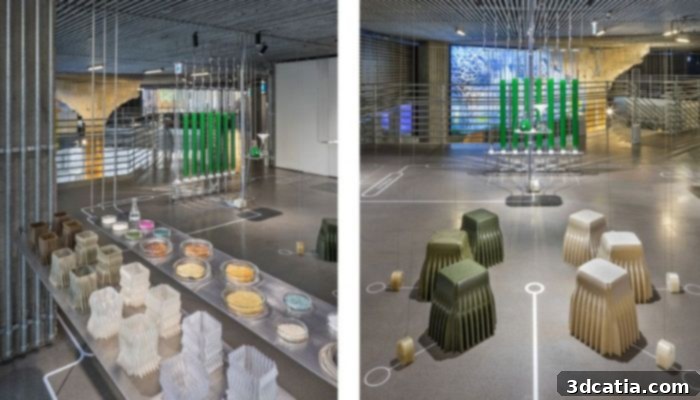
A selection of furniture, including stools, designed using the innovative computational program that also created Tree One.
The Habitat One project, with its awe-inspiring 3D printed Tree One and integrated Bio Lab, marks a significant milestone in the journey towards creating truly sustainable and carbon-neutral urban environments. It brilliantly demonstrates how the convergence of advanced additive manufacturing, intelligent design, and biotechnology can yield solutions that are not only environmentally responsible but also architecturally compelling and deeply educational. By transforming theoretical concepts of ecological cities into tangible, interactive experiences, EcoLogicStudio and Hyundai Motor Company have provided a powerful template for future urban development. This initiative underscores the critical role of innovative materials like algae-based biopolymers and the precision of robotic 3D printing in constructing a greener, healthier future for our planet. We invite you to share your thoughts: What do you think of the pioneering use of 3D printing to create Tree One for Habitat One in Seoul? How do you envision such bio-architectural innovations shaping our cities in the years to come? Let us know your insights and perspectives in a comment below or join the conversation on our LinkedIn, Facebook, and Twitter pages! Don’t forget to sign up for our free weekly Newsletter here to receive the very latest 3D printing news straight to your inbox! You can also find all our comprehensive videos and project showcases on our YouTube channel, offering even more visual insights into the world of additive manufacturing.
*All Photo Credits: EcoLogicStudio