
3D Printing Takes Flight: Crafting a Robotic Owl for ‘It’s A Wonderful Binge’ and Revolutionizing Film Production
The cinematic landscape has always been a crucible for boundless creativity, pushing the boundaries of imagination through innovative storytelling, breathtaking costumes, memorable characters, and ingenious props. In an industry constantly striving to craft unique and indelible experiences for audiences, studios and production teams relentlessly seek groundbreaking technologies to bring their visions to life. A compelling and recent example of this pioneering spirit is the integration of 3D printing technology to create a sophisticated robotic owl for a major film production. This remarkable feat was achieved through a collaboration between American High, a production company specializing in ‘high-school movies’ based in Syracuse, NY, and Budmen Industries, a digital fabrication solutions provider run by Steph and Isaac Budmen, located in Liverpool, NY. Budmen Industries was commissioned to engineer and produce this intricate robotic prop for American High’s latest Christmas comedy, ‘The Binge 2: It’s A Wonderful Binge’, showcasing the transformative power of additive manufacturing in modern filmmaking.
Titled ‘The Binge 2: It’s A Wonderful Binge’, this festive comedy is set against a unique premise: all drugs and alcohol are strictly prohibited throughout the year, except for a single, chaotic 12-hour period that serendipitously falls on Christmas Eve. For this distinctive narrative, American High envisioned a ‘futuristic’ 3D printed owl. The production company specifically required a prop that would transcend conventional temporal and geographical associations, ensuring it seamlessly integrated into the film’s black-and-white aesthetic and its setting, which deliberately lacks a particular time period. As a surreal comedy unfolding in the near future, the project demanded not just a visually striking owl model, but one capable of dynamic, expressive movement, adding another layer of complexity to its design and fabrication. This challenge highlighted the need for a manufacturing process that could deliver both intricate detail and functional articulation, making 3D printing an ideal choice for the task.
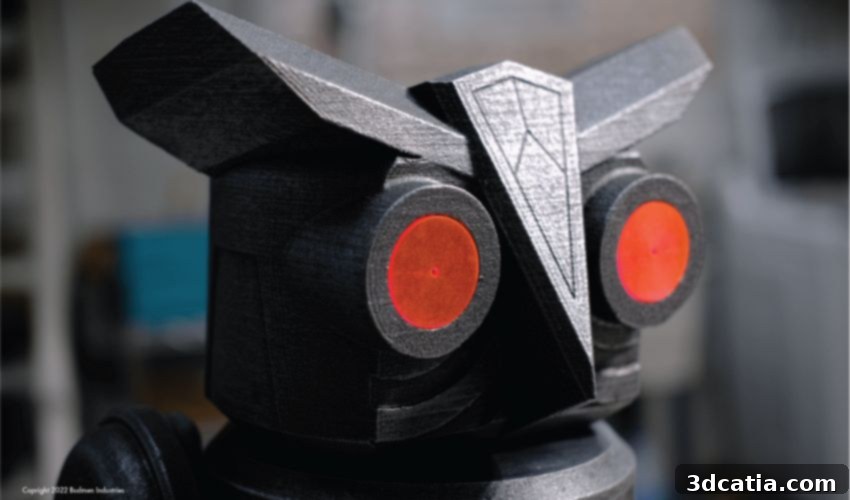
As the Budmen team put it, ‘While most of the Robo-Owl has an iron finish, the eyes are bright orange and light up to add an element of mischievousness and malice’. A testament to the intricate detail achievable with 3D printing.
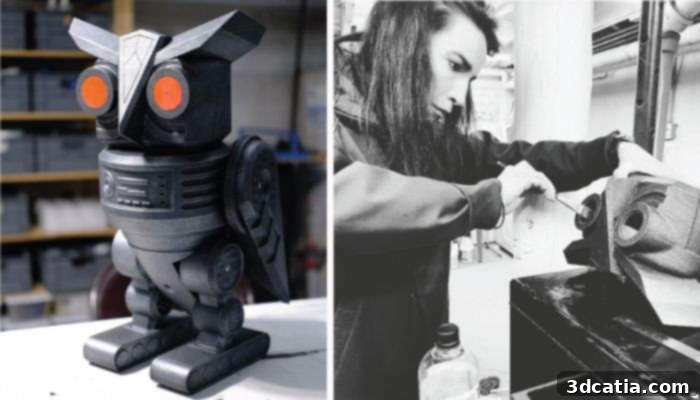
Budmen Industries rose to these ambitious requirements with unparalleled expertise, delivering a robotic owl for the movie that boasted both a smooth pivot mechanism and an impressive full range of creative expression. To ensure the owl could react dynamically to various on-screen situations and convey a spectrum of emotions, the skilled Budmen team meticulously designed it with an array of articulating joints. These crucial points of articulation included the wings and legs, allowing for realistic and fluid movements that would bring the character to life. The fabrication process leveraged advanced 3D printing techniques, primarily utilizing durable polymers and clear acrylics for the main body and intricate components. Following the printing phase, the owl underwent a meticulous finishing process, where it was expertly painted to achieve its desired aesthetic, including a distinctive “iron finish” that gave it a robust, almost antique yet futuristic look. For structural integrity and seamless assembly, the entire prop was constructed using high-quality stainless steel screws. This combination of innovative design, material science, and precision manufacturing resulted in a prop that was not only visually stunning but also functionally versatile, perfectly aligning with the film’s unique artistic direction.
The Expanding Role of Additive Manufacturing in Hollywood
The application of 3D printing, or additive manufacturing, in the movie industry is rapidly gaining prominence, moving beyond niche independent productions to become a vital tool in large-scale blockbusters and animated features. This revolutionary technology offers unparalleled advantages in terms of design freedom, speed of production, and cost-effectiveness, making it indispensable for creating complex props, intricate costumes, and detailed set pieces. Its ability to quickly iterate and produce highly customized parts with extreme precision has made it a favorite among prop masters, costume designers, and special effects artists seeking to push the boundaries of visual storytelling.
Unlocking Creative Freedom: From Royal Adornments to Fantastical Creatures
One of the most celebrated instances of 3D printing’s impact on cinema can be seen in Marvel’s globally acclaimed Black Panther movies. The iconic crown and necklace donned by ‘Queen Ramonda’, exquisitely designed to reflect Wakandan royalty and technological prowess, were meticulously crafted using advanced 3D printing techniques. This method allowed designers to achieve intricate patterns and geometric details that would have been incredibly challenging, if not impossible, to produce with traditional manufacturing processes. The ability to create lightweight yet durable pieces ensured comfort for the actor while maintaining visual grandeur, contributing significantly to the film’s stunning aesthetic and cultural authenticity. Beyond costumes, 3D printing has become essential for rapid prototyping of concept models, crafting highly detailed miniature sets, and even fabricating components for complex animatronics, giving filmmakers an unprecedented level of control over their creative output.
Revolutionizing Animation: The Art of Stop-Motion with 3D Printing
The benefits of 3D printing extend profoundly into the realm of animation, particularly in the intricate world of stop-motion. LAIKA Studios, renowned for its visually stunning and technically innovative films, has been at the forefront of integrating additive manufacturing into its production pipeline. For their critically acclaimed movie Missing Link, LAIKA utilized 3D printing to create an astonishing number of intricate puppets, each designed with meticulous detail to articulate and convey a wide range of emotions. This allowed the animators to achieve unparalleled levels of expression and fluidity in their characters’ movements. Similarly, the same studio famously employed this technology to create the thousands of unique faces for Coraline (2009), a groundbreaking animated film that also featured puppets. Each face, with its subtle variations in expression, was precisely 3D printed, enabling a level of emotional nuance and visual consistency previously unimaginable in stop-motion animation. This capability transformed the creative process, allowing artists to focus more on performance and storytelling, knowing that the physical accuracy of their characters’ expressions could be reliably and efficiently produced.
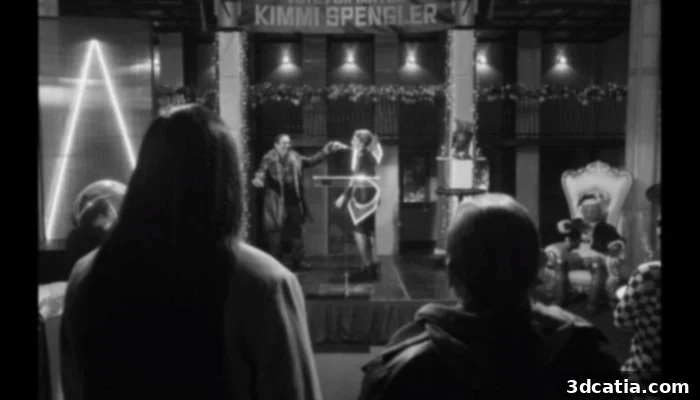
The meticulously crafted robotic owl, a product of 3D printing innovation, features prominently in the back right of this image, seamlessly integrated into the film’s surreal aesthetic. (Photo credit: American High & Hulu)
The Future of Film Production: Embracing Additive Innovation
The successful creation of the robotic owl for ‘It’s A Wonderful Binge’ by Budmen Industries serves as a testament to the ever-growing capabilities of 3D printing in the entertainment sector. It exemplifies how additive manufacturing can not only meet stringent aesthetic demands but also deliver functional, complex mechanisms that enhance storytelling. As technology continues to evolve, we can anticipate even broader adoption of 3D printing for everything from rapidly prototyping concept art and designing elaborate costumes to fabricating highly specialized camera rigs and on-set components. This innovative approach significantly reduces production timelines, allows for greater artistic freedom, and often proves more cost-effective for unique, custom-made items compared to traditional fabrication methods. The ability to create custom molds, intricate textures, and diverse material properties through 3D printing means that filmmakers are only limited by their imagination, not by the constraints of conventional manufacturing processes.
To delve deeper into Budmen’s incredible creation of this robotic owl for the movie using cutting-edge 3D printing technology, you can explore their detailed project page on their website HERE. What are your thoughts on this astonishing robotic owl? Has this innovative use of 3D printing piqued your interest and tempted you to watch the film? We encourage you to share your comments and insights below or engage with us on our social media platforms: Linkedin, Facebook, and Twitter. Don’t miss out on the latest advancements and news in the 3D printing world—sign up for our free weekly Newsletter here, delivering the most current 3D printing updates directly to your inbox! You can also find an extensive collection of our compelling videos and interviews on our dedicated YouTube channel, offering visual insights into the world of additive manufacturing.
*Unless stated otherwise, all photo credits: Budmen Industries.