
Revolutionizing Construction: Brunel University Pioneers 3D Printing with Recycled Building Waste
In a significant step towards a more sustainable future for the construction industry, a dedicated team of researchers at Brunel University London is spearheading the innovative DigiMat project. This groundbreaking initiative focuses on the ambitious goal of transforming waste from the construction sector into viable materials for 3D printing. The overarching vision is to drastically reduce the substantial environmental impact associated with traditional concrete production and consumption, while simultaneously introducing an entirely new, efficient, and eco-conscious method for constructing tomorrow’s buildings. Envisioning structures that could be assembled with the ease and modularity of interlocking LEGO bricks, the project is currently in its formative stages. While it may be several months before the initial tangible results are unveiled, the DigiMat project powerfully underscores a growing global imperative and an unwavering desire within the scientific community to forge more ecologically sound alternatives for building our future.
The field of concrete additive manufacturing has already demonstrated its transformative potential, frequently employed to realize intricate architectural designs or to significantly compress traditional construction timelines. Proponents of this technology often highlight its inherent ecological advantages, primarily due to its ability to deposit material precisely where it’s needed, thereby minimizing waste. However, this promising aspect has a crucial caveat: conventional concrete itself remains an exceptionally polluting material. Its production is a major contributor to global carbon emissions, releasing approximately 70 kg of CO2 for every ton produced. Alarmingly, concrete continues to be one of the most extensively utilized resources on Earth, cementing its status as an environmental challenge. Recognizing this critical issue, the advanced 3D printing industry is actively exploring and developing innovative solutions to replace traditional concrete with more sustainable, environmentally friendly materials. A notable example of this pioneering spirit is WASP, an Italian company renowned for its commitment to ecological construction. WASP designed GAIA, an experimental small house constructed from an ingenious blend of locally sourced mud and agricultural waste products, specifically straw and rice husks. The Brunel University team, through the DigiMat project, aims to build upon these principles by leveraging construction waste, thereby championing a truly circular economy approach within the building sector.
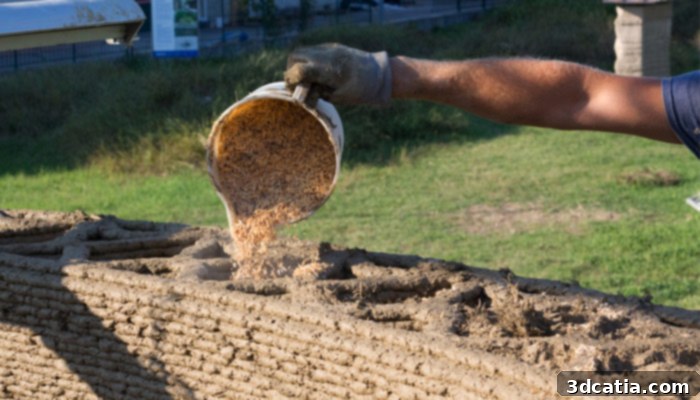
Pioneering initiatives in the 3D printing sector, like WASP’s GAIA, are actively seeking to replace conventional concrete with innovative, recyclable materials (photo credits: WASP)
Under the expert guidance of Dr. Seyed Ghaffar, an esteemed associate professor in civil engineering at Brunel University, the DigiMat team is focused on the ambitious task of creating novel 3D-printed building blocks. These blocks are meticulously designed to interlock effortlessly, much like the iconic LEGO bricks, promising a revolutionary approach to structural assembly. Dr. Ghaffar eloquently articulates the project’s foundational premise, explaining, “Demonstration projects built over the past few years have shown both the viability and potentials of 3D printing technologies; however, these projects have primarily used conventional raw materials in their concrete feedstock. The use of recycled waste-driven secondary raw materials to replace virgin aggregates for 3D printing of a building block has not yet been done, but we hope to demonstrate it with this project.” This statement clearly delineates DigiMat’s unique contribution: moving beyond mere technological demonstration to pioneering the integration of truly sustainable raw materials, addressing a critical gap in current additive manufacturing practices for construction.
The environmental footprint of conventional concrete is immense, encompassing not only the CO2 emissions from cement production but also the significant energy consumption involved in quarrying virgin aggregates and transporting raw materials. The extraction of sand and gravel, essential components of concrete, leads to habitat destruction, river erosion, and increased turbidity in water bodies. Moreover, the sheer volume of construction and demolition waste globally is staggering, often ending up in landfills where it occupies vast amounts of space and prevents the recovery of valuable resources. The DigiMat project directly confronts these challenges by proposing a full-scale circular economy model. Instead of extracting new resources and generating more waste, it aims to transform what is typically considered refuse into a valuable building material. This approach not only diverts waste from landfills but also reduces the demand for virgin materials, thereby conserving natural resources and significantly lowering the embodied carbon of new construction.
One of the key innovations of the DigiMat project lies in its commitment to utilizing 100% recycled aggregates. While the specific 3D printing machine to be employed for this ambitious endeavor remains under wraps, it is easy to envision a robust articulated robotic arm system, expertly extruding this innovative, recycled concrete mixture layer by layer. The transition from virgin materials to fully recycled aggregates presents unique engineering challenges, particularly concerning material consistency, workability during extrusion, and achieving adequate structural strength and durability for load-bearing applications. The Brunel team will undoubtedly need to conduct extensive research and rigorous testing to formulate the ideal mix design that ensures optimal printability and meets all necessary building codes and performance standards. Their immediate objective is to print large-format blocks, measuring approximately 500 x 500 mm, which will then be assembled to form a demonstrator wall. This wall will serve as a crucial proof-of-concept, validating the structural integrity and aesthetic potential of these recycled 3D-printed components. Beyond the technical demonstration, a primary focus of the project is to quantify and significantly reduce the CO2 footprint of these innovative bricks when compared to their traditional concrete counterparts, offering a tangible metric for their environmental benefits. To delve deeper into the specifics of this pioneering research and its progress, interested parties are encouraged to visit the university’s dedicated website HERE.
The potential broader implications of the DigiMat project extend far beyond mere environmental benefits. By demonstrating the feasibility of using waste materials for high-quality construction, Brunel University is paving the way for a paradigm shift in how we conceive and execute building projects. This technology could significantly contribute to addressing global housing shortages by making construction more affordable and accessible, particularly in regions with abundant construction and demolition waste. The ability to rapidly 3D print modular, interlocking components from locally sourced recycled materials could also prove invaluable in disaster relief efforts, enabling quick and resilient reconstruction. Furthermore, such innovations foster the development of new industries and skill sets within the green economy, creating jobs in material processing, 3D printing operation, and sustainable construction design. The success of DigiMat could inspire widespread adoption of similar practices, leading to a substantial reduction in the overall carbon footprint of infrastructure development worldwide. It’s an exciting vision of a future where waste is not merely discarded but re-envisioned as a fundamental resource for building stronger, greener communities.
While the initial stages are promising, the path to widespread adoption will involve overcoming several hurdles. These include refining material properties for long-term durability, ensuring regulatory compliance for novel building materials, and scaling up production capabilities. However, the collaborative spirit exemplified by projects like DigiMat, combining academic research with industry-focused innovation, is precisely what is needed to navigate these complexities. The research at Brunel University London represents a powerful testament to human ingenuity in confronting environmental challenges, offering a tangible blueprint for transforming an often-polluting industry into a cornerstone of sustainable development. It is a bold step towards a built environment that not only serves human needs but also respects the planetary boundaries upon which all life depends, fundamentally reshaping the future of construction through the power of 3D printing and the principles of a circular economy.
*Thumbnail photo credits: Lewis Tse Pui Lung / Shutterstock
What are your thoughts on these innovative efforts to significantly reduce the environmental impact of concrete and to construct structures using methods akin to LEGO bricks? We encourage you to share your perspectives in a comment below or engage with us on our Facebook, Twitter andLinkedIn pages! For the very latest updates in the world of 3D printing, remember to sign up for our free weeklyNewsletter here, delivering news straight to your inbox!