

Master Your 3D Printing Workflow: A Deep Dive into STL vs. 3MF File Formats
The journey from a digital concept to a physical object in additive manufacturing is a fascinating process, starting universally with Computer Aided Design (CAD). This foundational step involves meticulously modeling a part in either two or three dimensions, precisely defining its geometric contours and structural integrity. Once the intricate 3D model is finalized within the CAD environment, the next critical phase requires exporting it into a compatible file format that can be interpreted by a slicer software. The slicer acts as an essential intermediary, translating the 3D model into detailed instructions that a 3D printer can execute. However, this is where users often face a pivotal decision: selecting the appropriate file format. With a multitude of options available, including OBJ, STL, PLY, 3MF, and many others, navigating this choice can be challenging. To empower users with a clearer understanding and to highlight the distinct advantages and disadvantages of prominent file types, we delve into an in-depth comparison of STL vs. 3MF files, arguably the most prevalent formats among dedicated additive manufacturing enthusiasts today.
The STL format, launched in 1987 by 3D Systems – the pioneering company in the realm of 3D printing – has long held the title as the most widespread and recognized file format in the market. Its name, derived from stereolithography (or sometimes referred to as Standard Triangle Language), aptly describes its fundamental approach to representing 3D models. STL files are ubiquitous, found across virtually all major platforms offering 3D models, suchific as Thingiverse, MyMiniFactory, and Cults. In stark contrast, the 3MF format (3D Manufacturing Format) is a much more recent innovation, developed by a distinguished consortium spearheaded by Microsoft. Introduced to the market in 2015, 3MF has rapidly gained traction due to its groundbreaking properties designed to overcome the inherent limitations of older formats. 3MF models are specifically engineered to be highly intelligible, comprehensive, and to significantly reduce the likelihood of errors throughout the complex 3D printing workflow, promising a more robust and streamlined manufacturing process.
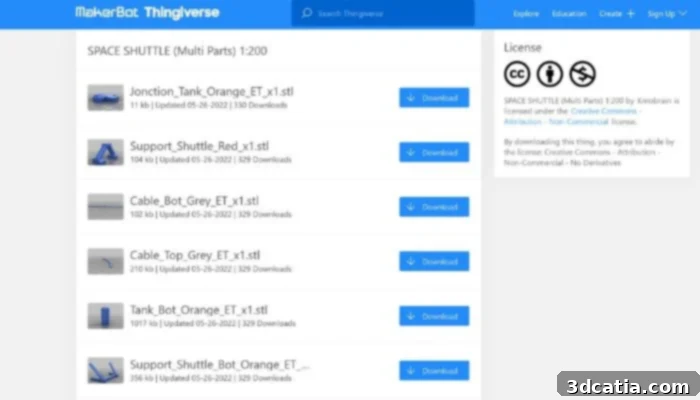
Currently, the STL format is the most popular (photo credits: 3Dnatives)
Understanding the Legacy: Characteristics of STL Files
Since its inception over three decades ago in 1987, the STL format has cemented its position as the dominant file type for 3D printing users, largely owing to its long-standing presence and early adoption. Its compatibility with virtually all CAD software and slicing programs has made it a universal choice, particularly in the rapid prototyping industry. As its alternative name, Standard Triangle Language, suggests, the STL format represents every 3D model through a process known as tessellation, where complex surfaces are approximated using thousands, or even millions, of interconnected triangles. Essentially, an STL file recreates the geometric shape of a 3D model by breaking down its surfaces into a mesh of planar triangles. For instance, any flat surface with four sides is inherently divided into two triangles. Extending this, a simple cube, possessing six faces, is therefore represented by twelve triangles. This triangular approximation is fundamental to how STL files describe a part’s geometry.
The accuracy and fidelity of the printed part are directly correlated with the quantity and density of these triangles. A highly detailed or intricately curved surface, for example, necessitates a significantly greater number of smaller triangles to faithfully represent its form. While these triangles strive to approximate the original 3D model’s shape as closely as possible, they inherently carry a critical limitation: they contain no information beyond the pure geometry. This means an STL file lacks any data regarding the manufacturing process, the intended material, specific textures, or colors. This absence of rich metadata constitutes one of the primary shortcomings of the STL format, particularly in an era of advanced, multi-material, and full-color 3D printing.

The more precise the STL format is, the more triangles it contains
Despite their potentially large file sizes, STL files are exclusively dedicated to defining the geometry of a part. While a user can subsequently utilize a slicer to introduce various printing parameters – such as layer height, infill density, and support structures – these critical slicing settings cannot be saved directly within the STL file itself. This necessitates managing separate files for the model and its associated print profiles, leading to fragmented workflows. A common and frustrating issue associated with STL files is the frequent occurrence of damaged or defective files. These imperfections often arise during the conversion process from CAD software to STL or due to errors in the original model generation. When such defects occur, users are compelled to undertake a repair process, an additional and often time-consuming step in the printing workflow. Specialized repair programs, such as Netfabb and Meshmixer, exist precisely to correct these flaws in 3D files. However, incorporating these tools adds an extra layer of complexity and time to the overall manufacturing pipeline. Furthermore, the STL format itself is not human-readable; its content can only be interpreted and processed by compatible software, making it opaque for direct inspection or modification by users.
Embracing the Future: Characteristics of 3MF Files
In stark contrast to the venerable STL format, the 3MF format is a much more contemporary development, emerging from the collaborative efforts of a consortium spearheaded by Microsoft. This influential group includes industry giants such as Dassault Systèmes, Autodesk, Stratasys, and Ultimaker, among others. Upon its launch, Adrian Lannin, executive director of the 3MF Consortium, articulated the ambitious goals driving the project: “3MF empower people, maximise productivity, and unlock the full capabilities of 3D printing.” Conceived as a robust and viable solution for professionals to store and exchange complex 3D files, the 3MF format distinguishes itself through its remarkably lightweight nature and its unparalleled capacity to encapsulate a vast amount of essential manufacturing information within a single file.
Unlike the purely geometric mesh representation of STL, 3MF files are structured as archive files, conceptually similar to a standard .zip archive. This intelligent packaging allows a 3MF file to contain not only the 3D model’s mesh geometry but also a wealth of crucial data directly related to the model’s manufacturing. This includes detailed specifications for manufacturing methods, material properties, color and texture information, optimal scaling, assembly instructions for multi-part models, and even recommended printing options. As Microsoft succinctly explains: “3MF is a file format specially adapted for 3D printing and Windows. 3MF includes colors, textures, scaling containing recommended printing options, and many other enhancements.” This comprehensive data aggregation is a monumental leap forward, eliminating the need to manage multiple disconnected files. Moreover, a 3MF file is encoded in XML, a structured and human-readable markup language. This means that, unlike STL, its contents can be understood and even manually inspected by a human, not just by a machine. In practice, if you simply rename a .3MF file’s extension to .ZIP, you can open it to explore the individual components and characteristics stored within its archive. Beyond its inherent openness and readability, 3MF is also engineered for greater intelligence in handling common mesh errors. It proactively addresses issues related to geometric integrity, such as non-manifold edges, self-intersections, and unintended holes in the mesh, thereby preventing common printing problems before they arise and leading to significantly more reliable 3D prints.
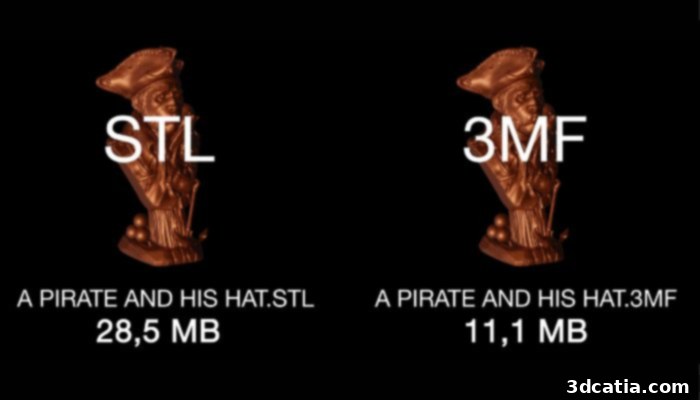
3MF formats are much lighter than STL formats (photo credits: Prusa)
At present, the primary constraint on the widespread adoption of the 3MF format isn’t a deficiency in its technical properties, but rather its relatively lower popularity compared to its older counterpart. Despite the various technical limitations inherent in STL, it remains significantly more democratized than 3MF. This disparity is particularly evident on popular 3D model sharing platforms such as Thingiverse, Cults, or Printables, where STL files still vastly outnumber 3MF uploads. Other challenges persist, including a lack of full integration with certain older slicers and CAD software that may not yet natively support the format. Furthermore, there can be issues with inter-compatibility between different slicers; parameters configured within one slicer for a 3MF file may not always transfer perfectly when the same project is opened in another slicer. However, there is strong optimism that as 3MF continues to gain traction and adoption, these integration and compatibility issues will be actively addressed and resolved by software developers. Given its extensible archive file structure and XML foundation, the 3MF format is inherently designed for continuous improvement and broader interoperability. We can envision a future where enhanced cross-compatibility allows for seamless sharing of 3D printing projects, ensuring that files are consistently and correctly interpreted across a diverse ecosystem of slicing software and 3D printers.
The Concrete Benefits of 3MF vs. STL: Streamlining Your 3D Printing Workflow
To truly appreciate the transformative potential of 3MF, let’s consider practical scenarios in the additive manufacturing workflow. Imagine you own a 3D printer and wish to print a particularly complex model that requires specialized expertise. If you enlist the help of an external 3D printing service, they can meticulously configure the model within their advanced slicing software, embedding all optimal parameters – from support structures and infill patterns to material settings and print orientation. Crucially, they can then export this entire configuration, complete with the 3D model, into a single 3MF file. When you receive this file, you find not just the geometric model, but also all the printing profiles, any specific modifiers, and other essential parameters bundled together. This holistic approach ensures that you can reproduce the part exactly as intended by the expert, minimizing guesswork and significantly improving print success rates. In contrast, using the STL format for the same scenario, the service provider would have to export the raw mesh separately from the print profiles. Even if they shared these profiles, critical information like specific modifiers, custom support settings, or material-specific nuances would likely be missing or require manual re-entry, increasing the risk of errors and inconsistencies.
Now, consider yourself a 3D designer keen to share your innovative 3D models with a global community on platforms like Thingiverse, Printables, or Cults. Leveraging the 3MF format empowers you to embed a wealth of additional information directly within the file. This could include precise material recommendations, suggested printing modifiers that simplify the printing process for end-users, or even specific instructions for assembly. Beyond technical parameters, 3MF also allows you to define the license under which your model is distributed and associate copyright information directly with the file. You can also integrate your name, contact details, and a comprehensive description of the model. The immense benefit here is that all this vital metadata is stored intrinsically within the 3MF file itself, rather than solely relying on the download page of the sharing site. This means that if your model is downloaded and subsequently shared across different platforms or between individuals, all the embedded information – including licensing, authorship, and printing guidance – remains intact and travels with the file, ensuring proper attribution and adherence to your specifications. This level of data preservation and contextual information is simply unattainable with the more limited STL format.
Is 3MF the Inevitable Format of the Future for 3D Printing?
As the capabilities and complexities of 3D printing continue to advance, it becomes increasingly clear that the 3MF format is poised to become the new industry standard. Its superior functionality and comprehensive data handling have already captivated numerous technology experts and early adopters. Charly Le Roy, co-founder of Polyfab – a company specializing in 3D solutions and training – eloquently explains his reasoning: “The main difference, in my opinion, is the amount of information stored. An STL contains only the 3D model, its 3MF counterpart contains the model but also its orientation, its supports, its printing parameters… So the 3MF is much more practical for multiple iteration needs.” This perspective is strongly echoed by Michael P. Bourque, Director of Digital Manufacturing at Boston Engineering, who observes the industry’s reliance on STL with skepticism: “I can’t believe that STL is the most common format among 3D printing enthusiasts. STL is a terrible format for reproducing model geometry and is only used because the slicing step is fast. […] I prefer 3MF because it is self-contained and can hold additional data to reduce problems.” These sentiments highlight a growing consensus among professionals regarding 3MF’s intrinsic advantages for modern additive manufacturing processes.
With its inherent ability to significantly limit the risk of errors during the intricate 3D printing process and its unparalleled capacity to facilitate seamless and information-rich model sharing, the 3MF format is demonstrably more appropriate for the evolving landscape of digital manufacturing. Its robust design positions it for long-term endurance and widespread adoption. A particularly strong indicator of this future dominance is the notable fact that the American additive manufacturing giant, 3D Systems – the very creator of the STL format in 1987 – made the strategic decision to join the 3MF Consortium at its inception in 2015. This move by a foundational player in the industry underscores the recognition of 3MF’s superior capabilities and its potential to shape the future of 3D printing. Charly Le Roy concludes with a forward-looking statement that encapsulates the prevailing expert opinion: “The format that will be used for sharing printing projects through libraries of ready-to-print models will definitely be the 3MF format. It naturally limits the risk of error and saves time when manufacturing parts.” This vision points towards a future where 3MF not only optimizes existing workflows but also unlocks new possibilities for efficient, reliable, and advanced additive manufacturing globally.
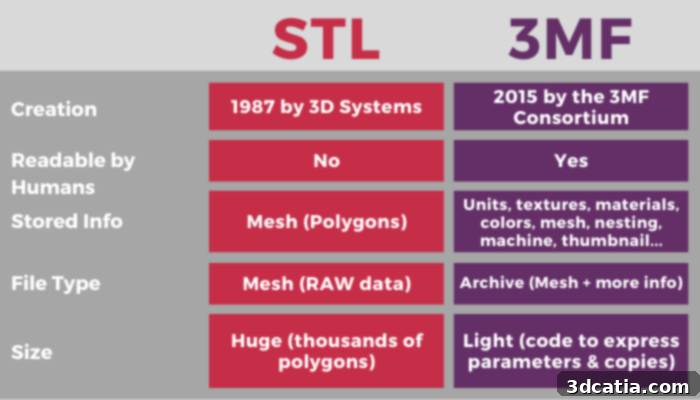
Photo Credits: 3Dnatives
What are your thoughts on the comparison between STL and 3MF? Which file format do you predominantly use in your 3D printing endeavors, and why? We invite you to share your experiences and insights in a comment below or join the conversation on our LinkedIn, Facebook, and Twitter pages! Don’t forget to sign up for our free weekly Newsletter here, to receive the latest 3D printing news straight to your inbox! You can also find all our compelling videos and tutorials on our YouTube channel for more in-depth content.
Article co-written by Philippe Girardie and Elliot Saldukaite
*Cover Photo credits: 3Dnatives