
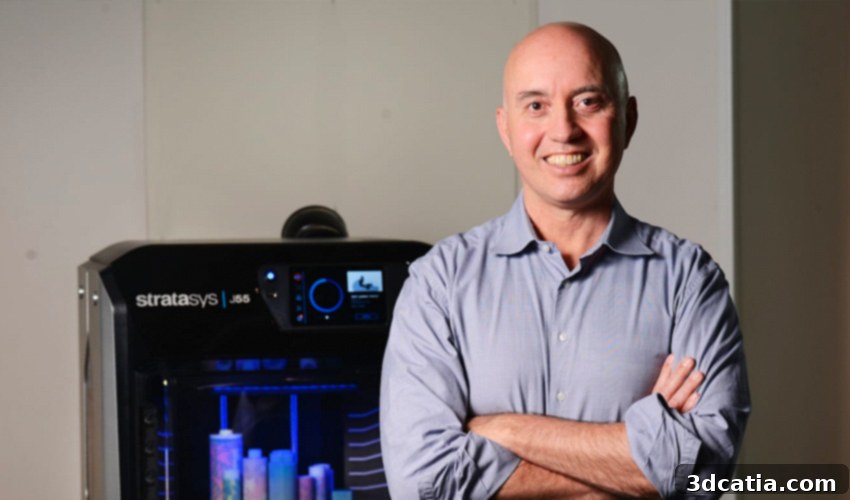
Stratasys CEO on Strategic Merger with Desktop Metal: Paving the Future of Industrial Additive Manufacturing Consolidation
The additive manufacturing landscape is experiencing a profound transformation, with market consolidation emerging as a dominant trend. Recent weeks have seen a flurry of significant announcements that have captivated the entire 3D printing sector, signaling a pivotal shift towards integrated solutions and expanded capabilities. At the forefront of this movement is the proposed union between Stratasys and Desktop Metal, two industry behemoths renowned for their industrial 3D printing solutions. This intended combination, poised to create a powerhouse in advanced manufacturing, has naturally sparked considerable discussion and competitive interest. Prior to this landmark announcement, Nano Dimension had publicly expressed its own intent to acquire Stratasys, highlighting the perceived value and strategic importance of the Israeli manufacturer. Furthermore, mere days after the Desktop Metal deal was unveiled, 3D Systems also entered the fray, launching a takeover bid for Stratasys. To gain deeper insight into these dynamic developments and understand Stratasys’ strategic direction amidst such intense market activity, we went directly to the source. We sat down with Stratasys CEO, Yoav Zeif, who graciously shared detailed insights into the company’s vision, its strategic rationale behind the Desktop Metal merger, and the current status of ongoing discussions with other interested parties in the competitive additive manufacturing ecosystem.
3DN: Could you introduce yourself and provide an overview of the current situation surrounding Stratasys?
My name is Yoav Zeif, and I took on the role of Stratasys CEO in mid-2020, right in the midst of the global pandemic. It was during that challenging period that we meticulously defined and solidified our company’s strategic roadmap. Our core focus was, and remains, to establish undisputed leadership in polymer additive manufacturing, while simultaneously working towards delivering comprehensive, end-to-end solutions for the most compelling and impactful use cases across the entire additive manufacturing spectrum. This strategic direction has yielded remarkable success and progress. We have introduced a diverse array of innovative offerings for our cornerstone Fused Deposition Modeling (FDM) and PolyJet technologies, continuously enhancing their capabilities and application breadth. Beyond these foundational technologies, we have strategically integrated three additional advanced manufacturing technologies into our portfolio, significantly broadening our addressable market and enabling us to serve a wider range of industrial demands. Furthermore, we have adopted a unified and open software strategy, fostering greater flexibility and integration for our users, complemented by a hybrid material strategy meticulously designed to meet the rigorous demands of production-grade manufacturing. Having successfully executed these foundational steps, we now find ourselves at a crucial juncture, poised to embark on the next transformative phase of our journey.
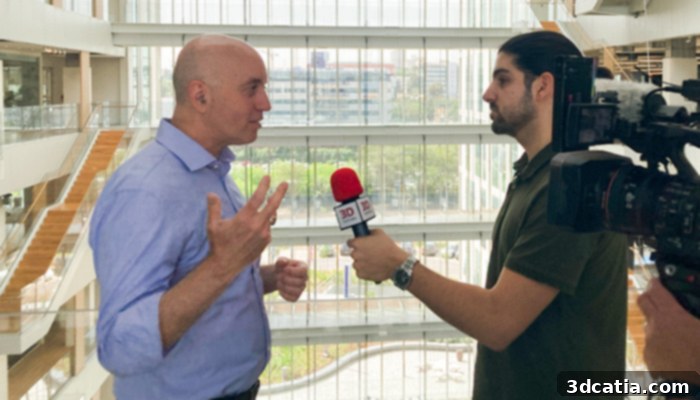
On the left, Yoav Zeif, CEO of Stratasys, in an interview with the 3Dnatives team.
3DN: What was the primary motivation behind the decision to combine with Desktop Metal?
Our overarching objective with this combination is to forge a truly next-generation additive manufacturing enterprise. One that possesses the unparalleled capability to deliver a comprehensive suite of solutions, spanning the entire product lifecycle from initial design to full-scale production, and encompassing an extensive range of materials including polymers, metals, sand, and ceramics. This expansive capability translates directly into substantially greater value for our global customer base. Having firmly re-established our clear leadership within the industrial polymer space, the natural and logical progression for us has always been to significantly expand our presence in metal additive manufacturing. This strategic imperative led to a series of substantial and meaningful conversations, which commenced at RAPID+TCT last year. Quite simply, when considering the landscape of metal 3D printing technologies, Desktop Metal stands out. Their binder jet technology is, without a doubt, the premier production-scale metal 3D printing technology available on the market today. This cutting-edge technology is essential for truly scaling metal additive manufacturing to meet industrial demands.
Desktop Metal has meticulously curated and assembled a remarkably diverse portfolio of solutions that are profoundly complementary to our existing offerings, with very minimal overlap. Their capabilities in sand casting are particularly exciting, opening new avenues for large-format and complex geometries. Their robust dental solutions are strong and established, providing crucial entry points into high-growth medical applications. They are also widely credited with essentially pioneering and developing the Digital Light Processing (DLP) category, a testament to their innovation. Furthermore, Desktop Metal boasts one of the largest and most skilled R&D and engineering teams in the entire industry, underpinned by deep ties to institutions like MIT, ensuring a continuous pipeline of groundbreaking innovations. I am absolutely confident that our customers will respond exceptionally well to Desktop Metal’s advanced solutions. This confidence stems from Stratasys’ proven track record for delivering uncompromised quality, exceptional service and support, and the stability and profitability of our company, all supported by an extensive global partner network. This synergy will enable us to deliver unparalleled value and a broader range of solutions to our customers.
3DN: What significant impact do you foresee this new union having on the broader additive manufacturing market?
While I am confident that we will continue to witness the emergence of numerous innovative startups within the additive manufacturing landscape, it’s critical to acknowledge the current reality: 3D-printed parts presently constitute less than 0.1% of the total manufacturing industry output. This figure persists despite the widely documented and undeniable benefits that additive manufacturing offers across a multitude of applications. These benefits include, but are not limited to, the profound potential for mass personalization, significantly lower cost per part for short-to-medium run production volumes, and unprecedented flexibility within global supply chains. Our ambitious goal is to accelerate the widespread adoption of these transformative benefits into the broader manufacturing market, driving additive manufacturing towards mainstream industrial integration. We firmly believe that the combination of Stratasys and Desktop Metal will dramatically enhance our collective capacity to achieve this vision. By bringing together our complementary strengths, technologies, and market reach, we will be better equipped to overcome existing barriers to adoption and unlock the full potential of additive manufacturing.
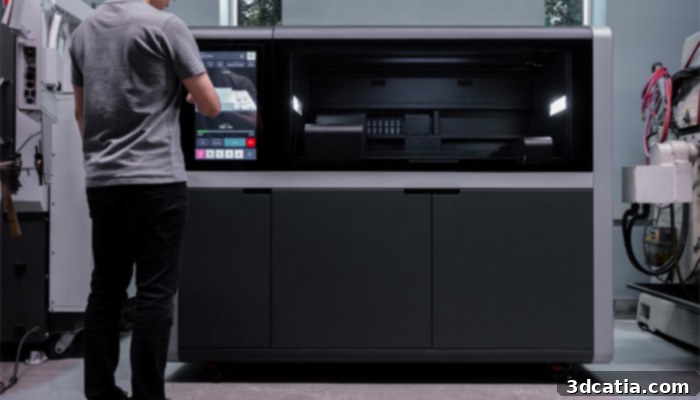
Through the union of Stratasys and Desktop Metal, the two companies hope to “reshape the additive manufacturing industry.”
At Stratasys, we are already observing a growing trend among our customers towards the increased adoption of additive manufacturing for diverse production applications. This includes many of the world’s largest and most established companies, such as General Motors (GM) and Boeing, who are leveraging our solutions for critical manufacturing needs. Simultaneously, we are also serving rapidly emerging and innovative players like Tesla and Boom Supersonic, who are pushing the boundaries of what’s possible with additive technologies. These leading companies consistently look to us for holistic, comprehensive solutions, not just individual printers. They are deriving immense benefit from our unwavering commitment to product quality, our development of a common software platform that seamlessly integrates across multiple technologies, and our provision of open materials options, all meticulously designed with robust manufacturing requirements in mind. I strongly believe that these fundamental ingredients—namely, innovative technology, profound industry expertise, unwavering quality, integrated software, and open materials—are precisely what will fuel the continued rapid growth and expansion of additive manufacturing applications. Modern manufacturers are not interested in approaches that advocate “failing fast”; rather, they seek to “scale confidently” and reliably. And what they are consistently discovering is that when they integrate Stratasys solutions into their production workflows, we consistently deliver on that promise of confident scalability and performance.
3DN: We’ve also heard about 3D Systems and Nano Dimension’s interest in Stratasys. What is the current status of these conversations and offers?
Indeed, there has been significant market interest in Stratasys, which we view as a testament to our strong market position and future growth potential. Regarding the proposal from 3D Systems, we announced earlier this week that our Board of Directors has unanimously concluded that their proposal does not constitute a “superior proposal” in comparison to our planned merger with Desktop Metal. Consequently, their offer does not provide a justifiable basis for Stratasys to engage in further discussions with them at this time. Our Board’s decision was made after a thorough and careful review of all aspects of the 3D Systems proposal, taking into account the long-term strategic value and benefits offered by our combination with Desktop Metal.
Turning to Nano Dimension, our Board has similarly and unanimously determined that Nano’s partial tender offer is both inadequate and significantly undervalues Stratasys’ industry-leading position, our robust growth opportunities, and the substantial strategic benefits that will accrue from our pending merger with Desktop Metal. Nano’s offer of $18.00 per share, as a partial tender, translates to approximately a 1.5x sales multiple based on consensus 2023 sales projections. This valuation represents a substantial discount when compared to the trading multiples of our peers in the industry, indicating a clear undervaluation of our true market worth. Furthermore, Nano’s partial tender offer inherently fails to capture the full intrinsic value of our business, particularly when considering the transformative potential of our forthcoming merger with Desktop Metal and the undeniable trajectory of Stratasys towards stronger and increasingly profitable growth. At this specific moment, Nano Dimension’s offer is set to remain open through June 26, unless they choose to extend the deadline. In response, our Board of Directors is unequivocally recommending that shareholders actively deliver a Notice of Objection via their respective brokers against that particular tender offer. That, in essence, is the current standing of these competitive bids.
3DN: What can users and companies expect from Stratasys in the near future following these developments?
The most crucial expectation that the entire industry, from individual users to large enterprises, can have from us is our unwavering commitment to remain “customer first” in everything we do. Right now, our dedicated team is intently focused on maintaining business continuity, driving operational excellence, and, most importantly, consistently meeting and exceeding our customers’ evolving needs. We are steadfastly adopting a solutions-driven approach, which means our engagement goes far beyond merely providing a 3D printer and leaving the customer to figure out how to extract value. Instead, our philosophy is centered on delivering a complete, integrated ecosystem: the printer system itself, the precise materials required, intuitive software for seamless operation, and comprehensive service and support, all meticulously tailored to address specific use cases. Whether that specific need involves manufacturing advanced tooling for electric vehicle (EV) production lines, developing a more efficient and aesthetically pleasing method for producing custom dentures, or fabricating lightweight, high-performance aerospace components, we provide the full stack. The proposed combination with Desktop Metal would significantly augment our ability to deliver an even broader spectrum of these sophisticated solutions to our customers, leveraging our world-class go-to-market organization. We are genuinely enthusiastic about the prospect of providing this expanded value and supporting our customers’ innovation and production goals more effectively than ever before.
3DN: Do you have any final words you’d like to share with our readers?
Ultimately, our strategic direction is about maximizing value creation through the intelligent integration of hardware, software, and materials solutions, addressed meticulously on a use-case-by-use-case basis. This focused and holistic approach is precisely what will propel us towards a future where 10% or even more of global manufacturing is powered by 3D printing technologies. To truly transform additive manufacturing into mainstream production, it demands not only cutting-edge innovation but also significant scale, consistent performance, and unwavering reliability. That is the fundamental impetus behind our pursuit of this combination with Desktop Metal. I am incredibly excited about the profound potential this union holds for our customers, our shareholders, and the entire additive manufacturing industry. For those interested in delving deeper into the specifics of this transformative merger, you can find more comprehensive information about the union HERE.
What are your thoughts on the proposed union between Desktop Metal and Stratasys and its implications for the future of additive manufacturing? Let us know your perspectives in a comment below or join the discussion on ourLinkedIn,Facebook, andTwitter pages! Don’t forget to sign up for our free weeklyNewsletter here to receive the latest 3D printing news straight to your inbox! You can also find all our engaging videos and content on ourYouTube channel.
*Cover Photo Credits: Stratasys