
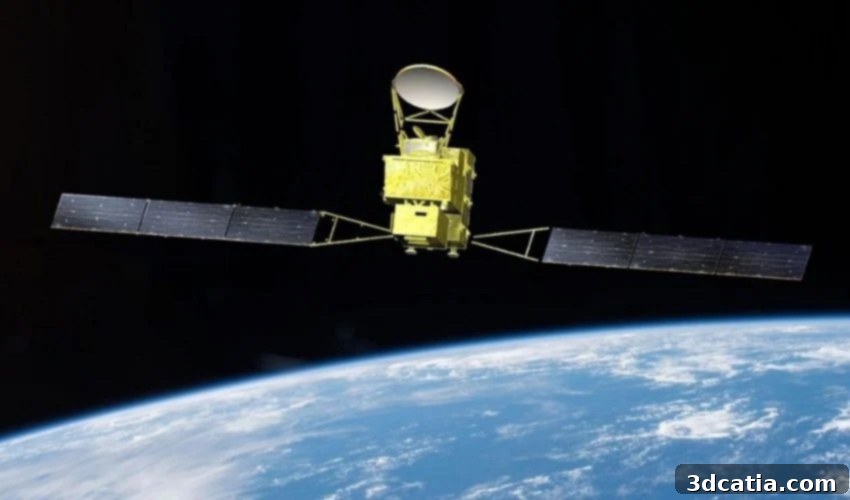
Mitsubishi Electric Pioneers In-Space 3D Printing for Advanced Satellite Antennas
Mitsubishi Electric, a global leader in electrical and electronic products, has long demonstrated its innovative prowess across diverse sectors, extending far beyond its well-known automotive ventures. In recent years, the Japanese conglomerate has significantly expanded its commitment to additive manufacturing technology, recognizing its transformative potential for new market frontiers. A groundbreaking announcement from the company reveals their latest advancement: the development of a revolutionary additive manufacturing process specifically designed for the harsh environment of outer space. This pioneering technology leverages a unique combination of photosensitive resin and ultraviolet light to 3D print satellite antennas directly in the vacuum of space. This innovation promises to redefine how future spacecraft are designed, built, and deployed, particularly for missions requiring high-performance communication capabilities.
The primary objective behind Mitsubishi Electric’s development of this novel liquid resin system is to address critical challenges in manufacturing small, cost-effective spacecraft buses that necessitate large, complex structures. Traditionally, the size of deployable components like antenna reflectors is severely restricted by the volume constraints of launch vehicles. By enabling the in-situ production of reflectors for high-performance antennas through additive manufacturing, this technology offers an unprecedented level of design freedom. This breakthrough not only facilitates the creation of larger, more efficient antenna structures but also contributes to the overall improvement of spacecraft designs, making them significantly thinner and lighter. The ability to print directly in orbit eliminates the need for intricate folding mechanisms and reduces the structural mass associated with large, stowed components, thereby enhancing spacecraft agility and reducing launch mass and associated costs.
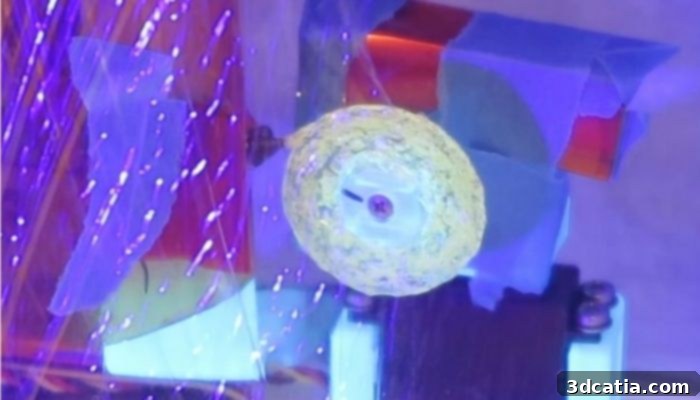
Medium pressure with an ultraviolet light source in a vacuum below 0.2 kPa (photo credits: Mitsubishi Electrics)
Mitsubishi Electric Solves Complex Design Challenges for Advanced Satellites
The design of spacecraft antennas presents a formidable set of engineering challenges, primarily governed by three often conflicting requirements: achieving high gain, ensuring wide bandwidth, and maintaining a low overall weight. High gain and wide bandwidth, crucial for robust and efficient communication, inherently demand a large aperture. However, the realities of space economics and orbital deployment dictate that antennas must remain sufficiently light and compact to fit within the confines of a launch vehicle’s fairing. This fundamental trade-off has long limited the performance and versatility of satellite communication systems. It is precisely at this intersection of conflicting demands that Mitsubishi Electric’s innovative approach shines. Their resin-based additive manufacturing solution offers a paradigm shift, enabling the efficient creation of antennas that boast high gain, wide bandwidth, and significantly larger apertures than previously feasible with conventional manufacturing and deployment methods. This capability is vital for next-generation telecommunications, Earth observation, and deep space exploration missions that require unparalleled data throughput and signal integrity.
Mitsubishi Electric’s commitment to this vision is further underscored by its development of a specialized 3D printer tailored for in-space operations. This advanced printer is engineered to precisely extrude ultraviolet-curing resin within the vacuum of space, a critical capability that unlocks numerous advantages for manufacturing satellite components directly in orbit. One of the most significant benefits is the substantial reduction in power consumption required for the printing process. Unlike ground-based systems that often rely on dedicated powerful UV light sources, Mitsubishi’s technology is ingeniously designed to harness the readily available ultraviolet radiation from the sun for polymerization and curing. This natural energy source dramatically lowers the operational power demands of the printer, making it far more sustainable for prolonged use in space. Furthermore, the inherent nature of in-space 3D printing removes the dimensional limitations imposed by launch vehicle fairings; the size of the antenna is no longer constrained by the initial packing volume but rather by the operational envelope of the printer itself. This eliminates the need for complex, cumbersome, and often failure-prone deployable antenna structures that must unfold post-launch. The ability to print a monolithic, structurally integrated antenna in space simplifies design, enhances reliability, and reduces the risk of deployment failures. Critically, this innovative 3D printer also facilitates significant weight and width reduction for satellite components. By optimizing material usage and integrating structural elements directly into the antenna design, the overall mass of the satellite can be dramatically lowered. This mass reduction translates directly into substantial savings on launch costs, making space missions more economically viable and accessible. The potential for on-demand manufacturing and repair of satellite components in orbit also opens doors for unprecedented mission flexibility and longevity.
Revolutionary Extrusion and Curing in a Vacuum with Mitsubishi’s Photosensitive Resin
Perhaps the most profound innovation underpinning Mitsubishi Electric’s new technology is the development of a unique photosensitive resin specifically engineered for extrusion and curing in the extreme vacuum conditions of space. This breakthrough addresses a fundamental hurdle that has long plagued attempts at in-space additive manufacturing. Typically, commercially available photosensitive resins are formulated with low molecular weights and possess high vapor pressures. In a vacuum, such resins would outgas significantly, leading to material loss, contamination, and, crucially, premature polymerization or inconsistent curing, rendering them unsuitable for space applications. Mitsubishi Electric’s solution elegantly circumvents these issues by utilizing a meticulously formulated resin system. At its core is a high molecular weight, low vapor pressure oligomer base. This foundational component provides the necessary structural integrity and reduces the tendency for outgassing. To achieve the precise viscosity required for stable extrusion in a vacuum, this oligomer base is mixed with a specialized, vacuum-stable plasticizer. This plasticizer is derived from a non-volatile polyphenyl ether, a compound chosen for its exceptional thermal stability and minimal volatility in a vacuum environment. This careful chemical engineering ensures that the resin maintains its integrity and processability during the extrusion phase, preventing undesirable changes before curing. Upon successful polymerization, which occurs through exposure to the sun’s abundant ultraviolet radiation, the resin transforms into a solid material with remarkable properties. Notably, it exhibits a heat resistance of at least 400°C. This extraordinary thermal stability is critical for orbital operations, where components are subjected to extreme temperature fluctuations due to solar radiation and eclipses, often exceeding the maximum heat tolerance of conventional materials. The ingenious use of natural sunlight for polymerization and curing eliminates the need for a dedicated, power-hungry UV light source within the 3D printer itself, further contributing to reduced power consumption and simplifying the overall system design. This self-curing capability marks a significant step towards truly autonomous and sustainable in-space manufacturing.
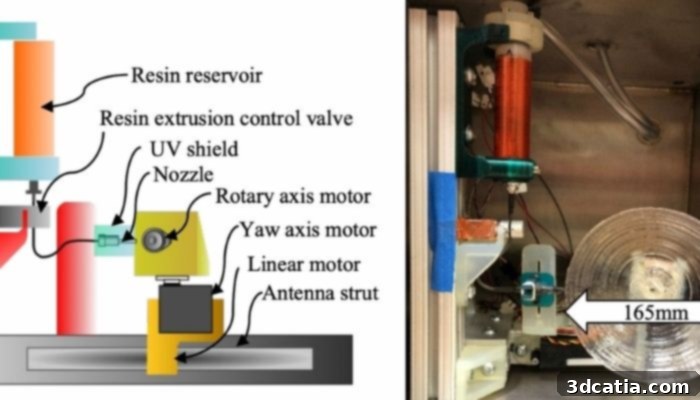
Schematic (left) and photo (right) of the 3D printer (photo credits: Mitsubishi Electrics)
Looking ahead, Mitsubishi Electric is firmly committed to leveraging its extensive research and development capabilities to introduce advanced technologies and innovative solutions that address pressing global challenges. This groundbreaking in-space 3D printing initiative is a testament to that commitment, promising to significantly simplify and enhance critical applications such as Earth observation, global telecommunications, and even deep space exploration. By enabling the on-demand fabrication of complex structures like high-performance antennas directly in orbit, Mitsubishi is paving the way for a new era of space infrastructure that is more adaptable, cost-effective, and capable than ever before. This technology has the potential to revolutionize how we build and maintain assets in space, fostering greater accessibility and sustainability for future space endeavors. The ability to customize and upgrade satellite components post-launch could lead to longer operational lifetimes and more resilient space systems, reducing the reliance on costly and time-consuming ground-based manufacturing and launch cycles. If you are keen to delve deeper into Mitsubishi Electric’s exciting projects and future visions in space additive manufacturing, additional comprehensive information can be found HERE.
What are your thoughts on Mitsubishi Electric’s pioneering new technology for creating sophisticated satellites and their components directly in outer space? We encourage you to share your insights and opinions in the comments section below, or engage with us on our social media platforms: LinkedIn, Facebook, and Twitter. Don’t miss out on the latest advancements and news in the additive manufacturing industry – remember to sign up for our free weekly newsletter here, delivering the freshest 3D printing updates directly to your inbox! You can also explore all our insightful videos and content on our dedicated YouTube channel.
*Cover Photo Credits: Mitsubishi Electrics