
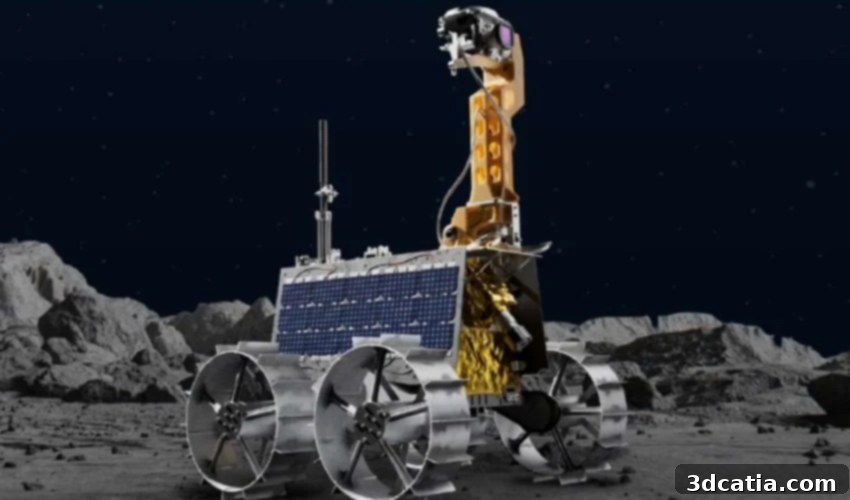
Pioneering the Lunar Frontier: European 3D Printed PEEK Components Touch the Moon with ESA and Orion AM
The cosmos has long captivated humanity, driving innovation and pushing the boundaries of technology. In recent years, additive manufacturing, commonly known as 3D printing, has emerged as a transformative force in space exploration, offering unparalleled opportunities for crafting complex parts, reducing mass, and enabling on-demand production. Space agencies like NASA and the European Space Agency (ESA) have been at the forefront of integrating 3D printing into their missions, leveraging its capabilities for research, development, and operational applications. This trend is not merely anecdotal; industry forecasts, such as those from Smartech, project the additive manufacturing market within the private space sector to reach an astounding $2.1 billion by 2026. This significant growth underscores the profound impact and expanding role of 3D printing in advancing our cosmic ambitions.
Evidence of this profound impact can be seen in numerous groundbreaking projects. NASA, for instance, has demonstrated its commitment to lunar exploration and colonization by awarding ICON a substantial $57.2 million contract to develop 3D printed infrastructure on the Moon. This initiative aims to construct habitats and landing pads using additive manufacturing, potentially revolutionizing how we establish a sustainable human presence beyond Earth. Furthermore, the agency’s monumental Artemis mission, which seeks to return humans to the Moon and eventually journey to Mars, successfully launched the world’s most powerful rocket, the Space Launch System, incorporating critical 3D printed components. These parts contribute to the rocket’s structural integrity, performance, and overall mission reliability, showcasing the material and design advantages offered by additive manufacturing. Now, in a historic development, the European Space Agency (ESA) has announced a significant milestone: European-made 3D printed parts are set to make their first contact with the lunar surface. Among these pioneering components are specialized parts crafted from PEEK by Orion Additive Manufacturing, marking a new era for European involvement in lunar exploration and the application of high-performance polymers in extreme extraterrestrial environments.
Orion Additive Manufacturing (Orion AM), a dynamic Berlin-based startup, stands at the cutting edge of developing advanced 3D printing systems tailored for demanding applications. Their expertise is crucial to the success of the “Material Adhesion and Abrasion Detection” project, an innovative ESA initiative focused on rigorously testing the resilience of various materials against the exceedingly harsh conditions prevalent on the lunar surface. The Moon’s environment is characterized by extreme temperature fluctuations, abrasive regolith dust, and intense radiation, posing significant challenges for conventional materials. To address these challenges, Orion AM has manufactured a series of additively produced samples, which have been strategically affixed to the wheels of the Rashid rover. This advanced rover is a vital component of the Emirates Lunar Mission, an ambitious endeavor spearheaded by the United Arab Emirates. Following a successful launch on December 11, 2022, the mission anticipates its historic lunar landing in April of this year, bringing these European-made 3D printed components closer to their ultimate test.
The scientific team behind this project has meticulously designed and produced a diverse array of samples, with a particular focus on those 3D printed from polyetheretherketone (PEEK). PEEK is a high-performance thermoplastic renowned for its exceptional properties, making it an ideal candidate for applications requiring extreme durability and reliability. The decision to utilize PEEK was driven by its remarkable robustness, which is considered more than sufficient to withstand the unforgiving lunar environment. Its strength, thermal stability, and chemical resistance are so significant that PEEK is increasingly being explored as a viable alternative to traditional metallic components in aerospace and defense sectors, promising weight reduction without compromising structural integrity. Beyond PEEK, another innovative material selected for testing is a composite blend of polylactic acid (PLA) and lunar regolith – the loose, dusty material that covers the surface of the Moon. This particular composite is crucial for research into in-situ resource utilization (ISRU), exploring the potential to use lunar resources to construct habitats and tools directly on the Moon, thereby reducing the logistical and economic burden of transporting materials from Earth. Testing these varied materials will provide invaluable data, informing future designs for lunar rovers, landers, and prospective lunar bases, paving the way for sustained human presence on our celestial neighbor.
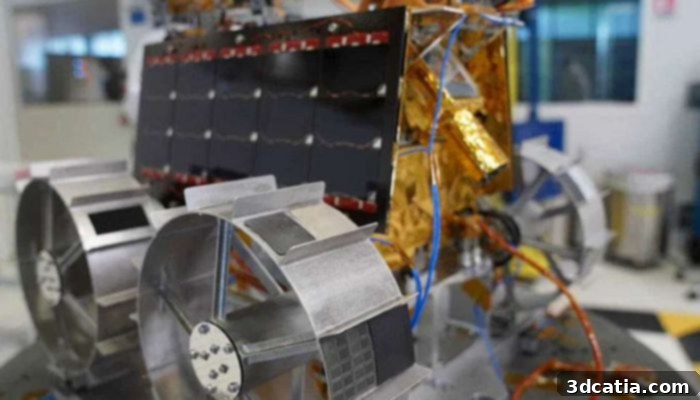
The 3D-printed components were glued to the wheels of the Rashid rover before launch (photo credits: ESA/MBRSC)
Advanced 3D Printing of PEEK Enables Lunar Material Testing
While PEEK is an undoubtedly superior material for applications in space due to its impressive thermal, chemical, and mechanical properties, it is generally considered a challenging material to process, especially in additive manufacturing. The primary difficulty lies in its high melting point and the critical need for precise temperature management throughout the printing process. Without optimal temperature control, PEEK prints can suffer from warping, poor layer adhesion, and significant internal stresses, leading to structural failures and compromised mechanical performance. Furthermore, traditionally 3D printed PEEK parts have often struggled to achieve the same high-quality mechanical properties as those manufactured through more conventional methods like injection molding, limiting its adoption in critical applications. However, Orion Additive Manufacturing has engineered a breakthrough solution with its A150 AM system. This specialized system is meticulously optimized for PEEK, allowing it to achieve remarkable material values that are up to 87% higher than those produced by other 3D printing technologies not specifically designed for this demanding polymer. This technological leap means that PEEK components produced by Orion AM exhibit superior strength, stiffness, and durability, rivaling and in some cases exceeding, the performance of injection-molded parts. Consequently, these high-performance PEEK polymers can now be confidently deployed in vital aerospace applications, such as the 3D printed test samples that will rigorously assess wear and tear on the wheels of the Rashid rover as it traverses the abrasive lunar terrain. This capability opens new avenues for using advanced polymer composites in highly demanding environments, propelling space exploration forward with more resilient and lightweight components.
This monumental achievement represents years of dedicated research, development, and innovation. Adam Rumjahn, Managing Director of Orion Additive Manufacturing, eloquently encapsulated the significance of this milestone, stating, “We have developed this technology over the last 5 years, and are proud to announce this achievement – it is truly a dream come true to have 3D printed parts from Orion AM on the moon!” His words highlight the culmination of relentless effort and the realization of a vision to apply cutting-edge additive manufacturing to the most challenging frontiers. This successful integration of European 3D printed technology into a lunar mission not only validates Orion AM’s advanced capabilities but also positions Europe as a key player in the evolving landscape of space manufacturing. The insights gleaned from the performance of these PEEK and PLA-regolith composite samples on the Moon will be instrumental in designing future generations of space hardware, contributing to more efficient, reliable, and sustainable space exploration. This collaboration between ESA and Orion AM underscores the critical role of private innovation in advancing public sector space endeavors. For those eager to delve deeper into this groundbreaking mission and Orion AM’s technological contributions, further details are available in Orion AM’s official press release HERE, and the comprehensive announcement from the European Space Agency HERE.
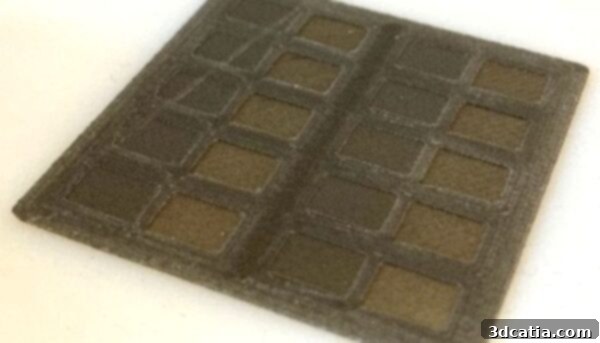
The teams tried a variety of materials for the samples, including 3D printed PLA combined with regolith (photo credits: ESA)
The prospect of European-developed 3D printed components making their inaugural contact with the lunar surface is a truly exciting moment for both the additive manufacturing industry and the broader space community. This achievement signifies not just a technical triumph but also a testament to international collaboration and ingenuity in pushing the boundaries of what is possible in extraterrestrial environments. We invite you to share your thoughts on this historic development: What are your expectations for the future of 3D printing in space? How do you envision this technology shaping our presence on the Moon and beyond? Let us know in a comment below or join the conversation on our LinkedIn, Facebook, and Twitter pages! For the latest updates and breaking news in the additive manufacturing world, don’t forget to sign up for our free weekly Newsletter here, delivering cutting-edge 3D printing insights directly to your inbox. Additionally, immerse yourself in our extensive collection of videos covering various aspects of 3D printing technology by visiting our YouTube channel.
*Cover Photo Credits: ESA