
Unlocking Innovation: Top 5 Revolutionary 3D Printing Applications You Need to See
Welcome to our weekly showcase of groundbreaking advancements in the world of additive manufacturing! Every week, we bring you a curated selection of the most exciting and impactful videos demonstrating how 3D printing is continuously pushing boundaries across diverse industries. This edition features incredible innovations, from transforming the music and arts sector to revolutionizing the supercar industry, and even offering life-changing solutions for wounded refugees. These aren’t just fascinating concepts; they are real-world applications that highlight the immense potential and versatility of 3D printing technology. Make sure to check back every Sunday for our latest ‘Top 5 Videos’ ranking – you won won’t want to miss what’s next!
A Deep Dive into the Week’s Most Compelling 3D Printing Innovations
The rapid evolution of 3D printing, or additive manufacturing, continues to captivate and inspire. From creating intricate artistic instruments to engineering components for high-performance vehicles and delivering critical medical solutions, this technology is proving to be a cornerstone of modern innovation. Let’s explore five compelling examples that showcase its transformative power and its ability to address complex challenges in unique ways.
1 – The Harmonious Blend of Technology and Art: A 3D Printed Violin
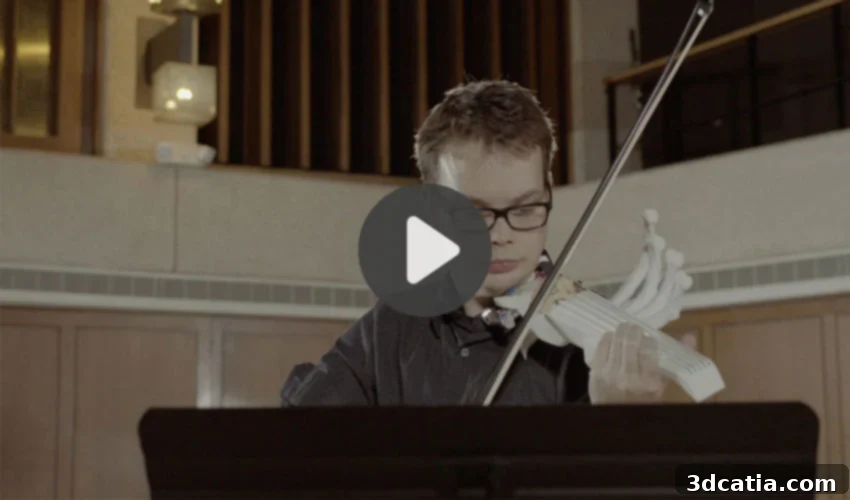
The first stop on our innovation tour takes us into the harmonious realm of music, where traditional craftsmanship meets cutting-edge technology. This week, we feature a remarkable six-string violin, entirely brought to life through 3D printing at the prestigious University of Texas at Austin’s Butler School of Music. The video vividly demonstrates a student’s ability to print this unique instrument on-demand, followed by a captivating performance that showcases its surprisingly rich and resonant sound. This project isn’t merely a novelty; it represents a significant leap for musical instrument design and accessibility.
The ability to 3D print a functional musical instrument opens up a myriad of possibilities. For students and aspiring musicians, it drastically reduces the barriers to entry by offering a more affordable and customizable alternative to traditional, often expensive, instruments. Designers can experiment with unconventional geometries and internal structures that would be impossible or prohibitively difficult to create with conventional manufacturing methods. This allows for exploration into new acoustic properties and aesthetic forms, pushing the boundaries of what musical instruments can look and sound like. Furthermore, the use of various materials, from durable plastics to composites, allows for diverse tonal qualities. We have previously delved into the extensive applications of 3D printing in music, covering everything from custom instrument parts to unique sonic art installations. This 3D printed violin is a testament to how additive manufacturing is not just enhancing existing fields but actively creating new avenues for artistic expression and technological integration, democratizing the creation of complex objects and fostering a new generation of hybrid artist-engineers. It exemplifies how personalized manufacturing can cater to individual needs and creative visions, proving that innovation can be both highly functional and beautifully artistic.
2 – Engineering Excellence: Bugatti’s 3D Printed Titanium Brake Calipers
Next, we shift gears from art to adrenaline, diving into the high-octane world of supercars. Bugatti, a name synonymous with unparalleled luxury, blistering speed, and engineering marvels, recently made headlines with its pioneering use of 3D printing. The company announced the successful 3D printing of a titanium brake caliper, designed for integration into its future vehicle models. This isn’t just an incremental improvement; it’s a testament to 3D printing’s transformative impact on the automotive sector, particularly in the realm of high-performance components.
What makes this achievement particularly remarkable is Bugatti’s claim that this titanium caliper is the largest functional component ever to be 3D printed using the material. Titanium, renowned for its exceptional strength-to-weight ratio and corrosion resistance, is an ideal choice for high-stress applications like braking systems. By leveraging additive manufacturing, Bugatti engineers were able to create an incredibly complex, lightweight structure that would be impossible to produce using traditional forging or machining methods. The intricate internal lattice designs possible with 3D printing significantly reduce the component’s weight while maintaining or even enhancing its structural integrity and heat dissipation capabilities, critical for maintaining peak performance in extreme conditions. This innovation translates directly into superior braking performance, enhanced vehicle dynamics, and improved fuel efficiency – all paramount for a brand like Bugatti. The development of such a large and complex titanium part through 3D printing signals a major step forward for industrial additive manufacturing, demonstrating its readiness for serial production of critical, high-value components. Testing of this groundbreaking piece is slated to commence this year, paving the way for its eventual inclusion in Bugatti’s next-generation supercars. For a more detailed account, you can read our full article on this here, exploring the intricate details of its design and the implications for the future of automotive engineering.
3 – Redefining the Process: Volumetric 3D Printing With Light
Our third video takes us to the forefront of additive manufacturing research, showcasing an innovation that fundamentally rethinks the 3D printing process itself. This captivating demonstration from Brigham illustrates how creativity and innovation can fuse with advanced manufacturing techniques to create something truly unprecedented. Instead of the conventional layer-by-layer deposition seen in FDM (filaments), SLA (resins), or DMLS (metals), this pioneering method utilizes light to create volumetric images. This process is often referred to as volumetric 3D printing or tomographic 3D printing.
Traditional 3D printing methods build objects slice by slice, which can be time-consuming and often results in visible layer lines. Volumetric 3D printing, however, forms the entire object simultaneously within a volume of photosensitive resin by projecting light from multiple angles. This creates a complex light pattern that hardens the resin only where the light intensity is above a certain threshold, forming the object in one swift go. The advantages of this approach are profound: significantly increased print speeds, the ability to create incredibly smooth and intricate geometries without the stair-stepping effect, and the potential for printing objects embedded within other materials or even multiple materials at once. This method reduces mechanical stress on the object during printing, which is especially beneficial for delicate structures or biologically sensitive materials. Brigham’s work exemplifies how pushing the boundaries of light manipulation can unlock new dimensions in manufacturing, promising a future where objects are materialized with unparalleled speed, precision, and geometric freedom. Potential applications span from micro-optics and biomedical devices to highly customized consumer products, showcasing a path toward truly instant manufacturing of complex, high-resolution objects. This technology is not just an alternative to existing methods; it’s a paradigm shift in how we conceive and execute additive manufacturing.
4 – Advancing Healthcare: New 3D Printed Mask for Brain Scans
The fourth video highlights 3D printing’s life-changing impact on healthcare, demonstrating its capacity to enhance medical diagnostics and personalized patient care. This innovation introduces a novel 3D printed mask designed to revolutionize the way brain scans are conducted. Specifically, for patients suffering from neurological conditions such as epilepsy, this custom-fit mask offers a more precise and comfortable method for identifying areas of abnormal brain activity. The data gathered from these advanced scans can then be critically used to inform and tailor more effective treatment plans, ultimately improving patient outcomes.
The key advantage of a 3D printed mask lies in its ability to be fully customized to each patient’s unique facial anatomy. Traditional brain scanning methods often rely on generic equipment that can be uncomfortable, leading to patient movement and reduced scan accuracy. A bespoke mask ensures a perfect, snug fit, minimizing motion artifacts and maximizing the precision of brain activity mapping. This unparalleled level of personalization not only enhances patient comfort, especially during extended scan periods, but also significantly improves the quality and reliability of the diagnostic data. For conditions like epilepsy, where pinpointing the exact origin of seizures is crucial for surgical intervention or medication management, this precision is invaluable. Beyond comfort and accuracy, 3D printing offers a cost-effective and rapid manufacturing solution for these patient-specific devices, making advanced diagnostics more accessible. This application is a prime example of the broader trend of 3D printing transforming medical practices, from creating custom prosthetics and orthotics to producing intricate surgical guides and highly accurate anatomical models for pre-operative planning. By bringing personalized medicine to the forefront, 3D printing is empowering healthcare professionals with tools that lead to more accurate diagnoses and profoundly better patient experiences.
5 – Humanitarian Impact: 3D Printed Prosthetics for Refugees
Our final, and perhaps most poignant, video powerfully illustrates that 3D printing transcends mere hobbyist projects or luxury goods; it serves a profound, life-changing purpose on a global scale. This segment focuses on the incredible humanitarian potential of additive manufacturing, specifically in providing prosthetics for refugees and individuals in war-torn regions. The video tells the touching story of Ahmed, who tragically lost his arm at the age of 14 due to a barrel-bomb. For years, he had to navigate life with just one arm, facing immense challenges and limitations. However, with the advent of accessible 3D printing technology, the creation of functional and affordable prosthetics for children like Ahmed has become a far more feasible and widespread reality.
The traditional process of obtaining prosthetics is often prohibitively expensive, time-consuming, and geographically challenging for those in refugee camps or impoverished areas. Conventional prosthetics require highly specialized manufacturing processes, multiple fittings, and can cost thousands of dollars – a luxury far out of reach for most refugees. 3D printing completely disrupts this paradigm. It offers a low-cost, rapid, and highly customizable solution. Prosthetics can be designed and printed on-site or nearby using relatively inexpensive materials, drastically reducing production time from weeks or months to mere days. Furthermore, as children grow, their prosthetics need frequent replacement. 3D printing allows for quick and affordable iterations, ensuring that children like Ahmed always have a prosthetic that fits correctly and supports their development. This humanitarian application underscores the immense ethical and social value of 3D printing. It empowers individuals, restores dignity, and provides renewed hope by offering practical solutions to some of the world’s most vulnerable populations. Organizations and volunteers utilizing this technology are demonstrating how innovation, coupled with compassion, can directly alleviate suffering and improve the quality of life for countless individuals, making a tangible difference far beyond the confines of a workshop.
The Future is Printed: A Summary of This Week’s Innovations
This week’s collection of videos truly exemplifies the dynamic and multifaceted nature of 3D printing technology. From the artistic freedom embodied by a 3D printed violin and the engineering marvel of Bugatti’s titanium brake calipers, to the revolutionary speed of volumetric light printing and the critical medical advancements in brain scanning masks, all the way to the profound humanitarian impact of prosthetics for refugees, the applications are as diverse as they are impactful. Each story underscores the ability of additive manufacturing to innovate, optimize, and offer solutions that were once unimaginable or inaccessible.
The consistent thread running through these examples is 3D printing’s unparalleled versatility and its potential to reshape industries, improve lives, and drive progress. It’s clear that this technology is not just a trend but a fundamental shift in how we design, create, and solve problems across virtually every sector. We encourage you to reflect on the immense possibilities presented in these videos. What do you think of these incredible innovations? Share your thoughts and insights in a comment below or connect with us on our Facebook and Twitter pages. And don’t forget to sign up for our free weekly Newsletter, where you’ll receive all the latest news and updates in 3D printing delivered straight to your inbox every week!