
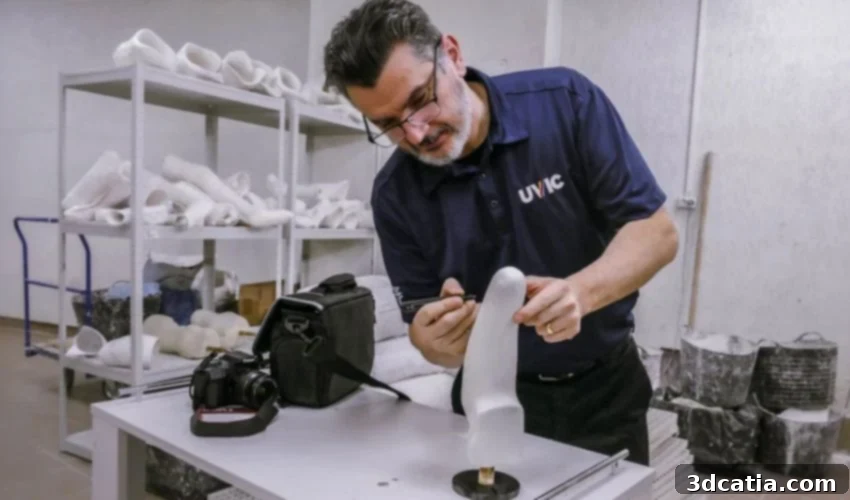
3D Printing Empowers Ukraine: Victoria Hand Project Delivers Life-Changing Prosthetics Amidst Conflict
Additive manufacturing has consistently proven its transformative potential across numerous sectors, particularly in the realm of medical devices and humanitarian aid. Its capacity to produce highly customized, functional, and often cost-effective solutions has made it an indispensable tool, especially for manufacturing prostheses of all kinds, playing a significant role in assisting individuals in dire need. The ongoing war in Ukraine has created an unprecedented humanitarian crisis, with devastating consequences for the civilian population. Estimates suggest that approximately 10,000 people have suffered amputations as a direct result of the conflict, while over 400,000 existing amputees can no longer access the vital care and support they require. In response to this urgent and profound need, the Canadian non-profit organization, Victoria Hand Project (VHP), has stepped forward with an innovative and highly effective solution.
VHP has pioneered a method to provide high-performance prosthetic limbs, meticulously crafted using advanced 3D printing technology, directly to those impacted by the conflict. This ambitious undertaking is a testament to the power of collaboration, bringing together leading industry partners. Working closely with BASF Forward AM, renowned for its cutting-edge materials, and UltiMaker, a global leader in desktop 3D printing solutions, VHP has leveraged additive manufacturing to create customizable and affordable prosthetic hands. These prostheses are not merely medical devices; they are instruments of hope, designed to help individuals who have suffered the tragic loss of a limb regain their independence, dignity, and active participation in daily life. The profound success and tangible impact of VHP’s efforts in Ukraine have been so significant that the organization has launched a dedicated fundraising initiative called “Hands for Ukraine.” This campaign aims to raise essential funds to sustain and expand the manufacturing of these life-changing prosthetics for the countless people in need across the country, ensuring long-term support for a vulnerable population.
A cornerstone of this groundbreaking project is the strategic selection and application of BASF Forward AM’s Ultrafuse PLA PRO1 material. This advanced filament stands out due to its exceptional print quality, which is critical for producing precise and highly detailed components. The ability to achieve such intricate detailing not only significantly improves the aesthetics of the prostheses, making them more natural and acceptable to wearers, but also fundamentally contributes to their optimal functionality and ergonomic design. The Ultrafuse PLA PRO1 material has undergone extensive optimization to excel in key performance areas: quality, speed, strength, and reliability. These rigorous optimizations ensure that the material consistently delivers superior results, exceeding the performance levels typically achieved with conventional filaments. For prosthetic applications, this translates directly into limbs that are not only visually appealing but also robust enough to withstand the rigors of daily use, comfortable for extended wear, and reliable in their mechanical operation, thereby enhancing the overall quality of life for the recipients. The material’s balanced properties allow for rapid production cycles without compromising on the structural integrity or cosmetic finish of the final prosthetic, a crucial advantage in responding to urgent humanitarian needs.
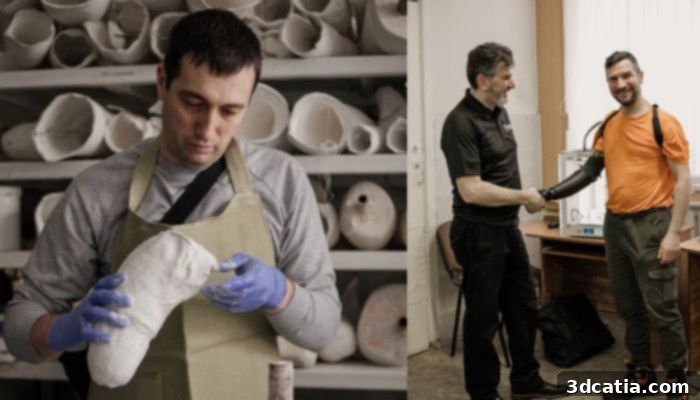
Construction of the prosthesis by the Victoria Hand Project for a Ukrainian citizen
Complementing the advanced material, UltiMaker’s sophisticated 3D printers and intuitive software ecosystem have been instrumental in enabling manufacturers to achieve consistent and high-quality 3D printing results. The reliability of UltiMaker’s hardware ensures that each prosthetic component is produced with precision and repeatability, vital attributes in medical device manufacturing. Furthermore, a key advantage of the selected equipment lies in its user-friendliness. This ease of use is particularly significant for clinicians and medical professionals who may have limited or no prior experience with 3D printing technology. UltiMaker’s integrated approach, from user-friendly interfaces to streamlined workflows and pre-optimized printing profiles, significantly lowers the barrier to entry, allowing these frontline healthcare providers to quickly learn and operate the technology effectively. The seamless integration of the robust properties of Ultrafuse PLA PRO1 material with the unwavering reliability and accessibility of UltiMaker 3D printers has empowered VHP to produce high-quality prosthetic hands. These hands not only meet exacting medical and functional requirements but also instill confidence and enhance the daily lives of their wearers, facilitating a smoother transition back to normalcy and activity.
The impact of limb loss, particularly in the aftermath of traumatic events like war, extends far beyond physical disability. It deeply affects an individual’s psychological well-being, social integration, and overall independence. The provision of a functional, comfortable, and aesthetically acceptable prosthetic can be profoundly life-changing, enabling amputees to perform daily tasks, return to work, and re-engage with their communities. The Victoria Hand Project understands this multifaceted challenge and strives to deliver solutions that address both the physical and emotional needs of its recipients. Michael Peirone, CEO of Victoria Hand Project, eloquently articulates this philosophy:
“By harnessing the print quality and mechanical properties of Forward AM Ultrafuse PLA PRO1 in addition to the exceptional dependability from UltiMaker, Victoria Hand Project creates prosthetic hands that not only meet functional requirements, but also empower users. These hands are not only just tools; they become symbols of resilience, self-assurance, and durability in the daily lives of amputees.”
Peirone’s statement underscores the core mission: to provide more than just a limb, but a pathway to renewed confidence and a stronger sense of self. The customized nature of 3D printed prosthetics ensures a better fit and comfort, crucial for long-term wear and user acceptance. The speed of production, facilitated by additive manufacturing, means that individuals in urgent need can receive their prostheses much faster than through traditional methods, reducing waiting times and accelerating rehabilitation. Each hand crafted through this collaboration is a testament to human ingenuity and compassion, offering a tangible manifestation of hope and the ability to overcome adversity. These prosthetics allow individuals to regain control over their lives, whether it’s performing simple tasks like eating and dressing, or more complex activities that enable them to pursue employment and hobbies, thereby fostering a greater sense of inclusion and purpose.
In January 2023, VHP achieved a significant milestone by successfully completing a pilot project in Ukraine, made possible through the generous contributions of numerous donors and supporters. During this critical phase, a dedicated member of the VHP team traveled to Ukraine to conduct initial training sessions, set up the necessary 3D printing equipment, and personally fit and provide prosthetic arms to five amputees in urgent need. The success of this pilot project served as a powerful proof-of-concept, demonstrating the viability and profound impact of their approach on the ground. Building on this initial triumph, VHP is now focused on establishing sustainable, long-term partnerships within Ukraine. The strategic goal is to train local prosthetists and other medical experts in 3D printing technology, empowering them to independently print and assemble Victoria hands. This localized production model is vital for ensuring that prosthetics can be distributed efficiently and as needed to those requiring assistance, circumventing complex international logistics and creating local capacity. The ultimate aim is to fully equip two partner facilities, strategically located in Lviv and Vinnytsia, with advanced 3D printing technology, state-of-the-art scanning tools for precise measurements, and a steady supply of prosthetic materials. This infrastructure will establish regional hubs capable of serving a broad population. Furthermore, if the ongoing fundraising campaign exceeds its initial financial goals, additional funds will be allocated to further expand the reach and impact of this crucial humanitarian project, potentially establishing more centers or broadening the range of prosthetics offered, truly embedding a sustainable solution for years to come.
The collaborative spirit and innovative approach demonstrated by Victoria Hand Project, BASF Forward AM, and UltiMaker serve as a beacon of hope and a model for effective humanitarian aid. By leveraging the agility and precision of 3D printing, they are directly addressing critical needs in a conflict zone, providing not just medical devices but a means for individuals to rebuild their lives. Nadav Goshen, CEO of UltiMaker, expressed his organization’s commitment to this vital mission:
“We are thrilled to be a long-term partner of Victoria Hand Project and continue to support its mission to deliver prosthetic hands to people in need. With the UltiMaker 3D printing ecosystem on location, clinicians can print parts on-demand, providing better prosthetic support to their communities. By expanding access to prosthetic care with 3D printing, we believe we can help address the needs of individuals with limb loss or limb differences, promoting empowerment, inclusivity, and overall well-being.”
Goshen’s statement highlights the profound advantages of on-demand manufacturing in localized healthcare settings. This model significantly reduces logistical complexities, enables rapid iteration based on patient feedback, and ensures that prostheses can be tailored specifically to individual requirements, adapting to growth in children or changing needs in adults. The ability to print parts on-demand locally not only makes prosthetic care more accessible but also more responsive and cost-effective. This initiative is a powerful example of how technological innovation, when coupled with dedicated humanitarian efforts, can truly transform lives and foster greater empowerment, inclusivity, and overall well-being for individuals with limb loss or limb differences, offering them a path to renewed independence and active participation in society. More information about the project can be found HERE.
What are your thoughts on the incredible application of 3D printing technology to create prosthetic limbs for people affected by the war in Ukraine? We invite you to share your insights and opinions in a comment below. You can also engage with us and join the conversation on our LinkedIn, Facebook, and Twitter pages! Don’t forget to sign up for our free weekly Newsletter here to receive the latest 3D printing news straight to your inbox. For more visual content and in-depth discussions, you can also find all our videos on our YouTube channel.
*Cover Photo Credits: Victoria Hand Project.