
Revolutionizing Cycling: The New01bike — A Custom, Recycled, 3D Printed Masterpiece
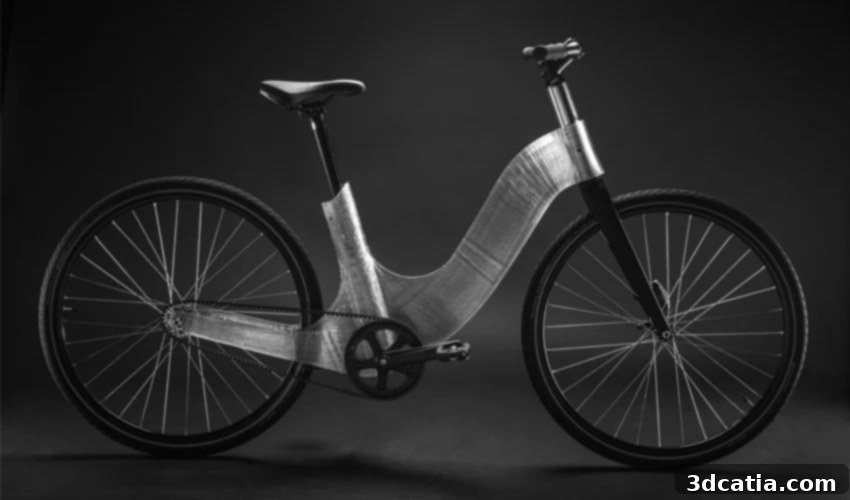
The world of cycling is constantly evolving, driven by innovations that push the boundaries of performance, design, and sustainability. A remarkable example of this progressive spirit recently captivated audiences at Milan Design Week: the unveiling of the New01bike, a groundbreaking 3D printed bicycle frame. This innovative prototype, the brainchild of Italian design and engineering powerhouses INDEXLAB and GIMAC-EXGINEERING, marks a significant leap forward in sustainable manufacturing. Crafted entirely from 100% recycled polycarbonate and brought to life through advanced robotic additive manufacturing, the New01bike stands as a testament to the potential of the circular economy and hyper-personalization in modern product design. Weighing a mere 8 kilograms, this state-of-the-art frame was showcased on a complete bicycle, demonstrating a tangible commitment to transforming end-of-life materials into bespoke, high-performance products tailored to individual user preferences and needs.
In recent months, the convergence of 3D printing technologies and the cycling industry has generated considerable buzz, with numerous companies exploring additive manufacturing for helmets, components, and even entire frames. However, the New01bike project distinguishes itself with a uniquely holistic approach. While many initiatives focus on lightweighting or design freedom, INDEXLAB and GIMAC-EXGINEERING’s vision extends far beyond. Their primary objective is to rapidly produce custom bicycles that are not only perfectly adapted to each rider but are also inherently recyclable at the end of their functional life. This innovative model addresses a critical gap in the current market, as eloquently articulated by INDEXLAB: “Custom ergonomic bikes are not only costly and slow to manufacture but also very difficult to mass-produce since they are tailored for particular needs and usages. On the other hand, mass-serialized bikes are seldom so versatile that they accommodate different user body proportions and measures, as they are made for the ‘standard user’. New01bike was created to fill this gap, make a custom bike affordable, fast, and easy to mass-produce and recycle.” This philosophy underscores a fundamental shift towards accessible personalization and environmental responsibility, challenging the conventional trade-offs between customization, speed, and sustainability.
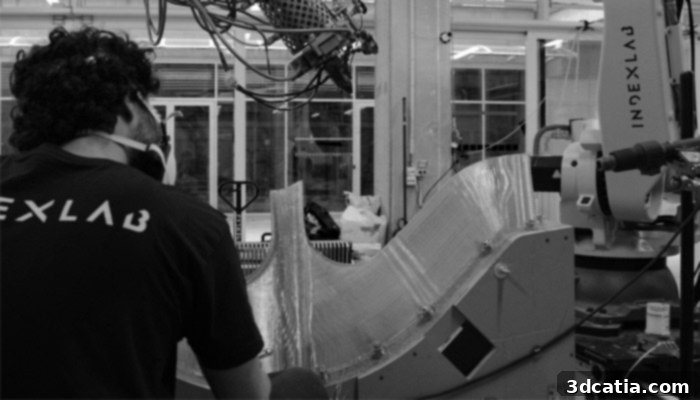
A 6-axis robot was used to manufacture the frame (photo credits: INDEXLAB)
A cornerstone of the New01bike’s pioneering design is its material: a robust, 3D printed polycarbonate derived entirely from recycled sources. This choice of material not only imbues the frame with a striking transparent effect but also highlights the project’s unwavering commitment to environmental stewardship. While the precise origins of the recycled polycarbonate are not explicitly detailed, the material’s inherent properties offer compelling clues. Polycarbonate is renowned for its exceptional impact resistance, durability, and optical clarity, making it a prevalent material in a wide array of consumer products. Given these characteristics, it would not be surprising if the recycled feedstock included items such as discarded safety glasses, motorcycle helmets, automotive headlamp lenses, water cooler bottles, or even old CDs and DVDs. The process of transforming these end-of-life products into a high-grade filament for additive manufacturing represents a significant achievement in material science, demonstrating that performance and sustainability can indeed go hand-in-hand. This innovative approach significantly reduces reliance on virgin plastics, minimizes landfill waste, and lowers the carbon footprint associated with bicycle frame production, paving the way for a truly green manufacturing paradigm.
The technological backbone of the New01bike project is a sophisticated manufacturing process known as Robotic Additive Molding. This advanced method leverages the unparalleled precision and flexibility of a 6-axis robotic arm for the 3D printing phase. Unlike conventional 3-axis machines, which are limited in their movement and complexity, a 6-axis robot can move and orient the extrusion head in virtually any direction, enabling the creation of intricate, curved geometries and continuous, strong parts that would be impossible with simpler systems. This capability is crucial for bicycle frames, which require complex curves and structural integrity to manage varied stresses during riding. Furthermore, the project employs a second robotic arm dedicated to post-processing: milling the crucial fixtures for components like the crankset and the rear wheel. This integrated robotic workflow ensures both the structural strength and the dimensional accuracy required for precise component assembly. The synergy between robotic additive manufacturing and subtractive finishing allows for the production of a frame that is not only robust and lightweight – weighing approximately 8 kilograms for the prototype – but also perfectly functional and ready for standard bicycle components. This multi-robot system exemplifies the cutting edge of industrial additive manufacturing, offering unprecedented design freedom and efficiency.
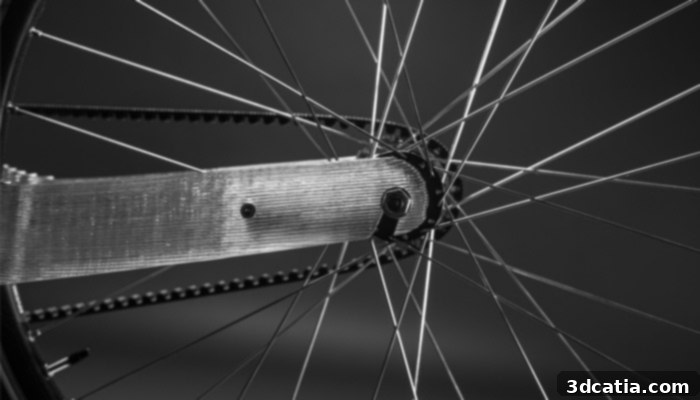
Another robot was used for fastening (photo credits: INDEXLAB)
INDEXLAB’s vision extends beyond individual product innovation to encompass a broader, more impactful goal: establishing a localized circular system for recycling and manufacturing. This ambitious objective aims to create an organized, regional ecosystem where materials are sourced, processed, and remanufactured within close proximity. Such a localized approach drastically reduces transportation costs and carbon emissions, fostering economic growth within communities while minimizing environmental impact. The implementation of this circular model involves collecting discarded polycarbonate products locally, processing them into raw material suitable for 3D printing, and then manufacturing custom bicycle frames tailored to regional demand. This closed-loop system promotes sustainable materials and introduces new, efficient production methods that do not compromise on product functionality or performance. In essence, the New01bike project is not just about a single product; it’s a blueprint for a sustainable manufacturing future where waste is minimized, resources are optimized, and products are designed for endless cycles of use and reuse. This represents a paradigm shift from the traditional linear “take-make-dispose” economy to a truly regenerative one, promising significant long-term benefits for both the environment and consumers.
The implications of projects like the New01bike reach far beyond the cycling industry, serving as a powerful demonstration of what’s possible when advanced manufacturing, material innovation, and sustainability converge. This pioneering work by INDEXLAB and GIMAC-EXGINEERING highlights the immense potential of 3D printing to enable truly mass customization, offering products that are not just personalized but also environmentally conscious and economically viable. For cyclists, the promise of an affordable, custom-fitted bike made from recycled materials means enhanced comfort, improved performance, and a reduced ecological footprint. For manufacturers, it offers a scalable model for adopting circular economy principles and robotic automation. As industries worldwide grapple with the challenges of waste reduction and resource depletion, the New01bike provides a tangible, inspiring example of how to build products without sacrificing quality, functionality, or the health of our planet. This innovative spirit is paving the way for a new era of responsible consumption and production, where design intelligence and technological prowess combine to create a more sustainable future for all.
What are your thoughts on this inspiring Italian project and its potential to reshape the future of cycling and sustainable manufacturing? We’d love to hear your perspective! Share your insights in a comment below or join the conversation on our LinkedIn, Facebook, and Twitter pages. Don’t miss out on the latest advancements in 3D printing – sign up for our free weekly Newsletter here to get cutting-edge news delivered straight to your inbox! For more in-depth content and visual showcases of additive manufacturing, explore all our videos on our dedicated YouTube channel.
*Cover photo credits: INDEXLAB