
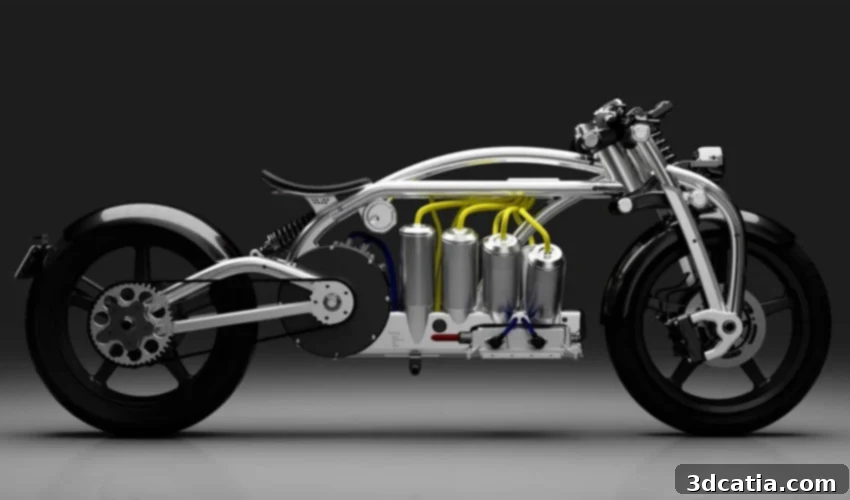
Curtiss Zeus 8: Revolutionizing Electric Motorcycle Design and Production with 3D Printing
The automotive industry is in constant evolution, pushing the boundaries of design, performance, and sustainability. At the forefront of this transformative wave is the Curtiss Motorcycle Company, an American startup dedicated to engineering groundbreaking electric motorcycles that not only redefine personal transportation but also champion environmental responsibility. This innovative company recently embarked on a pivotal collaboration with Fast Radius, a leading authority in additive manufacturing, to bring their latest creation, the Zeus 8, to life. This partnership saw Fast Radius’s 3D printing department produce approximately sixty intricate prototype parts for the new electric motorcycle, a testament to the speed and versatility of modern manufacturing techniques. What makes the Zeus 8 particularly compelling is its strategic blend of manufacturing approaches; while leveraging the rapid prototyping capabilities of 3D printing, it will also incorporate numerous components crafted through traditional subtractive manufacturing methods. This illustrates a powerful synergy between these two distinct yet complementary production philosophies. The highly anticipated Curtiss Zeus 8 is projected to make its grand market debut in early 2020, promising a new era for performance-focused, sustainable motorcycling.
Curtiss Motorcycle Company is not alone in recognizing the profound potential of additive manufacturing for vehicle development. This forward-thinking American manufacturer joins an exclusive group of pioneers who have embraced 3D printing to accelerate the creation of their motorcycles, whether powered by electricity or conventional fuel. For instance, the innovative Polish project Falectra recently captured attention with its prototype electric motorcycle, meticulously crafted using advanced 3D printing technologies. This method is increasingly favored due to its inherent ability to drastically reduce time-to-market for complex products, enabling visionary ideas to transition from concept to tangible reality at unprecedented speeds. Furthermore, the application of additive manufacturing is expanding beyond mere prototyping, gaining significant traction in the realm of final production for functional parts. This growing trend unequivocally demonstrates a heightened level of confidence among manufacturers in the reliability, precision, and scalability of 3D printing technology, marking a significant paradigm shift in how high-performance vehicles are conceived and manufactured.
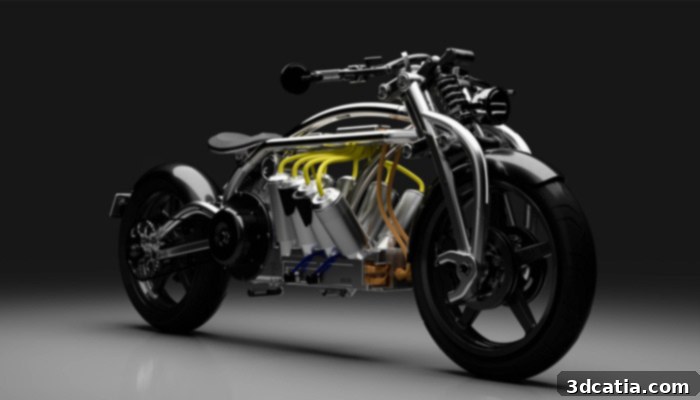
Credits: Curtiss Motorcycle Company
The Distinctive Design Philosophy Behind Curtiss’s Electric Motorcycles
Curtiss has already made a name for itself in the electric motorcycle landscape with its previous models, Zeus and Hades, both distinguished by their remarkably original and open architectural designs. These designs are not merely aesthetic choices; they are deeply rooted in a philosophy that marries form with unparalleled function. The Zeus 8, in particular, showcases this ethos brilliantly, featuring a striking battery pack that subtly echoes the iconic “V” configuration of traditional V8 internal combustion engines. This homage to classic powerhouses is not just visual; it is a clever engineering solution.
Jordan Cornille, the visionary designer behind Curtiss, elaborates on this ingenious approach: “With the battery cells packaged inside eight cylindrical towers configured in a flaring radial ‘V’ pattern, we’re not only able to tap into Glenn’s iconic V8 form language, but we’re also able to achieve maximum battery cooling efficiency. In this case, there exists no compromise between form and function.” This statement underscores Curtiss’s commitment to thoughtful design, where every element serves a dual purpose. The radial ‘V’ pattern ensures optimal thermal management for the high-performance battery cells, which is crucial for extending battery life and maintaining peak performance, especially under demanding riding conditions. This meticulous attention to detail and innovative packaging demonstrates how Curtiss is pushing the boundaries of electric vehicle design, moving beyond conventional limitations to create machines that are as visually compelling as they are technologically advanced and efficient. It represents a harmonious blend of historical design inspiration with cutting-edge electrical engineering, resulting in an electric motorcycle that stands apart in a rapidly evolving market.
3D Printing: Accelerating the Zeus 8 Manufacturing Process
The journey of the Curtiss Zeus 8 from concept to reality was significantly propelled by the strategic integration of 3D printing. Curtiss Motorcycle Co. had an ambitious goal: to unveil a compelling first prototype of the Zeus 8 at the prestigious Quail Motorsports Gathering show in California. Facing tight deadlines inherent in such high-profile events, the manufacturer astutely recognized the unparalleled advantages of additive manufacturing for rapid prototyping. To achieve this, they forged a crucial partnership with Fast Radius, a company renowned for its advanced digital manufacturing capabilities. This collaboration proved immensely fruitful, enabling the 3D printing of an impressive sixty distinct prototype parts for the Zeus 8.
The efficiency demonstrated by this partnership was remarkable; the entire prototype manufacturing process, from design finalization to the production of these complex parts, was completed in an astonishingly short span of just 12 days. This swift turnaround highlights one of the core benefits of leveraging 3D printing in product development: its ability to drastically compress timelines and facilitate rapid design iterations. Fast Radius further elaborated on their meticulous approach, explaining that while 3D printing was expertly utilized for the smaller, more intricate components of the motorcycle, larger structural parts were precisely crafted using advanced 5-axis CNC milling. This hybrid manufacturing strategy underscores the intelligent allocation of resources, where each technology is deployed to its optimal advantage.
While the specific 3D printing technology employed for the Zeus 8 parts remains undisclosed, Fast Radius boasts an extensive and versatile suite of additive manufacturing services. Their capabilities span a wide spectrum of technologies, ensuring that they can match any project with the most suitable method. This range includes popular techniques such as Fused Deposition Modeling (FDM), ideal for robust and functional prototypes; Multi Jet Fusion (MJF), known for its speed and ability to produce complex geometries with excellent surface finish; Stereolithography (SLA), favored for its precision and smooth details; and Selective Laser Sintering (SLS), which excels at producing strong, durable parts without the need for support structures. The choice of technology would have been meticulously determined based on the specific requirements of each of the sixty parts, considering factors such as material properties, mechanical performance, surface finish, and cost-effectiveness. This flexibility is a hallmark of modern digital manufacturing and a key reason why partnerships like that between Curtiss and Fast Radius are driving innovation in the electric vehicle sector.
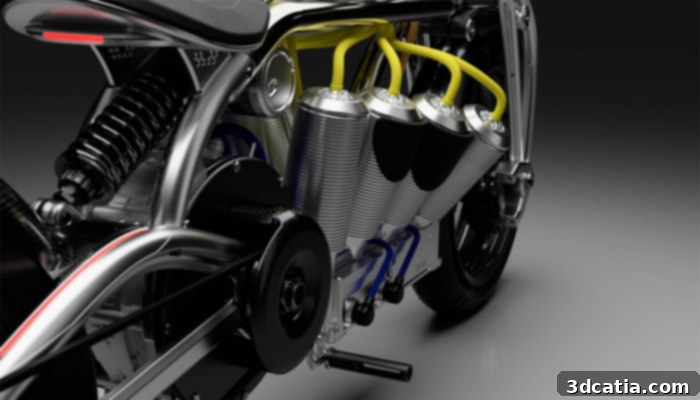
The apparent battery | Credits: Curtiss Motorcycle Company
Beyond Prototyping: Towards Full-Scale Production and Future Innovations
The success of the initial prototyping phase has solidified the commitment of both Curtiss Motorcycle Company and Fast Radius. With the design validated and manufacturing processes refined, the two partners have confidently moved forward with the production of the first 100 units of the Zeus 8 electric motorcycle. This significant step from rapid prototyping to limited-run production showcases the scalability and reliability that advanced manufacturing technologies, including 3D printing, now offer. The collaboration has been so fruitful that Curtiss is actively exploring the potential for integrating 3D printed components even further into the vehicle’s final assembly. This includes considering the additive manufacturing of other functional parts, such as the motorcycle’s handles, which could benefit from the design freedom and customization capabilities inherent in 3D printing.
Brian Simms, Vice President of Sales at Fast Radius, perfectly encapsulates the essence of this symbiotic partnership: “Our partnership with Curtiss is ideal because it allows them to do what they do best – design great bikes – while doing what we do best: match the project to the right technology and get quality parts manufactured quickly. We look forward to innovating with Curtiss as they develop their brand.” This statement highlights the core strength of their collaboration: leveraging specialized expertise. Curtiss, with its visionary design team and deep understanding of the motorcycle market, focuses on crafting exceptional vehicles. Fast Radius, on the other hand, provides the technological backbone, possessing the expertise to navigate the complex landscape of additive and traditional manufacturing to select and implement the most effective production methods for each specific component. This strategic division of labor ensures efficiency, optimizes costs, and accelerates innovation, enabling both companies to achieve their respective goals with greater impact. As Curtiss continues to expand its brand and push the boundaries of electric motorcycle design, the ongoing partnership with Fast Radius is set to be a crucial accelerator in bringing their advanced concepts to the global market.
The Curtiss Zeus 8: A Glimpse into the Future of Electric Mobility
The Curtiss Zeus 8 is positioned as a premium offering in the burgeoning electric motorcycle market, reflecting its cutting-edge design, advanced technology, and innovative manufacturing. Prospective owners should anticipate an investment of approximately $75,000 for this high-performance electric motorcycle, a price point that underscores its exclusivity and the advanced engineering within. The anticipation for its release is palpable, with availability expected to begin in early 2020. This timing places the Zeus 8 at the forefront of the electric vehicle revolution, appealing to enthusiasts and early adopters who seek not just a mode of transport, but a statement of innovation and environmental consciousness. The Zeus 8 is more than just a motorcycle; it’s a testament to the power of combining visionary design with advanced manufacturing techniques to create sustainable, high-performance vehicles. For those eager to delve deeper into the specifications, design intricacies, and the compelling story behind the Curtiss Zeus 8, comprehensive information is readily available directly from Curtiss. You can find more details about this groundbreaking electric motorcycle by visiting Curtiss’s official website HERE. The Zeus 8 represents a significant leap forward in electric mobility, promising an exhilarating and sustainable riding experience unlike any other on the market.
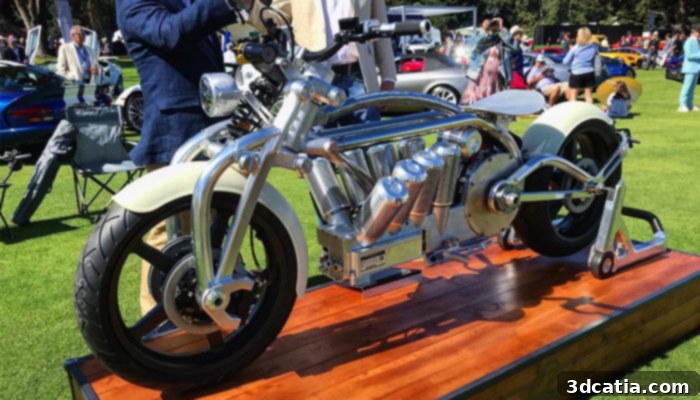
The Zeus 8 prototype
What are your thoughts on the innovative design and manufacturing process of the Curtiss Zeus 8 prototype? We invite you to share your insights in a comment below or join the conversation on our Facebook and Twitter pages! Don’t forget to sign up for our free weekly Newsletter to receive all the latest news in 3D printing delivered straight to your inbox and stay ahead of the curve in additive manufacturing advancements!