
Bio-Inspired 3D Concrete Printing: RMIT’s Spiral Patterns Unlock Stronger, Taller Structures
The construction industry is constantly seeking innovative solutions to build stronger, more sustainable, and aesthetically complex structures. Traditional concrete construction, while foundational, often faces limitations in design freedom and material efficiency. However, the advent of 3D concrete printing (3DCP) has begun to transform these challenges into opportunities. At the forefront of this revolution, scientists at Australia’s RMIT University have unveiled a groundbreaking approach that significantly enhances the structural integrity of 3D-printed concrete. Their research demonstrates that printing concrete in helicoidal, or spiral, patterns, rather than conventional parallel lines, results in a final product with superior strength and resilience. This remarkable innovation is poised to facilitate the construction of taller, more intricately designed, and creatively ambitious architectural masterpieces, pushing the boundaries of what is possible with concrete.
This pioneering research draws profound inspiration from the natural world, specifically from the internal structure of lobster shells. Crustaceans, including lobsters, have evolved robust, curved shells over millions of years, driven by an inherent need for extremely hard and protective shielding. By studying these natural architectures, the RMIT team sought to replicate nature’s optimized designs in engineered materials. This biomimetic approach addresses a key limitation of traditional concrete manufacturing, which typically relies on cumbersome molds. In contrast, additive manufacturing, or 3D printing concrete, inherently eliminates this need, offering unparalleled design flexibility and enabling the creation of geometrically complex structures. This flexibility, combined with bio-inspired patterns, opens up a vast array of options for developing solutions that target significantly increased material strength and performance.
Dr. Jonathan Tran, the lead researcher on this pivotal study, emphasized the significance of their findings: “Our study explores how different printing patterns affect the structural integrity of 3D-printed concrete, and for the first time reveals the benefits of a bio-inspired approach in 3DCP. We know that natural materials like lobster exoskeletons have evolved into high-performance structures over millions of years, so by mimicking their key advantages we can follow where nature has already innovated.” This statement underscores the power of biomimicry – learning from nature’s efficient designs to solve complex engineering problems. Lobster shells achieve their incredible toughness through a complex, layered structure where chitin fibers are arranged in a helicoidal or ‘twisted plywood’ configuration. This arrangement prevents cracks from propagating easily, distributing stress effectively and making the material incredibly resistant to damage. By adopting a similar spiraling pattern in 3D-printed concrete, the RMIT team has successfully imparted similar advantages, enhancing the material’s resistance to cracking and improving its overall mechanical properties.

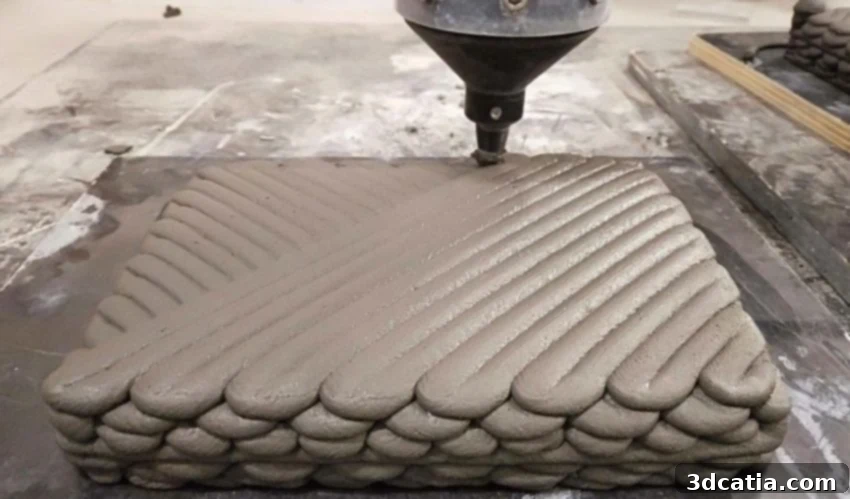
Different 3D printing patterns experimented by the RMIT research team (Photo Credit: RMIT University)
The methodology behind RMIT’s breakthrough involved extensive experimentation with a range of additive manufacturing approaches for concrete. Their goal was to expand the potential applications of 3DCP in various architectural and structural fields. The research was conducted using a robust 16 x 16 foot mobile robotic printer, allowing for precise control over printing parameters and the geometry of the concrete layers. Beyond the bio-inspired helicoidal patterns, the team also thoroughly investigated the effects of other conventional and experimental printing patterns, including parallel, cross-ply, and quasi-isotropic designs. Parallel printing, while common, often creates anisotropic structures where strength varies significantly depending on the direction of applied force. Cross-ply and quasi-isotropic patterns aim to mitigate this anisotropy, but the helicoidal pattern showed distinct advantages. Furthermore, the researchers explored the promising possibility of strengthening 3D-printed concrete by incorporating recycled waste materials, aligning with global efforts towards sustainable construction practices. The comprehensive research paper published by the RMIT scientists unequivocally concluded that “there are definite enhancements on the mechanical properties of printed concrete resulting from the unconventional printing patterns, which have a promising potential for being applied in highly complex or self-supporting concrete architectures.” This finding paves the way for a new generation of structural designs that were previously unimaginable, offering increased load-bearing capacity and resilience.
The potential repercussions of RMIT’s research extend far beyond mere structural enhancement. This development is part of a broader, transformative movement within the construction industry, driving it towards Industry 4.0 – an era characterized by automation, interconnectedness through the Internet of Things (IoT), and advanced digital manufacturing. 3D concrete printing, with innovations like the helicoidal pattern, promises to revolutionize how buildings are designed, fabricated, and assembled, leading to faster construction times, reduced labor costs, and significantly less material waste. By optimizing material usage and allowing for on-demand production of complex components, 3DCP contributes directly to a more sustainable and efficient construction paradigm.
Indeed, there have been several notable projects that have successfully leveraged 3D printing to enhance the integrity and design capabilities of concrete structures. For instance, researchers at UC Berkeley discovered an innovative method to reinforce concrete structures using 3D printed polymer lattices. These intricate internal scaffolds provide additional tensile strength and ductility to concrete, addressing its inherent brittleness. Similarly, RMIT researchers have consistently investigated the synergistic benefits of incorporating other materials into concrete mixes. Their studies found that by integrating just 1-2% steel fibers within a concrete mixture, its porosity and internal defects were significantly reduced. This minor addition dramatically increased the material’s overall strength, crack resistance, and ductility, making it more resilient to various stresses. Dr. Tran further elaborated on the far-reaching implications of RMIT’s ongoing research: “3D concrete printing technology has real potential to revolutionize the construction industry, and our aim is to bring that transformation closer.” This sentiment reflects a global drive to leverage advanced manufacturing for smarter, greener, and more resilient infrastructure.
The ability to print self-supporting, intricate concrete geometries without the need for extensive formwork not only accelerates construction but also drastically reduces material consumption and associated carbon emissions. This is particularly crucial in an era where environmental sustainability is paramount. Bio-inspired designs, like the helicoidal patterns derived from lobster shells, demonstrate how nature’s millions of years of optimization can be directly translated into engineering solutions that outperform conventional methods. As automation and digital fabrication continue to mature, the integration of such intelligent design principles will unlock new possibilities for building everything from affordable housing to avant-garde architectural landmarks. The impact of RMIT’s work resonates with the broader goals of Industry 4.0, where smart processes and materials are transforming industrial landscapes worldwide. You can watch a summary of RMIT University’s research project below, offering a visual insight into their innovative approach and the potential it holds for the future of construction:
To delve deeper into the technical specifics and detailed findings of this groundbreaking study, you can read the full research paper HERE. What are your thoughts on RMIT University’s latest research into bio-inspired 3D printed concrete? We encourage you to share your insights and comments below, or engage with us on our Facebook and Twitter pages! For the very latest 3D printing news and innovations delivered straight to your inbox, don’t forget to sign up for our free weekly Newsletter here.