
Starbucks Brews Innovation: The Role of 3D Printing in Crafting Unique Retail Experiences
Starbucks, a veritable titan in the global corporate landscape, has firmly established its presence with an astonishing network of over 26,000 coffee bars worldwide as of 2017. While its roots are deeply American, a significant proportion of Starbucks’ recent and explosive growth has been strategically concentrated in Asia, particularly the burgeoning market of China. By 2017, China alone boasted over 3,000 Starbucks locations, with an impressive 600 situated in the vibrant metropolis of Shanghai. This rapid expansion is perhaps best encapsulated by the fact that Starbucks was opening a new coffee bar in China roughly every 15 hours during that period, a testament to its aggressive market penetration and consumer appeal.
Interestingly, parallel to Starbucks’ eastward expansion, the Asian market has also emerged as a hotbed for advancements in 3D printing technology. Manufacturers like XYZprinting, a prominent player in the additive manufacturing sector, have been steadily expanding their reach from their base in Taiwan, signaling a robust and innovative ecosystem. This convergence of growth raises an intriguing question: what connection could possibly exist between a global coffee giant like Starbucks and the cutting-edge world of 3D printing?
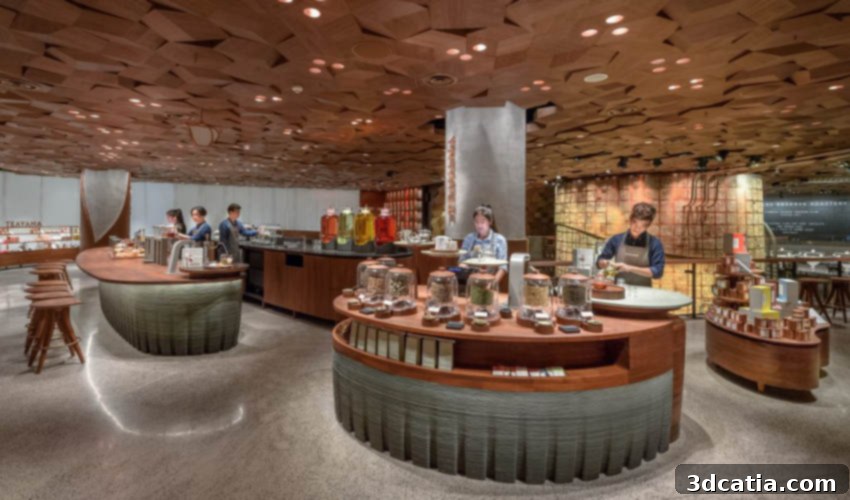
The answer lies in Starbucks’ innovative approach to retail design and its commitment to creating unparalleled customer experiences, particularly within its exclusive “Reserve Roastery” concept. These unique establishments represent the pinnacle of Starbucks’ brand identity, blending artisanal coffee craft with immersive, high-tech environments. The integration of advanced manufacturing techniques, such as 3D printing, plays a pivotal role in bringing these visionary spaces to life, offering bespoke design elements and sustainable solutions that elevate the retail experience far beyond a conventional coffee shop. This synergy between global brand power and technological innovation highlights a fascinating trend in modern retail: the use of advanced digital fabrication to craft truly memorable and impactful consumer spaces.
Starbucks’ Strategic Expansion: The Rise of Reserve Roasteries
Starbucks Reserve Roastery stores represent a distinct and premium tier within the company’s vast portfolio. These aren’t your everyday Starbucks locations; they are meticulously designed, sprawling temples to coffee, offering an immersive theatrical experience. While the Reserve Roastery in Shanghai has garnered significant attention, it was not the first of its kind. That distinction belongs to Starbucks’ original Reserve Roastery, which opened its doors in Seattle in 2014, marking a pivotal moment in the company’s evolution towards experiential retail. These unconventional stores are intentionally crafted to be more than just places to grab a quick coffee; they are destinations.
The design philosophy behind Reserve Roasteries is to celebrate the art and science of coffee, from bean to cup, in the most captivating way possible. Inside, customers encounter a multitude of distinct “stations” or experiences, each designed to engage the senses and deepen appreciation for coffee. This includes a Rocco Princi Italian bakery, offering freshly baked goods and savory delights that complement the coffee experience. Interactive augmented reality (AR) roasting displays allow visitors to virtually explore the intricate roasting process, adding a layer of digital engagement to the traditional craft. Furthermore, special Teavana Bars within these locations offer an elevated tea experience, showcasing a curated selection of rare and exotic teas. Each element is thoughtfully integrated to showcase coffee and tea in the best possible light, attracting not only existing loyal customers but also a new demographic eager for unique, high-end retail experiences.
The strategic goal behind these Reserve Roasteries is multi-faceted. Firstly, they serve as brand accelerators, elevating the Starbucks image and demonstrating its commitment to premium quality and innovation. Secondly, they foster deeper customer engagement by offering unique, sensory-rich environments that encourage longer visits and higher spending. They are a physical manifestation of Starbucks’ move into the “experience economy,” where consumers prioritize memorable interactions over mere transactions. Thirdly, these flagship stores act as innovation hubs, allowing Starbucks to experiment with new product offerings, store formats, and technological integrations before potentially scaling them to other locations. The success of the Seattle Roastery paved the way for a global expansion of the concept, with prominent locations subsequently opening in major cities such as Milan, New York, Tokyo, Chicago, and, of course, Shanghai. Each new Roastery is a testament to Starbucks’ vision of redefining the coffee experience, blending local culture with global sophistication and cutting-edge design.
The Teavana Bar: A Showcase for 3D Printing Innovation
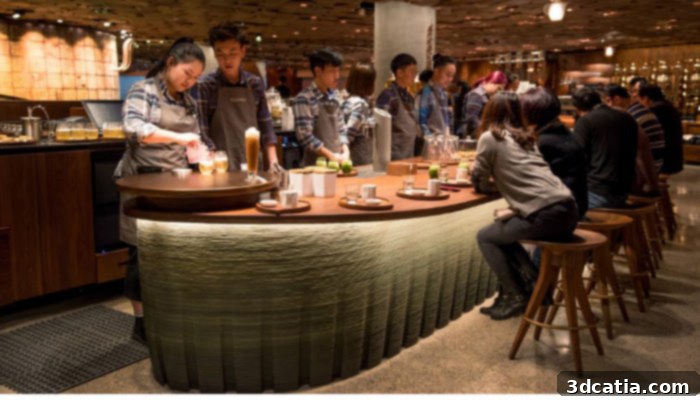
While Starbucks stands as an undeniable global powerhouse, it’s a fascinating tidbit that even within its home state, it’s not the largest company. Starbucks is proudly based in Seattle, Washington, a city that also hosts the global headquarters of Amazon, an enterprise of considerably larger scale. This detail, however, doesn’t diminish Starbucks’ innovative spirit, especially evident in its premium Reserve Roastery locations. The Shanghai Reserve Roastery, a marvel of modern retail design, features a particularly noteworthy element: its Teavana Bar. What makes this bar stand out isn’t just its selection of premium teas, but a critical piece of its construction – a striking 3D printed base.
Starbucks has proudly stated that this substantial 3D printed base was constructed using recycled materials, aligning with a growing global emphasis on sustainability and corporate environmental responsibility. This approach mirrors the efforts of pioneering companies like CONCR3DE, which specializes in sustainable construction materials and additive manufacturing. The utilization of recycled content for such a prominent structural element sends a powerful message about Starbucks’ commitment to eco-conscious practices, demonstrating how large corporations can integrate advanced technology with sustainable sourcing. The process involved layering materials through industrial 3D printing techniques to form a robust and aesthetically unique foundation for the bar, measuring an impressive 7.5 meters in length. This bespoke fabrication method allowed for a design that would be challenging, if not impossible, to achieve with traditional construction techniques, offering both functional integrity and a distinctive visual appeal.
The decision to incorporate 3D printing for such a significant feature in a flagship store underscores several advantages of additive manufacturing. Firstly, it allows for unparalleled design freedom, enabling the creation of complex geometries and custom textures that would otherwise be cost-prohibitive or time-consuming. Secondly, by using recycled materials, Starbucks tapped into the sustainability potential of 3D printing, reducing waste and the environmental footprint of its construction. Thirdly, the precision and efficiency of large-scale 3D printing can often lead to faster construction times and reduced labor costs for custom elements. The Teavana Bar’s 3D printed base is not just a structural component; it’s a statement piece, reflecting a harmonious blend of innovative technology, sophisticated design, and a responsible approach to resource utilization within a high-traffic commercial environment. It sets a new benchmark for how experiential retail spaces can leverage cutting-edge manufacturing to create both beauty and purpose.
Unveiling the Technology: How Large-Scale 3D Printing Made it Possible
Within the expansive 2,700 square meter Shanghai Reserve Roastery, the exact manufacturer responsible for Starbucks’ impressive 3D printed base remains officially undisclosed. However, based on the scale and complexity of the 7.5-meter structure, it is almost certainly the product of an advanced, large-scale robotic 3D printing arm. Such sophisticated systems are designed for industrial applications, capable of precisely depositing layers of material over significant areas, distinguishing them from smaller, desktop 3D printers. This type of technology is at the forefront of additive manufacturing for construction and large-format design elements.
Companies like Apis Cor exemplify the capabilities of such robotic systems in the realm of construction 3D printing. Apis Cor has garnered significant international attention for its pioneering work, famously demonstrating the ability to 3D print an entire house in an astonishing 24 hours. While the Starbucks Teavana Bar base is not a full building, the underlying principles of large-scale material extrusion by a robotic arm are highly relevant. These systems offer unparalleled precision, speed, and the ability to work with a diverse range of materials, including recycled composites, making them ideal for bespoke architectural and interior design elements that demand both structural integrity and unique aesthetics. The ability to directly translate complex digital designs into physical objects without the constraints of traditional molds or fabrication methods is a game-changer for interior architecture.
The adoption of industrial-scale 3D printing for a high-profile retail installation like the Starbucks Teavana Bar highlights several key advantages of this technology. Firstly, it offers unprecedented design freedom, allowing architects and designers to create organic, curvilinear forms and intricate patterns that would be prohibitively expensive or practically impossible to achieve with conventional manufacturing techniques. This enables truly unique and memorable retail environments that captivate customers. Secondly, 3D printing can significantly reduce material waste, especially when utilizing recycled composites as Starbucks did, contributing to more sustainable construction practices. The additive nature of the process means material is only used where needed, minimizing offcuts and excess. Thirdly, the digital workflow from design to fabrication can streamline the construction process, potentially reducing lead times for custom components. For a company like Starbucks, constantly seeking innovative ways to differentiate its brand and enhance the customer experience, investing in such advanced digital fabrication methods is a clear indication of additive manufacturing’s growing maturity and commercial viability in creating captivating, functional spaces.
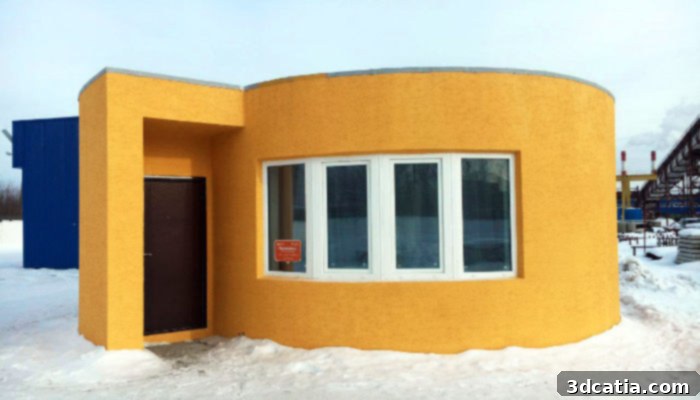
Apis Cor likely used a similar 3D printing technique when they 3D printed a house in 24 hours.
Beyond Coffee: The Broader Impact of 3D Printing in Retail and Architecture
The use of 3D printing by a global brand like Starbucks for a significant architectural element within one of its flagship Reserve Roasteries is far more than a mere novelty; it signifies a profound shift in how retail spaces are designed, constructed, and experienced. This impressive example of 3D printed architecture demonstrates the technology’s capability to deliver not just functional structures but also aesthetically compelling and unique design features that enhance brand identity and customer engagement. It underscores how far additive manufacturing has come, moving from a niche prototyping tool to a mainstream solution for large-scale, customized fabrication.
In the broader context of retail, 3D printing is emerging as a game-changer for creating truly experiential environments. Brands are increasingly recognizing that physical stores must offer more than just products; they need to provide memorable moments and unique aesthetics. 3D printing enables bespoke furniture, custom fixtures, intricate decorative panels, and even entire structural elements to be produced with unprecedented design freedom and precision. This allows retailers to craft highly personalized and immersive spaces that align perfectly with their brand narrative, fostering deeper connections with consumers. Imagine complex, organic shapes for display units, unique textured walls, or custom seating areas—all made possible and cost-effective through digital fabrication. The speed of production for custom items also means that retail environments can be refreshed and adapted more quickly to changing trends or seasonal campaigns, maintaining a dynamic and engaging atmosphere.
Furthermore, the implications extend deeply into the architectural and interior design sectors. Architects are embracing 3D printing for its ability to realize complex, non-standard geometries and intricate details that would be unfeasible with traditional construction methods. This opens up new frontiers for sustainable design, as materials can be optimized and waste minimized through the additive process, especially with the use of recycled or bio-based composites. From entire buildings constructed on-site, as pioneered by companies like Apis Cor and Icon, to customized facade elements and intricate interior features, 3D printing offers a path toward more efficient, sustainable, and creatively expressive construction. The Starbucks Teavana Bar is a prime example of how even a single, well-executed 3D printed component can elevate an entire space, transforming it into a statement piece of modern design and a testament to the boundless capabilities of additive manufacturing in shaping our physical world.
Conclusion: A Glimpse into the Future of Brand Experience
Overall, Starbucks’ integration of 3D printing into its Shanghai Reserve Roastery is an undeniably impressive step forward for additive manufacturing technology. The fact that such a globally recognized and influential company is leveraging 3D printing within its flagship stores speaks volumes about the technology’s maturity, reliability, and immense potential. It signals a shift from 3D printing being a tool for rapid prototyping to a viable method for producing large-scale, permanent, and aesthetically significant architectural elements. This move by Starbucks not only creates a unique, memorable experience for its customers but also serves as a powerful endorsement of 3D printing’s capabilities in the competitive world of retail and experiential design.
This impressive 3D printed architecture within the Roastery definitively shows that 3D printing is capable of delivering not just innovative concepts, but tangible, beautiful, and durable structures. It highlights the technology’s role in enabling bespoke design, promoting sustainable practices through recycled materials, and ultimately enhancing the overall brand experience. As companies continue to seek innovative ways to captivate consumers and differentiate themselves in an increasingly crowded market, the intersection of advanced manufacturing like 3D printing and experiential retail will undoubtedly continue to grow, shaping the future of how we interact with brands and their physical spaces.
What do you think of Starbucks’ 3D printed store and the future of additive manufacturing in retail? We’d love to hear your thoughts! Let us know in a comment below or join the conversation on our Facebook and Twitter pages! Don’t miss out on the latest advancements and news in the world of 3D printing—sign up for our free weekly Newsletter and get all the updates delivered straight to your inbox!