
Revolutionizing Tidal Energy: Renishaw, NSCC, and Biome Renewables Harness Additive Manufacturing for Sustainable Power
In a landmark collaboration underscoring the transformative potential of additive manufacturing, global engineering company Renishaw has partnered with the Nova Scotia Community College (NSCC) in Canada to produce critical ocean turbine components for industrial design firm Biome Renewables. This innovative project highlights how advanced manufacturing technologies are accelerating the development of sustainable energy solutions, specifically within the challenging tidal power sector. Biome Renewables, a pioneering startup, specializes in leveraging biomimetic design processes – drawing inspiration from nature’s efficient structures – to engineer highly effective and sustainable solutions. One of their flagship innovations is the PowerCone, a clever turbine retrofit designed to significantly boost annual energy production by up to 13%. Faced with the common industry challenge of high manufacturing costs and protracted lead times for specialized parts, Biome Renewables turned to the combined expertise of Renishaw and NSCC to find a more efficient and cost-effective production method.
The journey toward this groundbreaking achievement began when Biome Renewables decided to expand its focus into the nascent yet promising field of tidal wave energy. Recognizing the unique demands of this environment, they approached NSCC, a natural choice given the college’s distinguished specialization in ocean technology and its state-of-the-art engineering research facility, renowned for developing prototypes across diverse industrial sectors. Initially, NSCC explored conventional plastic manufacturing solutions for the turbine parts. However, the harsh, corrosive, and high-stress conditions inherent in tidal environments quickly revealed the inadequacy of plastic materials for such critical components. The need for robust, durable, and high-performance parts led them to pivot towards metal additive manufacturing (AM) as a viable alternative to significantly enhance the strength and longevity of the components. It was at this crucial juncture that Renishaw, a world leader in additive manufacturing technology, was brought in to provide essential technical assistance and expertise on the intricate metal AM process. This strategic collaboration ultimately yielded remarkable results: the partners not only achieved an impressive 80% reduction in production costs but also dramatically compressed the development timeline for the complex turbine components to an unprecedented two months.
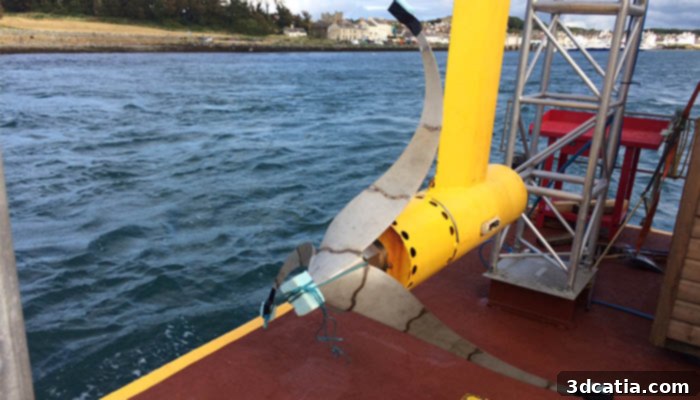
Image via Renishaw
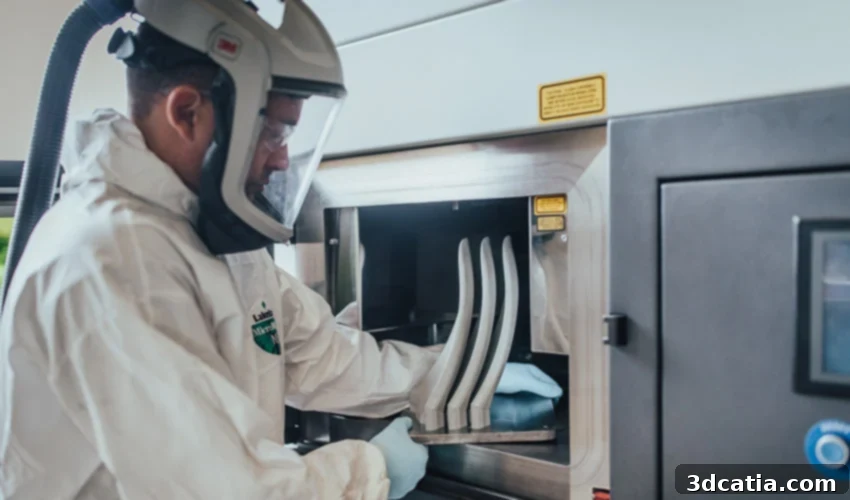
Renishaw’s pivotal role involved the expert design and production of two crucial components specifically tailored for Biome Renewables’ tidal turbine system. The first was an enhanced version of the PowerCone, a sophisticated retrofit part engineered to sit seamlessly on the hub of an existing turbine. Inspired by the efficiency of natural forms, this biomimetic design significantly improves overall turbine efficiency by an estimated 10-15 percent. Its innovative structure allows the turbine blades to rotate effectively at slower speeds, optimizing energy capture even in less turbulent conditions and reducing stress on the turbine system. The second set of components comprised specialized propellers featuring a uniquely curved design. This curvature is not merely aesthetic; it is meticulously engineered to minimize drag as the blades move through water, thereby maximizing the turbine’s kinetic energy conversion and improving overall performance. These high-performance, additively manufactured parts were subsequently integrated into a prototype turbine, which underwent rigorous testing at Strangford Loch in Northern Ireland – a globally recognized site for tidal energy research and development, providing a realistic and challenging operational environment. Mark Kirby, Additive Manufacturing Business Manager at Renishaw Canada, emphasized the profound impact of this approach, stating, “Additive manufacturing allowed us to produce the final parts in two months, which would be unthinkable using traditional methods.” He further elaborated on the broader significance of the project: “The ocean turbine project was not only a great opportunity for us to work with one of our many Canadian customers, it was a chance for us to see how metal AM can improve the efficiency of renewable sources.” This statement underscores Renishaw’s commitment not just to commercial success, but also to advancing sustainable technologies.
The collaboration between Renishaw, NSCC, and Biome Renewables serves as a powerful testament to the inherent advantages of Design for Additive Manufacturing (DfAM). Unlike conventional manufacturing constraints, DfAM allows for the creation of intricate geometries and optimized structures that can simultaneously add complexity, enhance functionality, and yield parts that are both stronger and significantly lighter. In the context of tidal turbine energy, where components must withstand immense forces and corrosive elements for extended periods, these attributes are invaluable. The tidal turbine energy market is currently one of the most dynamic and rapidly expanding segments within the broader renewable energy landscape. Consequently, breakthroughs and advancements like those demonstrated in this project are not just beneficial but truly transformative for the entire sector, pushing the boundaries of what is possible in sustainable power generation.
Despite its proven capabilities, a common misconception still pervades the industry: many people continue to view metal additive manufacturing as an inherently very expensive technology. While initial investment costs for AM systems can be significant, this project unequivocally demonstrates that in specific, high-value applications—such as the production of bespoke, high-performance components for demanding environments—metal AM can offer unparalleled economic advantages. In fact, Biome Renewables’ remarkable achievement of reducing the cost of building their turbine prototype by an astounding 80% directly challenges this perception. This substantial cost reduction, coupled with drastically shorter lead times, highlights AM’s potential to not only accelerate innovation but also to make previously unfeasible projects economically viable. This marks an incredibly exciting period in the evolution of additive manufacturing, as more companies across various sectors begin to discover and benefit from the strategic utilization of this game-changing technology. The ability to iterate rapidly, customize extensively, and optimize performance fundamentally changes the paradigm of product development and commercialization, especially in critical sectors like renewable energy where speed and efficiency are paramount.
The unique challenges of tidal energy, characterized by its remote locations, extreme operating conditions, and the critical need for long-term reliability, make it an ideal testbed for advanced manufacturing techniques. Traditional casting or machining methods often involve extensive tooling, multiple processing steps, and significant material waste, all contributing to higher costs and longer production cycles. Metal AM, by contrast, builds parts layer by layer directly from a digital design, allowing for material efficiency, reduction in assembly steps, and the creation of complex internal structures that improve performance without adding bulk. For components like the PowerCone and the optimized propellers, this means achieving superior hydrodynamic efficiency and structural integrity that would be difficult, if not impossible, to achieve with conventional manufacturing. The success at Strangford Loch validates not just the design of these specific parts, but the entire methodology of integrating biomimicry with additive manufacturing for real-world impact.
Furthermore, the educational aspect of this collaboration with NSCC cannot be overstated. By involving an academic institution with a strong focus on ocean technology, the project also serves as a critical pathway for knowledge transfer and skill development in advanced manufacturing. Students and researchers at NSCC gained invaluable hands-on experience with cutting-edge metal AM processes, preparing a new generation of engineers and technicians to lead future innovations in renewable energy and advanced manufacturing. This kind of industry-academia partnership is vital for nurturing talent and fostering an ecosystem of continuous innovation, ensuring that Canada remains at the forefront of sustainable technological development. The project is a shining example of how combining specialized academic research with industrial expertise can unlock solutions to some of the world’s most pressing energy challenges, paving the way for a more sustainable future fueled by efficient, resilient, and cost-effective renewable energy systems.
What are your thoughts on this pioneering project and the role of additive manufacturing in advancing renewable energy? We invite you to share your insights and comments below, or engage with us on our Facebook and Twitter pages! Don’t miss out on the latest advancements and news in the dynamic world of 3D printing—sign up for our free weekly Newsletter, delivered straight to your inbox, to stay informed and ahead of the curve!