

Australia’s First Fully Functional 3D Printed Semi-Automatic Gun Seizure Highlights Global ‘Ghost Gun’ Threat
A significant development in the ongoing global challenge of untraceable firearms has emerged from Western Australia. Police officers from the Drug and Firearm Squad recently conducted a house raid, leading to the apprehension of an 18-year-old suspect and the seizure of several illegal firearms. Among the illicit arsenal was a fully functional, 3D printed semi-automatic gun. Weighing approximately 4 kilograms, this dangerous weapon is capable of firing 15 lethal 9mm rounds, identical to the caliber used by armed police forces. Its functionality is notably enhanced by the strategic incorporation of select metal parts, addressing a common weakness in earlier 3D printed polymer firearms that often disintegrated quickly after minimal use. This discovery underscores a growing concern among law enforcement agencies worldwide regarding the accessibility and effectiveness of homemade, additive manufactured weaponry.
This incident in Australia resonates with warnings issued by international bodies like the European Police Office (Europol), which has increasingly expressed concerns over the proliferation of 3D printed weapons seized across Europe in recent years. These concerns culminated in a dedicated conference held in The Hague, Netherlands, where experts convened to strategize against this evolving threat. Similarly, the United States has also been grappling with the rising danger posed by these “ghost guns,” prompting the US Justice Department to propose new regulations. Now, with a fully functional 3D printed firearm surfacing down under, it is clear that the threat has become truly global, necessitating robust and coordinated international responses. The ease with which these weapons can be produced from readily available materials presents a formidable challenge to existing gun control frameworks.
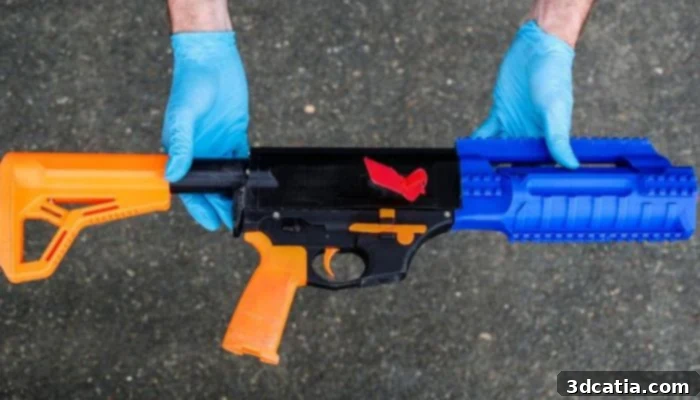
The deadly weapon looks like a plastic toy (photo credits: PerthNow)
According to detailed reports from various Australian news outlets, the police operation unfolded on June 3rd in Bayside, Western Australia. During the execution of a search warrant, officers were met with an alarming discovery: a fully functional, semi-automatic firearm, believed to have been manufactured right within a suburban residence. What makes this particular seizure profoundly concerning is the weapon’s deceptive appearance. Far from looking like a conventional firearm, it resembled a harmless plastic toy, yet it possessed the dangerous capability of an assault weapon, firing potent 9mm caliber rounds.
Detective Senior Sergeant Blair Smith articulated the gravity of the situation, stating, “It’s deeply concerning that this man was able to manufacture this firearm at home with a 3D printer and readily available materials.” He further emphasized the weapon’s lethality, clarifying, “That is a semi-automatic 9mm assault rifle in essence.” This incident not only highlights the ingenuity of individuals bypassing traditional firearm acquisition channels but also underscores the inherent difficulty for law enforcement to identify and trace such weapons before they can cause harm. The fact that crucial components were metal ensures the weapon’s reliability and longevity, making it a genuine threat rather than a mere prototype. The ease of access to 3D printing technology and online blueprints for firearms is a critical enabler of this growing problem.
Australia’s Unyielding Stance on Gun Control and the New 3D Printing Challenge
Australia maintains some of the world’s most stringent gun laws, largely a response to the devastating Port Arthur massacre in 1996, which led to sweeping reforms including a nationwide buyback scheme and significant restrictions on firearm ownership. While Australian police have encountered parts of 3D printed guns in the past, the firearm discovered in Bayside marks a critical turning point: it is the first fully functioning weapon of its kind found in Western Australia, fabricated using readily available materials and 3D printing technology. The weapon’s design featured a 3D printed body along with a 3D printed magazine, further demonstrating the advanced capabilities of homemade manufacturing. Crucially, metal components were integrated for the trigger and other mechanical parts, ensuring the weapon’s operational integrity and reliability—a significant upgrade from earlier, less durable plastic designs.
This discovery immediately highlights a new frontier in circumventing Australia’s tough gun control measures. The ability to manufacture firearms at home, largely untraceable and unregulated, poses an immense challenge to existing legal frameworks. In response to this escalating threat, the Government of Western Australia moved proactively last November, proposing a rigorous update to its existing gun laws. These newly proposed amendments specifically target the illegal manufacturing of plastic 3D firearms, elevating it to a serious felony. The potential penalties are severe, including prison sentences of up to 14 years and substantial fines reaching up to $75,000. These measures reflect the government’s determination to uphold public safety and prevent the proliferation of these dangerous “ghost guns,” recognizing the unique difficulties they present to law enforcement. The updates aim to close any perceived legal loopholes and send a strong deterrent message to those considering such illicit activities.

Detective Senior Sgt. Blair Smith and the 3D printed gun (photo credits: WA Police)
The precise methods of the firearm’s construction and the specific technologies employed remain largely undisclosed by the Police, along with further details concerning the alleged manufacturer. However, based on the weapon’s appearance and similarities to other global cases, it is highly probable that the perpetrator utilized a common desktop 3D printer. The models and blueprints for such firearms are frequently acquired from various online sources, including dark web forums and dedicated communities, enabling individuals with minimal technical expertise to produce dangerous weapons. This ease of access to digital schematics represents a significant hurdle for law enforcement agencies worldwide, as they grapple with regulating and tracking these virtually invisible supply chains.
In immediate response to this alarming discovery of a fully operational 3D printed semi-automatic firearm, the Australian police have taken decisive action by launching a special task force. This specialized unit is dedicated to identifying and targeting individuals engaged in the illicit manufacturing of firearms at home. The 18-year-old alleged gun manufacturer has been formally charged with multiple serious offenses, including the unlicensed manufacturing and possession of a prohibited weapon. He now faces considerable time in jail, a testament to the severity with which Australian authorities view such crimes.
Det-Sen Sgt Smith reiterated the police’s unwavering commitment to community safety, emphasizing the unprecedented nature of this particular seizure in Western Australia. He concluded with a stern warning: “These types of firearms are unregulated, unlicensed and have no place in our community. Our team or the drug and firearms squad will remain relentless in identifying these people using all available data to us locating them and you will be prosecuted with serious firearm offences.” This declaration highlights the proactive and persistent approach law enforcement intends to take against the emerging threat of 3D printed ghost guns, ensuring that the integrity of Australia’s strict gun laws remains uncompromised.
The discovery of this fully functional 3D printed gun in Australia represents a critical moment in the ongoing battle against illegal firearms. What are your thoughts on this development and the police’s response? Share your insights in a comment below or connect with us on our LinkedIn, Facebook, and Twitter pages! Don’t forget to sign up for our free weekly Newsletter here to receive the latest 3D printing news straight to your inbox. You can also find all our compelling videos on our YouTube channel.