
Unleashing Creativity: The Transformative Power of 3D Printing in Modern Jewelry Design
The ancient art of jewelry making is experiencing a profound revolution, thanks to the advent of additive manufacturing, commonly known as 3D printing. This innovative technique is rapidly becoming indispensable for professionals in the sector, offering unparalleled capabilities to design and produce complex, unique pieces with remarkable speed and precision. From intricate molds for lost-wax casting to functional prototypes for visualizing rings, necklaces, and bracelets, and even the direct creation of exquisite finished parts, 3D printing is redefining what’s possible in adornment. The versatility of its applications stems not only from the diverse range of printing processes available but also from the expanding array of materials that can be utilized.
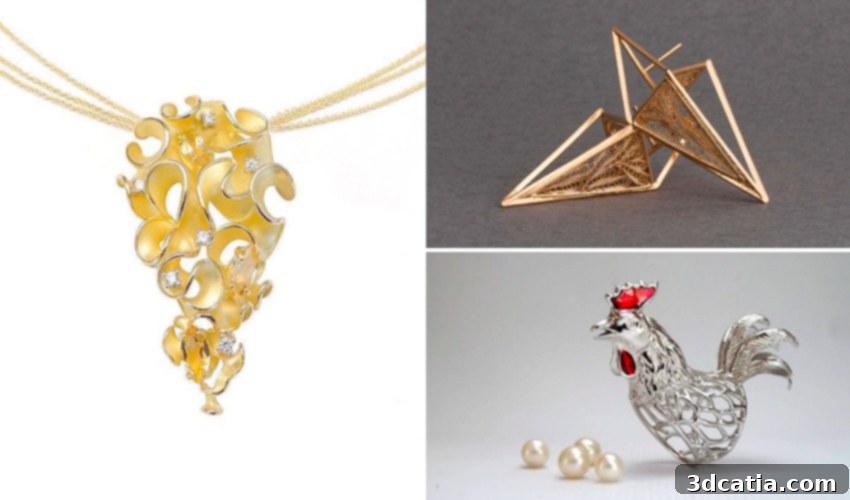
Different 3D printing technologies cater to specific needs within jewelry production. For instance, Stereolithography (SLA) is celebrated for its ability to produce highly detailed prototypes with smooth finishes, perfect for client visualization and design validation. On the other hand, advanced laser fusion techniques, such as Direct Metal Laser Sintering (DMLS), allow for the direct fabrication of finished metal parts, including those crafted from precious metals like gold, silver, and platinum. This technological breadth empowers jewelers and designers to push creative boundaries, experiment with novel forms, and streamline their production workflows. To fully grasp the immense potential of 3D technologies in this dynamic sector, let’s explore a selection of remarkable 3D printed jewelry pieces and the visionary companies behind them.
A World Record: The Ring with 7,801 Diamonds
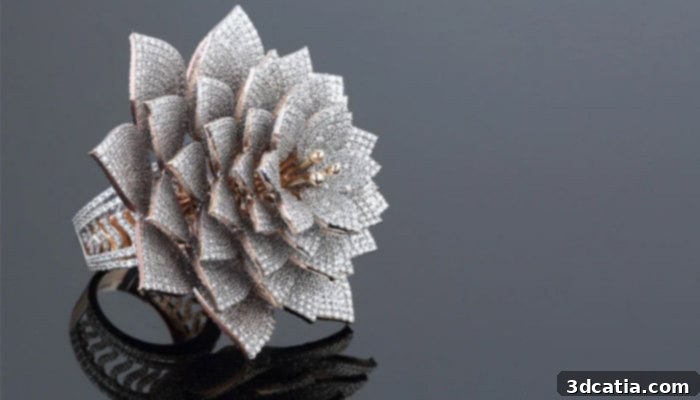
Our journey into the world of 3D printed jewelry begins with an extraordinary project that shattered a world record: a ring adorned with an astonishing 7,801 diamonds. While the sheer number of diamonds is certainly captivating, what truly highlights the power of additive manufacturing is its pivotal role in the creation of this unparalleled masterpiece. The acclaimed Indian service bureau, Imaginarium, was entrusted with bringing this intricate, flower-shaped ring to life. Their innovative approach involved 3D printing a highly detailed resin mold. This mold then served as the precise template for casting the precious metal, in this instance, gold.
It’s crucial to note that the ring itself wasn’t directly 3D printed in metal; rather, 3D printing was the indispensable enabler for its intricate design. Imaginarium emphasized that additive manufacturing was the sole method capable of producing a mold with such a complex structure, meticulously designed to incorporate thousands of individual diamonds. The ring’s design comprises seven distinct sections—six exquisite flowers and the ring band—with each floral element gracefully layered atop another. The ultimate outcome is a breathtaking ring that, with its 7,801 diamonds, is nothing short of a dazzling spectacle, showcasing how 3D printing facilitates designs previously deemed impossible by traditional methods.
Invaerso: Crafting Rings with Complex Geometries Through Rapid Prototyping
The Italian design house Invaerso stands as a prime example of how 3D printing can revolutionize jewelry development, particularly through its application in rapid prototyping. Recognized in 2020 for its innovative solutions, Invaerso leverages additive manufacturing to significantly accelerate its design and validation processes. By quickly producing physical prototypes, the company can efficiently test new product concepts, assess their wearability, aesthetic appeal, and structural integrity, and determine if any modifications are necessary. This agile approach drastically reduces the time and cost associated with traditional prototyping methods.
Maria Clelia Scuteri, the visionary designer behind Invaerso, highlights another key advantage: the ability of 3D printing to enable the creation of rings and other jewelry pieces with exceptionally complex geometries that would be exceedingly difficult, if not impossible, to achieve through conventional fabrication techniques. Furthermore, when seamlessly integrated with traditional craftsmanship, additive manufacturing serves to optimize and speed up overall production timelines, allowing Invaerso to bring intricate, cutting-edge designs to market more swiftly without compromising on quality or artistic vision.
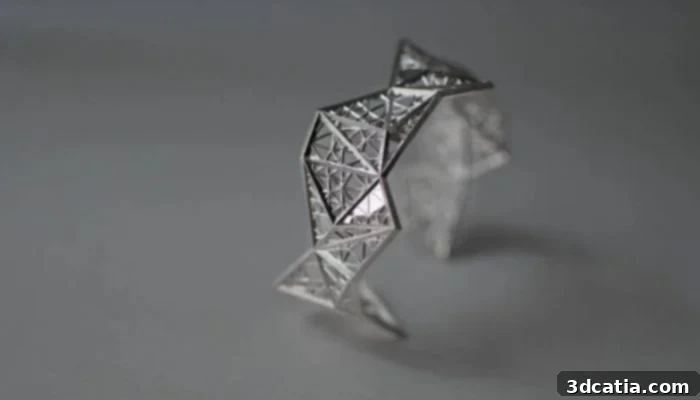
Photo Credits: Invaerso
Caroline Auraix: Harnessing SLS and Nylon for Luminous Jewelry
The embrace of additive manufacturing for enhancing production processes is also prominent in the French jewelry industry. Parisian artist Caroline Auraix exemplifies this trend, utilizing 3D technologies to effectively navigate and overcome the stringent time constraints prevalent in the sector. Her design workflow primarily centers around sophisticated 3D modeling software like Rhinoceros 3D, though she also creatively incorporates free modeling software. This flexible approach allows her to imbue her digital models with organic, “modeling clay” like effects, fostering a unique artistic expression in her designs.
Regarding the specific printing process, Caroline Auraix has found Selective Laser Sintering (SLS) to be the ideal technology for her intricate jewelry pieces. SLS offers exceptional design freedom and the ability to produce strong, lightweight parts with complex internal geometries. A significant portion of her creations are fabricated using nylon, a material chosen for its distinctive properties. When applied in very thin layers via SLS, nylon exhibits a fascinating translucency, allowing light to subtly pass through and create a luminous, ethereal effect within the jewelry. Beyond its aesthetic advantages, nylon’s inherent strength and remarkable lightness make it an eminently practical and desirable material for wearable art, ensuring durability without compromising comfort.
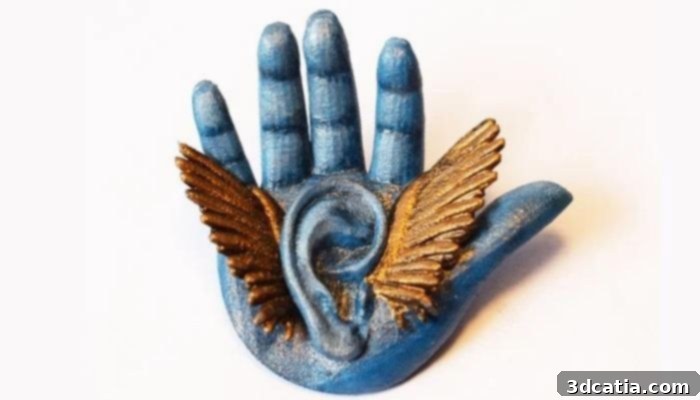
A brooch designed with 3D technologies. (photo credits: Caroline Auraix)
RADIAN: Pioneering Sustainable 3D Printed Jewelry and Home Goods
Stepping into the realm of sustainable innovation, Berlin-based label RADIAN distinguishes itself with its focus on environmentally conscious 3D printed jewelry and distinctive home goods. RADIAN’s design philosophy centers on creating jewelry that is straightforward yet features an artistic twist, resulting in pieces characterized by their intricate, edgy, and organic aesthetics. This unique vision is brought to fruition through the strategic application of 3D printing technologies, primarily Selective Laser Sintering (SLS) and binder jetting.
The brand offers three captivating collections for discerning buyers. The “Solitaire” collection emphasizes geometric and angular struts, showcasing modern architectural influences. The “Cubetwist” collection, as its name implies, ingeniously combines robust cubic patterns with graceful bends and twists, creating dynamic and visually engaging forms. Perhaps most imaginatively, the “Nefertiti” collection explores a fascinating hypothetical: what ancient Egyptians might create if they had access to 21st-century production methods, resulting in designs that blend historical grandeur with contemporary technology. RADIAN proudly champions 3D printing as a crucial element in their commitment to sustainability. By enabling local production and significantly reducing material waste compared to traditional manufacturing, additive manufacturing empowers RADIAN to minimize its environmental footprint while delivering truly innovative and responsible luxury.
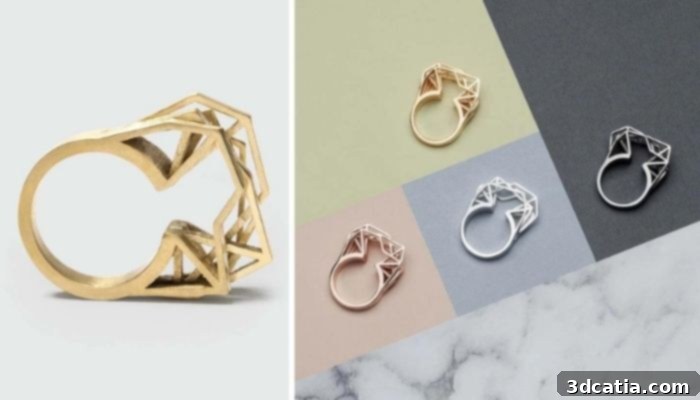
The Solitaire Ring from RADIAN’s collection (photo credits: RADIAN)
Elements Lab: Custom Jewelry and Mass Production via Additive Manufacturing
From Taiwan, ElementsLab emerges as a pioneering 3D printing service specializing in custom jewelry design and production. Founded by Ting Tang, the company possesses the advanced capabilities to create intricate silver and various metal alloy parts, and crucially, to scale this production to mass quantities. This ability to move beyond mere prototyping to efficient mass manufacturing of custom designs is a significant differentiator in the jewelry industry. Traditional metalworking methods, while steeped in history and craftsmanship, often face limitations in creating highly complex geometries efficiently or quickly adapting to intricate custom requests. Additive manufacturing at ElementsLab elegantly overcomes these challenges, enabling faster and more efficient creation of elaborate designs.
ElementsLab empowers its clientele to fully realize their creative visions, transforming conceptual ideas into bespoke, tangible pieces. While many 3D printed items might initially serve as prototypes, ElementsLab ensures that all its creations, whether one-off custom pieces or parts destined for mass production, adhere to rigorous durability standards and possess specific mechanical properties essential for high-quality jewelry. Each piece produced, therefore, carries a unique artistic signature and inherent meaning, blending cutting-edge technology with personalized expression.
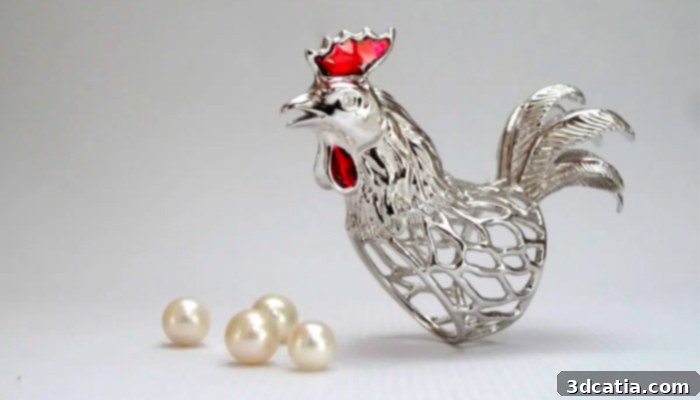
Photo Credits: Elements Lab
F-elia: The Art of 3D Printed Optical Jewelry
F-elia, an innovative young French company, is carving a distinctive niche in the market with its unique concept of ‘optical jewelry,’ made possible through the precision and design freedom of 3D printing. The company’s creations, primarily eyeglasses, are not merely functional items but highly original design statements. Each frame masterfully combines aesthetic appeal, featuring complex and unique shapes, with essential functionality, creating eyewear that truly stands out.
To achieve such sophisticated results, F-elia predominantly employs SLS (Selective Laser Sintering) technology. When it comes to materials, polyamide is their material of choice. This engineering plastic offers a superior combination of strength and flexibility, crucial for durable and comfortable eyewear. Furthermore, polyamide parts produced via SLS can achieve a remarkably smooth surface after appropriate post-processing stages, enhancing both the look and feel of the optical jewelry. Beyond eyeglasses, F-elia has expanded its product range to include complementary accessories such as magnifying glasses and stylish eyeglass necklaces, all bearing the hallmark of their original, 3D printed design ethos.
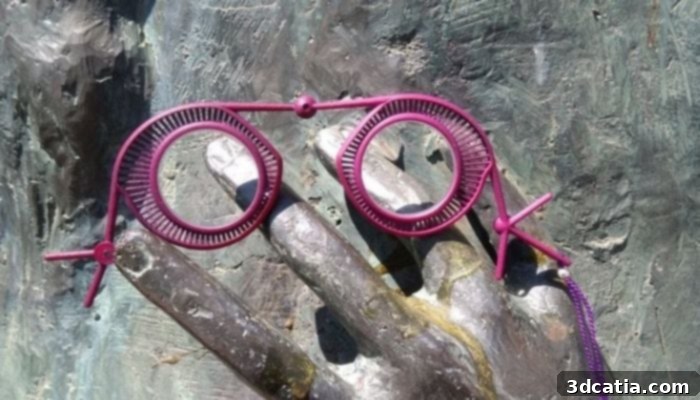
F-elia places an emphasis on originality with its 3D printed glasses (photo credits: F-elia)
Nuovi Gioielli: Merging Traditional Know-How with Additive Innovation
Established in 1985, Nuovi Gioielli embodies a profound commitment to heritage while fearlessly embracing innovation. This distinguished company offers jewelry that seamlessly fuses time-honored traditional craftsmanship with cutting-edge production methods. To craft its truly unique and exquisite pieces, Nuovi Gioielli intelligently integrates various manufacturing processes, prominently featuring 3D metal printing within its repertoire. The company works with a range of metals, with steel and bronze being common choices, and harbors ambitious goals of successfully 3D printing in precious metals like gold and platinum, pushing the boundaries of high-end jewelry production.
Like many forward-thinking entities in the industry, Nuovi Gioielli enthusiastically extols the benefits that 3D technologies bring to jewelry making, particularly highlighting the unprecedented design freedom they unlock. By thoughtfully combining the precision and versatility of new technologies with the rich legacy of traditional artisanal methods, Nuovi Gioielli creates pieces that are not only unique but also boundless in their creative expression. This synergistic approach allows them to honor their roots while simultaneously exploring uncharted territories of design, offering clients jewelry that is both deeply traditional and refreshingly contemporary.
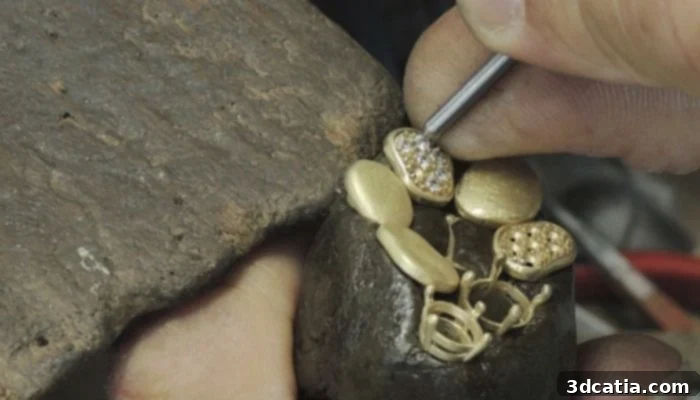
Photo Credits: Nuovi Gioielli
Nervous System: Algorithmic Design Meets Wearable Art
Nervous System, an American design studio, operates at the exciting intersection of art, science, and technology. They specialize in the creation of exceptionally complex and organic 3D printed objects, drawing profound inspiration from the intricate patterns and phenomena observed in nature. The studio employs sophisticated computer simulations and generative design algorithms to model these natural forms, translating them into wearable art such as bracelets, necklaces, and other unique jewelry items. This approach allows for the creation of designs that would be impossible to conceive or fabricate using traditional manual methods.
Once a digital 3D file is meticulously crafted and refined through their computational processes, it is then sent for 3D printing. The resulting physical objects are then offered to customers, each piece a testament to the seamless integration of algorithmic design and additive manufacturing. Nervous System’s creative output extends far beyond jewelry; their innovative methodology is also applied to design a diverse range of items, including sculptural cups and vases, avant-garde lamps, and other captivating sculptures, all embodying their distinctive aesthetic derived from biomimicry and computational artistry.
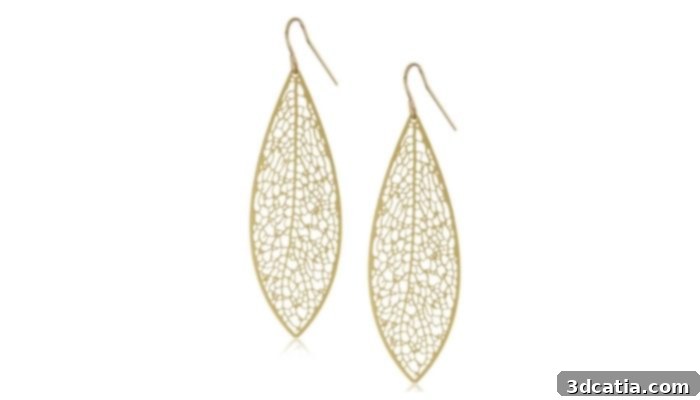
Photo Credits: Nervous System
Endswell Jewelry: Modern Minimalism in Solid Gold
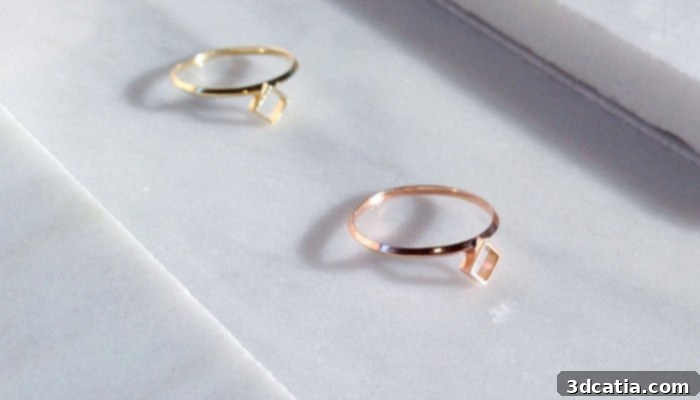
Rachel Gant and Andrew Deming, the creative minds behind Endswell Jewelry, have collaboratively embraced 3D printing to craft their distinctive line of solid gold rings. Their design philosophy centers on creating pieces that are both beautifully minimalist and profoundly meaningful, offering a refreshing alternative to conventional wedding rings. The inspiration for their unique designs stemmed from their personal journey as an unmarried couple, leading them to conceptualize jewelry that speaks to modern relationships and aesthetics. They utilize 3D printing technology to achieve the exceptional precision required for their clean, contemporary designs, ensuring every curve and angle is perfectly executed in solid gold. This allows them to explore unconventional forms and textures while maintaining the timeless elegance of precious metal, catering to individuals seeking understated yet impactful symbols of commitment.
Diana Law: Fashion-Forward 3D Printed Collections
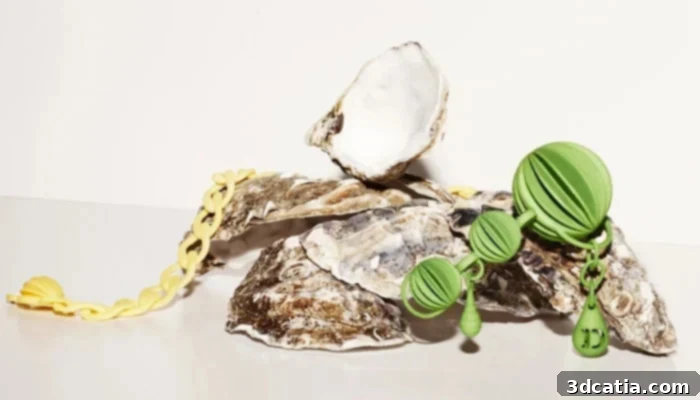
Diana Law, a visionary fashion and jewelry designer, honed her skills in France before a pivotal encounter with 3D printing ignited a new creative path. This transformative technology became the key to unlocking the stunning and intricate jewelry designs she had long envisioned. Her foray into additive manufacturing culminated in the release of her acclaimed collections, which prominently feature pieces crafted from durable plastics and elegant stainless steel. For her plastic jewelry, Diana Law employs selective laser sintering (SLS), a process that enables her to achieve exceptionally fine layers of nylon. This precision allows for the creation of lightweight yet robust pieces with intricate details and textures.
Inspired by the vibrant life around her, Diana Law’s work reflects a deep appreciation for organic forms and contemporary aesthetics. Beyond the artistic freedom, she is also a proponent of 3D printing due to its inherent environmental benefits. The ability to produce items on demand, with minimal material waste and localized production capabilities, aligns perfectly with a sustainable approach to fashion and luxury. Her collections exemplify how 3D printing can be a powerful tool for designers to merge artistic vision with ecological responsibility, producing stylish and conscience-driven adornments.
Ross Lovegrove’s Foliates: Sculptural 18K Gold Rings
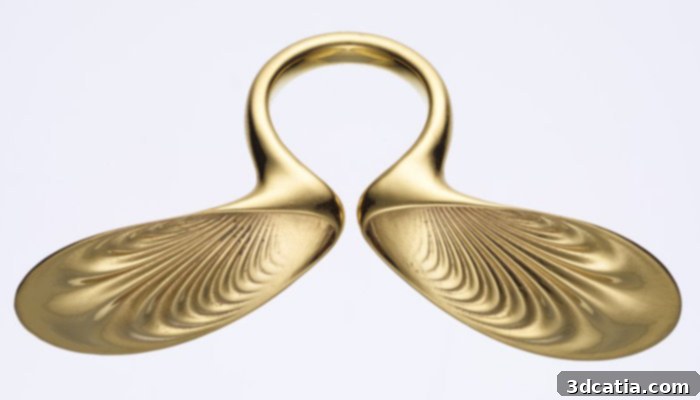
Renowned designer Ross Lovegrove has ventured into the realm of high-end 3D printed jewelry with his exquisite collection of rings, aptly named “Foliates.” This stunning collection comprises six unique ring designs, each meticulously crafted from luxurious 18K gold. To ensure their exclusivity and artistic integrity, each design is produced in a limited edition of only ten pieces. These captivating rings are brought to life through a sophisticated combination of advanced 3D printing techniques. Primarily, they are made using direct metal laser sintering (DMLS), a process that precisely fuses metallic powders into solid, intricate structures layer by layer.
Lovegrove’s approach also ingeniously combines 3D printing with traditional wax casting methods, leveraging the strengths of both. This hybrid technique allows for unparalleled freedom in creating the organic, fluid forms characteristic of the “Foliates” collection while ensuring the timeless quality and feel of solid gold. The result is a series of sculptural rings that are not just jewelry but miniature works of art, showcasing the extraordinary capabilities of integrating cutting-edge additive manufacturing with classic precious metal craftsmanship to achieve truly unique and valuable designs.
The Pjotr Spica Virginis: A Luxury 3D Printed Pen in Solid Gold
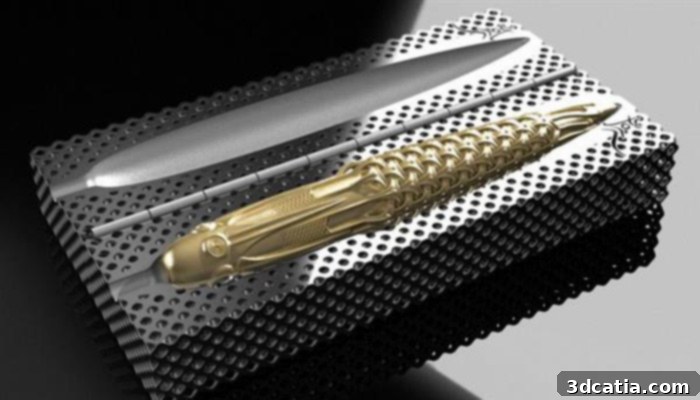
While not strictly a piece of jewelry, the Pjotr Spica Virginis pen serves as a magnificent testament to the capabilities of 3D printing in luxury accessory design, featuring precious materials and intricate craftsmanship akin to fine jewelry. Pjotr, under the masterful design guidance of Rein van der Mast, has unveiled a remarkable solid 18K gold 3D printed pen. This exquisite writing instrument, named Spica Virginis, represents the pinnacle of luxury and technical achievement in additive manufacturing.
The journey to this opulent version began with an equally luxurious titanium variant, which already set a high standard for elegance and precision. However, the introduction of the solid gold Spica Virginis elevates the concept of luxury to an entirely new echelon. The ability to 3D print an object of this complexity and material value highlights the advanced state of metal additive manufacturing, demonstrating that it can handle even the most demanding applications for high-net-worth consumers. Available for a price of €14,320, this pen is more than just a writing tool; it is a collector’s item, a symbol of status, and a fascinating example of how 3D printing is pushing boundaries in bespoke, high-value luxury goods.
The examples above clearly demonstrate that 3D printing is no longer a niche technology but a pivotal force transforming the jewelry industry. From record-breaking diamond rings to sustainable fashion statements and luxurious accessories, additive manufacturing empowers designers with unprecedented freedom, precision, and efficiency. It enables the creation of complex geometries, facilitates rapid prototyping, supports sustainable practices, and offers the versatility to work with a wide array of materials, from resins and nylons to precious metals like gold and platinum. As the technology continues to evolve, we can expect even more breathtaking innovations, further blurring the lines between traditional craftsmanship and digital fabrication, and making custom, intricate, and personal jewelry more accessible than ever before.
What are your thoughts on these incredible examples of 3D printed jewelry and accessories? We invite you to share your insights in the comments section below or connect with us on our LinkedIn, Facebook, and Twitter pages! For the latest updates and breaking news in the world of 3D printing, don’t forget to sign up for our free weekly Newsletter here, delivered straight to your inbox. You can also explore our extensive library of videos on our YouTube channel for more in-depth content.