
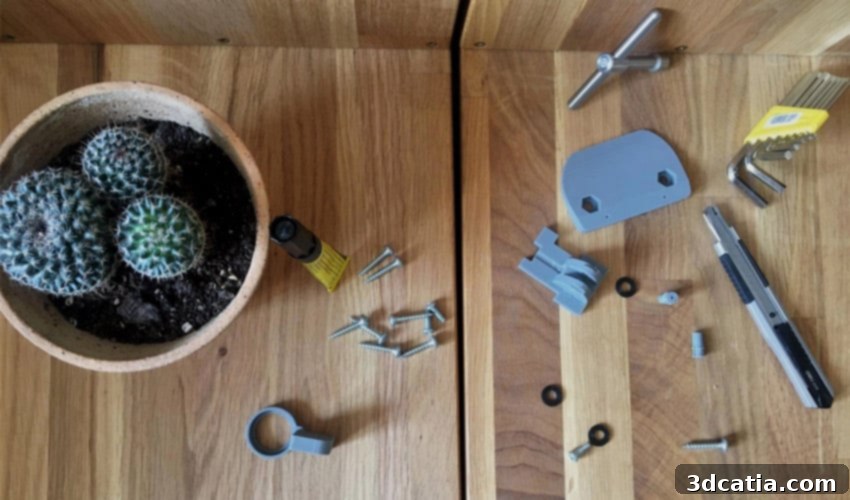
Marklix: Revolutionizing Spare Part Manufacturing and Fighting Obsolescence with On-Demand 3D Printing
In an era where sustainability and resource efficiency are paramount, the challenge of obtaining spare parts for everyday devices, from household appliances to vintage vehicles, often leads to unnecessary waste. Traditional manufacturing methods make many spare parts difficult, expensive, or time-consuming to acquire, especially for older models or niche items. This scarcity frequently pushes consumers to discard functional devices simply because a small, crucial component is missing or broken. The prohibitive costs associated with finding, manufacturing, and shipping these scarce parts, particularly evident in sectors like classic automotive repair, contribute significantly to this ‘throwaway’ culture. This is precisely the pervasive problem that Marklix aims to solve.
Marklix emerges as an innovative online platform leveraging the power of 3D printing (also known as additive manufacturing) to provide swift and cost-effective access to essential spare parts. By embracing this cutting-edge production method, Marklix, a dynamic startup, can efficiently produce small batches of components at significantly reduced costs. This approach not only facilitates local production but also opens up vast possibilities for creating an extensive catalog of spare parts across diverse categories, including household appliances, automotive components, and even specialized industrial parts. Marklix’s vision is to empower consumers and repair professionals to easily find and receive the exact part they need, fostering a culture of repair over replacement and actively contributing to the fight against planned obsolescence. To delve deeper into the platform’s innovative mechanics and ambitious goals, we recently had the opportunity to speak with Pierre-Jacques Lyon, a co-founder of Marklix.
3DN: Can you introduce yourself and your link with 3D printing?
My journey into the world of additive manufacturing and entrepreneurship began with a solid foundation in engineering. My name is Pierre-Jacques Lyon, and I am proud to be a co-founder of Marklix. My academic background is rooted in applied physics, a field that provided me with a rigorous analytical framework. I pursued my engineering studies at two distinguished institutions: the École Polytechnique de Montréal in Canada and the École Polytechnique Fédérale de Lausanne in Switzerland. These experiences were crucial in shaping my technical expertise and problem-solving abilities. Following my studies, I had the invaluable opportunity to complete my final year internship at the CEA in Cadarache, where I served as an R&D engineer. My work there focused on the advanced superconductor coils integral to the groundbreaking ITER fusion reactor project, an experience that honed my skills in cutting-edge technological development.

My initial encounter with a 3D printer profoundly influenced my career path, dating back to my time at Polytechnique Montréal. During our group design projects, 3D printing quickly became an indispensable tool. It significantly streamlined our design and prototyping processes, enabling us to rapidly iterate and visualize concepts. We utilized this technology for diverse applications, from crafting precision measuring tools to constructing sophisticated test benches. This hands-on experience revealed the transformative potential of 3D printing technology for rapid innovation.
Driven by an entrepreneurial spirit, even while still studying, I co-founded a company called D4print with a group of friends. Our initial ambition was to provide printing services using FDM (Fused Deposition Modeling) technology. This venture naturally led us down the path of designing and manufacturing our own FDM 3D printer, with the ultimate aspiration of bringing this innovative machine to market. Although the D4print project ultimately did not reach commercialization – primarily due to challenges related to securing sufficient capital and the varying commitment levels of the team to pursue full-time entrepreneurship – the lessons learned were immeasurable. This intense experience provided me with a comprehensive understanding of the additive manufacturing market, its key players, and the diverse range of underlying technologies. It was this deep immersion that later paved the way for the vision behind Marklix, demonstrating how 3D printing for spare parts could address a significant market need.
3DN: Why did you create Marklix?
The genesis of Marklix is directly rooted in the insights and challenges we encountered during the D4print venture. A critical observation from that period was the prevalent lack of public awareness and accessibility concerning 3D printing technology. Despite its immense potential, it remained largely a niche domain, difficult for the average consumer to engage with or even comprehend. Initially, our ambition was to leverage our collective expertise in 3D modeling to develop an extensive library of 3D files, acting as a crucial bridge between established manufacturer brands and individual users. The vision was to democratize access to 3D models for various applications.
However, as we progressed, a more profound realization emerged. We understood that on-demand 3D printing of spare parts held the potential for a truly transformative impact, particularly in the realm of device repair. This specific application resonated deeply with our desire to make a tangible difference. The ability to produce a specific part only when it’s needed, rather than mass-producing and stocking, represented a paradigm shift. It offered an elegant solution to the problem of scarcity and the environmental burden of discarded appliances.
This pivotal insight led us to refine our focus. We made a strategic decision to concentrate entirely on the repair sector, committing Marklix to actively participate in the global effort to combat planned and perceived obsolescence. By providing easily accessible and affordably manufactured 3D printed spare parts, we aim to extend the lifespan of countless products, from household gadgets to industrial machinery. Marklix is thus revolutionizing the system by making high-quality 3D printed solutions available to the broadest possible audience, transforming the way consumers approach product repair and sustainability. It was this confluence of successive ideas – from democratizing 3D files to focusing on sustainable repair – that ultimately brought Marklix to life, establishing it as a leading platform for additive manufacturing of replacement parts.
3DN: Can you explain how the platform works?
The name ‘Marklix’ itself is a clever amalgamation, signifying ‘Market,’ ‘Library,’ and ‘Exchange,’ which perfectly encapsulates the platform’s multifaceted approach. Essentially, Marklix.com functions as a dynamic online marketplace designed to forge vital connections within the additive manufacturing ecosystem. It seamlessly links 3D file designers – encompassing independent ‘Markers,’ established manufacturers, and industrial partners – with specialized 3D printing service providers. These providers, in turn, serve a diverse clientele: individual consumers and professional repair technicians who are actively seeking specific spare parts.
For the end consumer, navigating Marklix.com is designed to be as intuitive and user-friendly as popular e-commerce platforms like Amazon. Users can easily search for a required part by its part number or description, then proceed to order it directly from our extensive catalog. Recognizing that not every part can be immediately available, we’ve implemented an innovative program called ‘Ask for a Part.’ This unique service allows users to request components not yet featured in our growing database. The process is straightforward: customers complete a brief questionnaire detailing their needs, and if they possess the broken original, they can send it to us for expert reproduction. This bespoke service ensures that even rare or discontinued parts can be made accessible through custom 3D printing.
To uphold the highest standards of quality and efficiency, Marklix operates under stringent internal requirements. We prioritize a local production process, meaning that orders are automatically routed to a qualified 3D printing service provider situated in the customer’s country. This significantly reduces shipping times and environmental impact. Furthermore, our commitment to excellence dictates that we exclusively partner with industrial-grade service providers, ensuring that every Marklix part meets rigorous standards. Our network of ‘makers’ are all seasoned professionals in additive manufacturing.
To facilitate this complex network, we have developed a suite of sophisticated tools, including a dedicated ‘DashBoard’ administration area. This powerful interface enables our various stakeholders – 3D printing providers, designers, and professional makers – to interact seamlessly with the Marklix marketplace and our comprehensive management systems. This automation ensures efficient order processing, quality control, and streamlined communication. We are continuously investing in research and development, actively creating new tools to meticulously assess the feasibility of producing a wide array of parts through additive manufacturing, thereby constantly expanding the capabilities and offerings of the Marklix platform for on-demand spare parts.
3DN: What 3D technologies are used?
At Marklix, the selection of appropriate 3D printing technologies and materials is paramount to ensuring the quality, functionality, and longevity of the spare parts we provide. Our primary production partner in France is Silex3D, a highly reputable company located in the Rhône-Alpes region. Silex3D brings extensive experience and adheres to the most stringent industrial standards, guaranteeing precision and reliability in every printed component.
The predominant method employed for the vast majority of our parts is Selective Laser Sintering (SLS). This advanced additive manufacturing technique is particularly favored for its ability to produce highly durable, functional parts with excellent mechanical properties and intricate geometries. We primarily utilize PA12 (Nylon 12) powder, a versatile material renowned for its strength, chemical resistance, and flexibility, making it ideal for a wide range of replacement parts. These SLS parts are produced on state-of-the-art industrial printers, specifically EOS or HP Multi-Jet Fusion systems, known for their precision and high throughput capabilities.
While SLS forms the backbone of our production, Marklix also strategically incorporates other 3D printing methods to cater to specific part requirements. Some components are manufactured using Material Extrusion (FDM), which is often chosen for its cost-effectiveness, material variety, and suitability for parts that may not require the extreme precision of SLS but still demand robust physical properties. Additionally, for exceptionally detailed or aesthetically critical parts that require a smooth surface finish, we utilize Stereolithography (SLA). SLA is an ideal choice for creating parts with fine features and high accuracy, often used for prototypes or components where visual fidelity is crucial.
Our rigorous process involves meticulously associating each spare part reference with the most appropriate 3D printing technology and material. This decision-making process carefully considers the part’s intended application, its operational environment (e.g., exposure to heat, chemicals, stress), and its specific mode of use. This tailored approach ensures that every 3D printed spare part from Marklix not only fits perfectly but also performs optimally, meeting both the functional demands and our unwavering commitment to simplicity and uncompromising quality for the consumer. This meticulous selection underscores our dedication to providing reliable additive manufacturing solutions for every repair need.

Marklix uses EOS’ technology
3DN: What kind of spare parts do you offer?
The current Marklix catalogue boasts an impressive and continually expanding array of spare parts, designed to address a vast spectrum of repair needs. While we offer a diverse selection, there is a particular focus and high concentration on components for both small and large household appliances. This includes everything from obscure washing machine toggles and refrigerator shelf clips to vacuum cleaner attachments and coffee maker components – items that often render an entire appliance unusable when a single plastic part fails.
Beyond domestic utilities, our offerings extend to specialized parts for the automotive industry, encompassing components for vehicles that might be difficult to source through conventional channels, particularly for older or less common models. We also cater to the furniture industry, providing solutions for broken fixtures, connectors, or decorative elements that can revitalize beloved pieces of furniture. The ambition for Marklix is clear: to serve as a universal hub for repair, empowering every consumer to extend the life of their possessions rather than replacing them prematurely.
To achieve this goal, it is crucial for us to cover an exceptionally wide range of product categories. Our strategic focus is on identifying and providing solutions for parts that are known to break frequently across various devices. This data-driven approach ensures we meet the most pressing demands of our customer base. Furthermore, our innovative ‘Ask for a Part’ program plays a vital role in expanding this offering. This program directly empowers our customers to dictate their needs: if a specific replacement part isn’t yet in our database, they can request it, thereby actively shaping the future growth of our spare parts catalog and ensuring Marklix remains highly responsive to market demands for 3D printed repair solutions.
3DN: Why rely on 3D printing to produce spare parts?
The decision to heavily rely on 3D printing, or additive manufacturing, for the production of spare parts is fundamentally strategic, driven by a myriad of inherent advantages this technology offers over traditional manufacturing methods. One of the most significant benefits is the ability for on-demand manufacturing. This means parts are produced only when they are needed, eliminating the need for costly inventory, warehousing, and the associated risks of obsolescence for unsold stock. This lean production model translates into substantially constant and predictable costs per unit, regardless of batch size, making it economically viable to produce even a single, highly specialized part.
For small production runs, which are typical for many spare parts, 3D printing is an unparalleled production method. It offers remarkable agility, allowing for rapid iteration and customization without the need for expensive tooling or molds. This flexibility means we can quickly adapt to evolving demands and design specifications. Furthermore, the decentralized nature of 3D printing makes it exceptionally easy to deploy production capabilities across different geographical locations. This facilitates our commitment to local production, drastically reducing lead times and shipping costs, while simultaneously lowering the carbon footprint associated with long-distance transportation.
Beyond these logistical and economic benefits, additive manufacturing provides an extensive palette of materials and diverse technologies. This broad spectrum allows us to precisely match the material and production method to the specific functional requirements of each part. Whether a part needs to be rigid, flexible, heat-resistant, or chemically inert, there’s likely a 3D printing material and process (like SLS, FDM, or SLA) that can meet those demands. This versatility ensures that Marklix can manufacture a wide range of parts for vastly different uses, all while maintaining optimal performance and durability. In essence, 3D printing is not just a method; it’s a sustainable, efficient, and highly adaptable solution to the global challenge of spare parts availability and the fight against waste.

3DN: A last word for our readers?
We sincerely encourage all our readers to explore Marklix.com and discover how 3D printed spare parts can transform your approach to repair and sustainability. Your feedback is invaluable to us as we continue to grow and refine our platform. We are building a community dedicated to extending product lifespans and combating obsolescence, and your insights help us immensely.
For professionals within the additive manufacturing industry – including 3D file designers, material developers, or 3D printing service providers – we extend a special invitation. If you share our vision for a more sustainable future and believe your expertise or services could contribute to the Marklix ecosystem, please do not hesitate to contact us directly through our website. We are always eager to forge new partnerships that strengthen our network and expand our capabilities in delivering high-quality, on-demand spare parts globally. Join us in shaping the future of repair!
What do you think of Marklix? You can read about our last #3Dstartup HERE. Let us know in a comment below or on our Facebook and Twitter pages! Don’t forget to sign up for our free weekly Newsletter, with all the latest news in 3D printing delivered straight to your inbox!