
Transforming Biodiesel Waste: Pioneering Sustainable 3D Printing Materials with MONG
The global landscape is currently defined by rapidly escalating energy demands, propelled by relentless industrialization, burgeoning populations, and robust economic growth. This surge necessitates a critical shift towards renewable and sustainable energy sources, with biofuels like biodiesel, biogas, and bioethanol emerging as frontrunners in the race to mitigate the adverse effects of climate change, particularly the greenhouse gas effect. Biodiesel, in particular, is witnessing remarkable expansion, with production projected to increase by approximately 4.5% annually. While this growth signifies progress towards a greener future, it simultaneously introduces a significant challenge: the generation of substantial waste products. Among these are glycerol and a complex non-glycerol mixture often referred to as Matter Organic Non-Glycerol, or MONG. Historically, these byproducts have been relegated to landfills, posing considerable environmental burdens and undermining the sustainability goals of biofuel production.
Addressing this environmental conundrum is paramount for truly realizing the potential of renewable fuels. The imperative to minimize the carbon footprint associated with industrial processes, especially those integral to sustainable energy production, has driven extensive research into innovative alternatives to traditional waste disposal. One such promising avenue involves the valorization of MONG – transforming this challenging waste stream into high-value products. This approach not only diverts waste from landfills but also contributes to a more circular and sustainable economy. Simultaneously, the demand for eco-friendly solutions and bio-based materials within advanced manufacturing sectors, such as 3D printing (also known as additive manufacturing), is experiencing unprecedented growth. This convergence of challenges and opportunities positions MONG as a potentially revolutionary raw material, particularly its residual fatty acids, which could be harnessed for the production of sustainable 3D printing filaments. However, the consistent quality and specific properties of MONG remain a subject of ongoing investigation, as they can fluctuate significantly depending on the particular biodiesel production process and the original feedstock, such as soy or rapeseed.
The MONG Challenge: From Waste Byproduct to Sustainable Resource
Matter Organic Non-Glycerol (MONG) is more than just a byproduct; it’s a complex mixture that presents both environmental and technological challenges. Generated during the transesterification process of biodiesel production, MONG typically consists of unreacted triglycerides, diglycerides, monoglycerides, fatty acid methyl esters, free fatty acids, soaps, and other impurities. Its variable composition and viscous nature make it difficult to handle and process, traditionally leading to costly disposal in landfills or, in some cases, low-value applications like animal feed additives, though often with limited efficacy. Landfilling MONG not only consumes valuable space but can also contribute to soil and water contamination if not managed properly. The sheer volume of MONG produced globally alongside the rising biodiesel output underscores the urgent need for viable, large-scale valorization strategies that can transform this waste into a resource.
The burgeoning sector of 3D printing offers an exciting new frontier for MONG valorization. As industries worldwide increasingly adopt additive manufacturing for prototyping, custom fabrication, and even mass production, the environmental impact of conventional plastic filaments (often derived from fossil fuels) comes under scrutiny. This has spurred a significant push for the development of greener, bio-based alternatives. Imagine a future where the waste from biofuel production directly feeds into the creation of advanced, sustainable materials for 3D printing. The fatty acid content within MONG makes it a particularly interesting candidate for polymer synthesis, as fatty acids are fundamental building blocks for various bioplastics and composite materials. This concept perfectly aligns with the principles of a circular economy, where waste from one process becomes a valuable input for another, ultimately reducing reliance on virgin resources and minimizing environmental impact.

The surface structure and lump formation of MONG. (A) untreated, (B) acid-treated, and (C) acid- and peroxide-treated. (Photo Credits: University of Louisville)
Pioneering Research at the University of Louisville
Recognizing the immense potential of MONG and the pressing need for sustainable solutions, researchers at the University of Louisville have embarked on a groundbreaking project to thoroughly investigate the properties and potential applications of MONG. Their primary objective is to transform this industrial byproduct into a valuable resource, specifically exploring its utility as a copolymer and as a component in NFC (Natural Fiber Composite) filaments for 3D printing. This research is crucial because, in its raw form, MONG’s inconsistent nature and solid, often lumpy, texture make it largely unsuitable for advanced material processing techniques like filament extrusion, which demand highly consistent and flowable feedstock.
To address these challenges, the research team meticulously designed and implemented a series of pre-treatments aimed at enhancing MONG’s stability and processability. Their experimental framework involved analyzing MONG derived from soy biodiesel processing plants, evaluating it in three distinct states: untreated, acid-treated, and acid- and peroxide-treated. The untreated MONG presented significant handling difficulties; its inherent solid and often heterogeneous consistency rendered it impractical for integration into polymer blends destined for 3D printing applications. Such material characteristics would lead to clogged nozzles, inconsistent extrusion, and ultimately, failed prints.
However, the subsequent pre-treatments yielded highly promising results. The acid-treated MONG showed improved consistency, while the acid- and peroxide-treated MONG demonstrated a remarkable transformation. This specific dual treatment effectively stabilized the MONG, converting it into a more homogeneous, manageable paste. This transformation is pivotal, as a paste-like consistency is far more amenable to being mixed with thermoplastics and subsequently processed into a viable 3D printing material. The chemical modifications induced by these treatments likely alter the molecular structure of MONG’s components, making it more reactive, compatible, and stable when blended with other polymers, thereby unlocking its potential as a functional copolymer.
Key Findings and Future Applications
Further in-depth analysis into the surface composition and thermal properties of the treated MONG revealed critical insights into its enhanced suitability for advanced material applications. The MONG paste that underwent both acid and peroxide treatments exhibited significantly stronger lump formation and a more uniform surface structure. This improved morphology is a direct indicator of enhanced compatibility between MONG and the primary polymer matrix during the filament extrusion process. Optimal compatibility is crucial for preventing phase separation, ensuring uniform material distribution, and producing filaments with consistent mechanical properties and smooth extrusion behavior.
Moreover, the treated MONG demonstrated a substantial improvement in thermal stability. This is a vital characteristic for any material intended for 3D printing, especially for processes like Fused Deposition Modeling (FDM) or Fused Filament Fabrication (FFF), which involve heating the filament to its melting point. Materials with poor thermal stability tend to degrade, lose weight, or undergo undesirable chemical changes at elevated temperatures, leading to inconsistent extrusion, weak prints, and potentially hazardous fumes. The ability of treated MONG to exhibit less weight loss at higher temperatures means it can withstand the thermal stresses of extrusion without compromising its structural integrity or material properties. This enhanced thermal resistance positions the treated MONG paste as an exceptionally promising and viable substitute for conventional synthetic polymers in the formulation of natural fiber composites.
This innovative material holds immense potential for future applications in sustainable manufacturing. It could be seamlessly integrated into filament extrusion lines, either as a standalone bio-based component or, more likely, as a key additive in polymer blending. By acting as a copolymer, MONG can significantly reduce the proportion of synthetic, petroleum-derived polymers in bioplastics and natural fiber-reinforced composites. This not only lowers the overall carbon footprint of the final product but also diversifies the material supply chain, reducing reliance on finite fossil resources. The practical implications are far-reaching, enabling the creation of new, environmentally conscious materials for a wide array of 3D printing applications, from consumer goods to industrial components.
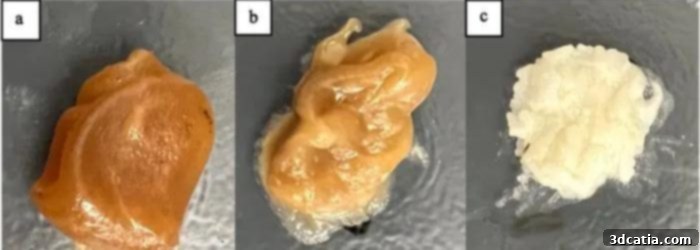
MONG samples. (A) untreated, (B) acid treated, and (C) acid + peroxide treated. (Photo Credits: University of Louisville)
Towards a Circular Economy: Broadening MONG’s Impact
The transformational potential of MONG extends far beyond its specific application in soy biodiesel waste. The research at the University of Louisville opens doors to the valorization of MONG derived from various other biomass sources and biofuel production processes. This includes, but is not limited to, MONG obtained from the production of biogas and bioethanol, and even from the vast quantities of used cooking oil, which represents another significant waste stream. This versatility underscores MONG’s potential as a universal component in a broader strategy for waste-to-resource conversion, creating a powerful synergy across different sectors of the bioeconomy.
As a versatile copolymer, MONG plays a crucial role in enhancing the sustainability credentials of natural fiber-reinforced plastics. By replacing a portion of synthetic polymers with a bio-derived waste material, MONG directly contributes to a more environmentally sound manufacturing process. This paradigm shift moves us closer to a genuine circular economy, where waste and residual materials from biofuel production are not discarded but are instead ingeniously repurposed into valuable, high-performance products. This not only reduces waste and minimizes pollution but also lessens the demand for virgin fossil-based plastics, thereby mitigating resource depletion and lowering greenhouse gas emissions throughout the product lifecycle.
The continued advancement of research into MONG’s properties and processing methods is vital. With sustained innovation and investment, MONG is poised to become a pivotal player in the evolution of sustainable production technology. Its ability to serve as a bridge between waste streams and high-tech applications like 3D printing represents a significant step towards achieving environmental stewardship while fostering economic growth. This groundbreaking work exemplifies how interdisciplinary research, combining chemical engineering, materials science, and advanced manufacturing, can unlock solutions that address some of the most pressing environmental challenges of our time. To delve deeper into the specifics of this project and its scientific underpinnings, interested readers are encouraged to click here for the detailed research publication.
What are your thoughts on the groundbreaking use of MONG in 3D printing? We invite you to share your perspectives in a comment below or join the conversation on our LinkedIn, Facebook, and Twitter pages! Don’t miss out on the latest advancements in additive manufacturing—sign up for our free weekly newsletter here to get the freshest 3D printing news delivered straight to your inbox! You can also explore all our insightful videos on our dedicated YouTube channel.
*All Photo Credits: University of Louisville