
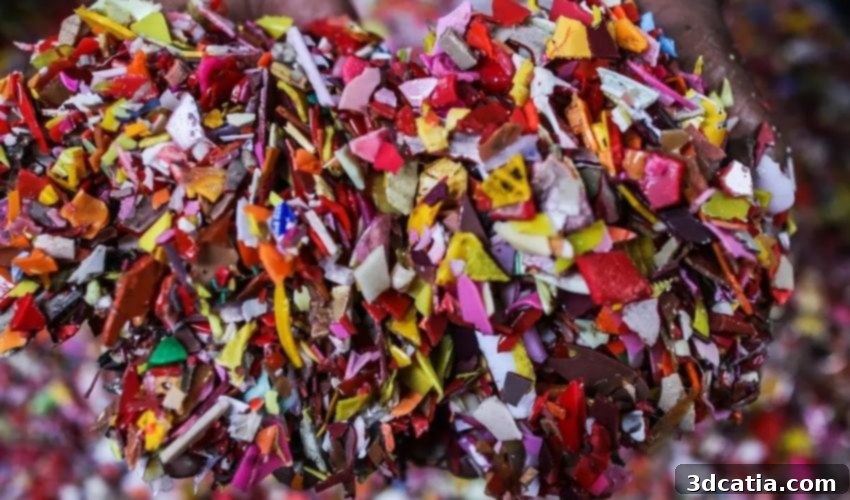
Revolutionizing Sustainable Plastics: University of Bath’s Breakthrough in Making PLA Truly Degradable
In a significant stride towards addressing the global plastic waste crisis, researchers at the University of Bath have unveiled a groundbreaking method to make Polylactic Acid (PLA), a widely used bioplastic, far more degradable. This innovative approach involves incorporating specific sugar units into the PLA polymers, enabling them to break down more easily when exposed to ultraviolet (UV) light. This development marks a crucial turning point, as companies worldwide increasingly focus on developing more recyclable and degradable plastics to mitigate environmental impact—a challenge that has gained considerable attention within the 3D printing community, where PLA is a staple material.
PLA, or polylactic acid, is a material derived from lactic acid, typically produced through the fermentation of sugars. Its origin from renewable resources often leads to its perception as a sustainable alternative to conventional plastics, which are made from fossil fuels. Consequently, PLA has found diverse applications across various industries, notably becoming a go-to filament for 3D printing due to its ease of use and accessibility. However, despite its green credentials, PLA is frequently and incorrectly labeled as universally biodegradable. The reality is more nuanced: while PLA can degrade under specific industrial composting conditions, requiring high temperatures and humidity, its decomposition in natural environments such as soil or seawater is severely limited. Dr. Antoine Buchard, a Royal University Society research fellow and polymer chemistry lecturer, elaborated on this critical distinction: “Lots of plastics are labelled as biodegradable, but unfortunately this is only true if you dispose of it in an industrial waste composter – if put into domestic compost heaps, it can last for years.” This misclassification has contributed to an ongoing environmental challenge, as consumers might unknowingly dispose of PLA in ways that do not facilitate its breakdown.
The Persistent Problem of Plastic Pollution and PLA’s Environmental Footprint
The global surge in plastic production and consumption has led to an unprecedented environmental crisis. Millions of tons of plastic waste accumulate in landfills, oceans, and natural ecosystems each year, posing severe threats to wildlife, human health, and planetary stability. In response, there has been a significant push to develop sustainable alternatives and enhance the end-of-life options for existing plastics. Bioplastics like PLA emerged as a promising solution, offering a reduced carbon footprint during production compared to petroleum-based plastics. Its widespread adoption in packaging, medical devices, and especially in the burgeoning field of additive manufacturing or 3D printing, underscored its potential. However, the misconception surrounding PLA’s biodegradability has undermined some of its intended environmental benefits. When PLA products are discarded into natural environments, they persist for extended periods, contributing to microplastic pollution and ecological disruption, much like traditional plastics. This dilemma highlighted the urgent need for innovations that could truly unlock PLA’s potential as a naturally degradable material, allowing it to fulfill its promise as a genuinely sustainable choice.
The University of Bath hopes the project will make plastics more degradable at the end of their life (photo credits: oilslo)
A Sweet Breakthrough: How Sugar Units Enhance PLA Degradation
Fortunately, a promising solution has now emerged from the Center for Sustainable and Circular Technologies (CSCT) at the University of Bath. Scientists there have engineered a method to make PLA materials degradable even under natural environmental conditions. The key to this innovation lies in the strategic incorporation of varying amounts of sugar molecules directly into the polymer structure. Dr. Antoine Buchard explained the underlying mechanism: the addition of these sugar units effectively introduces weak points within the PLA’s polymer chains. These weak points make the plastic more susceptible to hydrolysis, a chemical reaction with water that breaks down the material into smaller, more manageable fragments. This enhanced sensitivity to hydrolysis, particularly when combined with exposure to UV light—such as sunlight—significantly accelerates the degradation process. As a result, PLA treated with this new technology becomes genuinely biodegradable in diverse natural settings, including ocean environments or standard garden compost heaps, where temperatures and conditions are far less controlled than in industrial facilities.
The efficacy of this process is remarkably high. Researchers demonstrated that incorporating just three percent of these specialized sugar polymer units into PLA can lead to a substantial 40 percent degradation of the material within a mere six hours after exposure to UV light. This rapid degradation rate stands in stark contrast to conventional PLA, which would remain largely intact under similar conditions for extended periods. Beyond its environmental benefits, another critical advantage of this new technology is its compatibility with existing plastics manufacturing processes. This means the innovative sugar-modified PLA could be quickly adopted by the plastics industry without requiring significant overhauls of current production infrastructure, thereby lowering the barrier to entry for widespread implementation. The researchers are optimistic that their findings will pave the way for plastic waste to be degraded in a more efficient and environmentally responsible manner at the end of a product’s life cycle. Dr. Buchard articulated the broader vision: “This strategy remains to be translated to real-life plastics objects and tested with sunlight, but we hope our technology could be used in the future to make plastics that are strong when you’re using them, but can break down easily when reuse and recycling are not possible anymore.” This dual functionality—durability during use and rapid degradation post-use—is paramount for creating a truly circular economy for plastics.
Implications for 3D Printing and the Future of Sustainable Materials
For the 3D printing community, this research offers particularly exciting prospects. PLA is arguably the most common filament used in FDM (Fused Deposition Modeling) 3D printers, favored by hobbyists and professionals alike for its ease of printing, low warping, and wide availability. The ability to produce PLA objects that genuinely degrade in natural environments would significantly enhance the sustainability credentials of 3D printed parts. This could open doors for new applications, particularly in areas where plastic waste accumulation is a concern, such as temporary outdoor installations, educational models that might be discarded, or even specific medical applications where disposability is key. Beyond 3D printing, the implications extend to a vast array of consumer products, packaging materials, and agricultural films, all of which currently contribute to plastic pollution when not properly recycled or composted. Imagine food packaging that naturally breaks down if it accidentally ends up in the soil, or single-use items that leave a minimal environmental footprint.
This breakthrough also underscores the broader movement towards circular economy principles, aiming to design out waste and pollution, keep products and materials in use, and regenerate natural systems. By making PLA more susceptible to natural degradation, the University of Bath’s research contributes a vital piece to this complex puzzle. It highlights that true sustainability in materials science requires not only the use of renewable resources but also careful consideration of a product’s entire lifecycle, from creation to its eventual return to nature. While further research is needed to test these modified PLA materials under real-world sunlight conditions and in complex environmental matrices, the initial results are incredibly promising. It represents a significant leap forward in developing plastics that are both functional for modern needs and benign to the planet, offering a hopeful vision for a future where plastics can coexist with ecological health.

Photo Credits: University of Bath
Conclusion: A Greener Horizon for Polymer Science
The University of Bath’s pioneering research into enhancing the degradability of PLA through the incorporation of sugar units is a monumental step forward for sustainable materials science. By addressing the critical limitation of conventional PLA—its inability to easily degrade in natural environments—this innovation promises to transform how we approach plastic waste. It offers a tangible solution for a material widely used across industries, especially within 3D printing, ensuring that its environmental promise can finally be fully realized. As we move towards a future demanding greater ecological responsibility, such scientific advancements are not just desirable but essential. They empower us to create products that serve their purpose effectively during their lifespan but also gracefully return to the earth when their utility ends.
You can delve deeper into the specifics of this project by accessing the full research paper HERE. What are your thoughts on this exciting development in making PLA more degradable under natural conditions? Share your perspectives in a comment below or join the discussion on our LinkedIn, Facebook, and Twitter pages! Don’t miss out on the latest advancements in additive manufacturing—sign up for our free weekly Newsletter here to get all the cutting-edge 3D printing news delivered straight to your inbox. You can also explore our extensive library of videos on our dedicated YouTube channel.
*Cover Photo Credits: Dhiraj Singh