
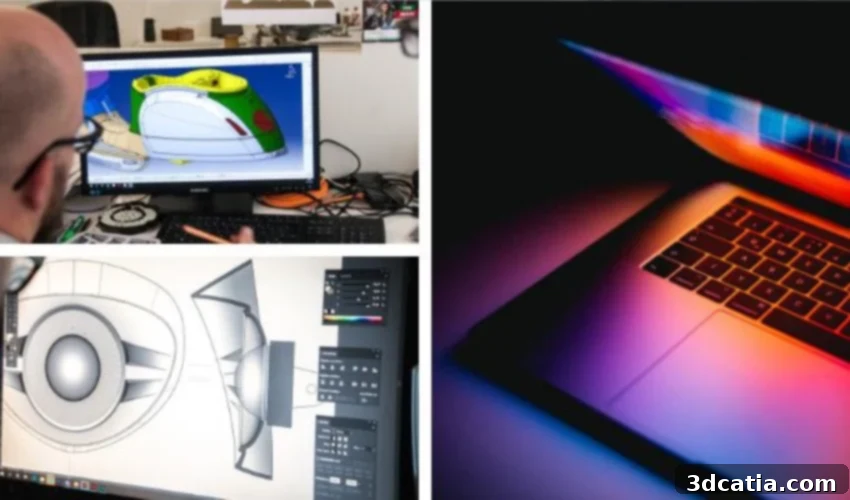
Best Computers for CAD Software: A Comprehensive Guide to Optimal Performance
Computer-Aided Design (CAD) is a fundamental technology that underpins modern design and engineering across a multitude of industries. From architecture and mechanical engineering to manufacturing, including advanced techniques like additive manufacturing, and even entertainment, CAD software is indispensable for creating, modifying, analyzing, and optimizing designs. These powerful CAD software applications can handle both intricate 2D drawings and complex 3D models, demanding significant computational resources to operate smoothly and efficiently. Understanding the intricate relationship between CAD software and computer hardware is crucial for any professional seeking to maximize productivity and design capabilities.
The efficacy and responsiveness of your CAD software are directly tied to the specifications of the computer it runs on. A high-performance workstation equipped with a rapid processor, ample Random Access Memory (RAM), a dedicated graphics card, and a Solid State Drive (SSD) will invariably outperform a system with a slower processor, limited memory, integrated graphics, and a traditional Hard Disk Drive (HDD). However, it’s important to note that the exact hardware requirements are also heavily influenced by the complexity and scale of the CAD models you intend to work with. A basic 2D schematic, for instance, requires considerably less processing power than a highly detailed, large-scale 3D assembly model or a complex architectural rendering. This guide aims to demystify the hardware selection process, helping you build or choose the ideal computer for your specific CAD workflows.

Some laptops offer enhanced performance, even on the move (photo credits: Dell)
In the following sections, we will delve into the critical hardware components that dictate CAD performance, providing actionable advice for choosing the right computer. We’ll then explore the recommended configurations for some of the most widely used CAD software applications today. Finally, we’ll offer insights into selecting a suitable CAD workstation, whether it’s a powerful desktop or a versatile laptop, to empower your design endeavors.
Tips for Choosing the Right Computer for CAD
Selecting the optimal computer for your CAD needs can feel like a labyrinth, given the myriad of technical specifications and diverse options available in the market. To simplify this crucial decision, here are several key considerations and tips to guide you toward a system that will elevate your CAD experience.
- Always Check the Specific System Requirements for Your CAD Software: Before committing to any hardware purchase, the absolute first step is to consult the official system requirements published by the developers of the CAD software you currently use or plan to implement. These requirements will outline the minimum and recommended specifications for components such as the processor (CPU), RAM, graphics card (GPU), storage space, and operating system. While minimum specifications might allow the software to run, they often result in sluggish performance and a less-than-ideal user experience, especially with more complex projects. For truly fluid and efficient operation, it is highly recommended to aim for or even exceed the *recommended* specifications. This provides a buffer for future software updates and larger project files, ensuring your investment remains relevant for longer.
- Ensure Operating System Compatibility with Your Chosen CAD Software: The operating system (OS) is the foundational software that manages all basic computer functions. While many modern CAD applications are designed to be cross-platform, offering compatibility with Windows, macOS, and Linux, some industry-standard software packages, such as SolidWorks, are exclusively available on a single OS (Windows, in this particular example). Therefore, it is paramount to verify that the operating system of your prospective computer is fully compatible with the specific CAD software you intend to use. This seemingly minor detail can prevent significant headaches and ensure that your software performs as expected.
- Opt for a Processor (CPU) with High Clock Speed and Multiple Cores: The Central Processing Unit (CPU) is often referred to as the “brain” of your computer, directly influencing how quickly and efficiently tasks are executed. For CAD applications, both clock speed and the number of cores are vital. Clock speed, typically measured in gigahertz (GHz), indicates how many instruction cycles the processor can complete per second, impacting single-threaded performance crucial for many CAD operations like modeling and design changes. The number of cores, or threads, dictates how many tasks the processor can handle simultaneously, which is beneficial for multi-threaded operations such as rendering, simulations, and complex computations. A powerful CAD workstation benefits immensely from a CPU that combines a high base and boost clock speed with a substantial number of cores (e.g., 6, 8, or more). This configuration ensures rapid processing, smooth navigation within large models, and the ability to multitask effectively without experiencing lags or crashes, making it indispensable for handling demanding design workflows. Leading manufacturers like Intel (Core i7, Core i9, Xeon) and AMD (Ryzen 7, Ryzen 9, Threadripper) offer excellent options tailored for professional applications.

Intel is one of the most popular CPU manufacturers (photo credits: Intel)
- Invest in High-Capacity, High-Speed Random Access Memory (RAM): RAM serves as your computer’s short-term memory, actively storing data and programs that are currently in use. For CAD professionals, sufficient RAM capacity is crucial to prevent bottlenecks, especially when working with large assemblies, complex simulations, or multiple applications simultaneously. Measured in gigabytes (GB), RAM capacity determines how much data your system can hold readily accessible for the CPU. A minimum of 16GB is often recommended for entry-level CAD work, but 32GB or even 64GB is preferable for advanced 3D modeling, rendering, and large project files. Beyond capacity, RAM speed (measured in megahertz, MHz) is also important as it dictates how quickly data can be transferred to and from the processor. Faster RAM can contribute to a more responsive system. High-capacity, high-speed RAM is essential for running CAD software efficiently, allowing for seamless multitasking and preventing slowdowns or crashes when juggling numerous design elements and software functionalities.
- Select a High-Performance Dedicated Graphics Card (GPU) with Ample Video Memory (VRAM): The Graphics Processing Unit (GPU) is the component responsible for rendering all visual elements on your screen. In CAD, a powerful dedicated graphics card is indispensable for smooth 3D model navigation, realistic rendering, and handling complex visual data without lag. Video Memory (VRAM), measured in gigabytes (GB), is the dedicated memory on the graphics card that stores graphical data and textures. The larger the VRAM, the more complex models and textures the GPU can manage efficiently. Performance, often indicated by teraflops (TFLOPS), denotes the speed at which the GPU can process graphics and visuals. For professional CAD applications, dedicated GPUs are categorized into consumer-grade (e.g., NVIDIA GeForce, AMD Radeon) and professional-grade (e.g., NVIDIA Quadro, AMD Radeon Pro). Professional cards are often optimized for CAD software, offering enhanced stability, certified drivers, and specialized features that consumer cards lack, making them a worthwhile investment for serious CAD users. A GPU with large VRAM (ee.g., 8GB, 12GB, or more) and high processing power will ensure high-quality graphics, fluid manipulation of 3D models, and artifact-free animations, even in the most demanding scenarios.

NVIDIA is one of the best-known graphics card manufacturers (photo credits: NVIDIA)
- Choose a Fast and Spacious Storage Drive, Preferably an SSD: Your computer’s long-term storage holds all your operating system files, installed software, and personal data, including CAD projects. The two main types are Hard Disk Drives (HDDs) and Solid State Drives (SSDs). While HDDs offer vast storage capacities at a lower cost, their mechanical nature makes them significantly slower. SSDs, which use flash memory, provide dramatically faster boot times, application loading, and file transfer speeds. For CAD, an SSD is no longer a luxury but a necessity. The speed of data transfer (measured in MB/s or GB/s) directly impacts how quickly you can open large CAD files, save projects, and load textures or libraries. For the best performance, look for NVMe SSDs (connected via PCIe) which are substantially faster than SATA SSDs. In terms of capacity, aim for at least 500GB for the operating system and essential software, with 1TB or more being ideal to comfortably store numerous CAD projects and related files. Combining a smaller, ultra-fast NVMe SSD for your OS and CAD software with a larger, slower HDD for archival storage can be a cost-effective solution for those needing extensive storage. A fast and spacious storage drive ensures quick access to your CAD files and programs, significantly reducing waiting times and enhancing overall productivity.
Popular CAD Software in 2024 and Their Hardware Needs
The CAD market is rich with diverse software solutions, each offering unique features, advantages, and target applications. Your choice of software will heavily influence the specific hardware configuration you require. Below, we highlight some of today’s most popular CAD programs and their general recommended system configurations, helping you align your hardware choices with your software ecosystem.
AutoCAD
AutoCAD, developed by Autodesk, stands as one of the oldest and most widely adopted CAD programs globally. Renowned for its comprehensive suite of tools, it excels in both 2D drafting and detailed 3D design. AutoCAD is compatible with Windows and macOS and offers specialized toolsets catering to diverse fields such as architecture, mechanical design, electrical engineering, and civil engineering. Its versatility makes it a staple in many design offices. As a subscription-based software, it is currently priced around $1975/year for a single user license.
While AutoCAD can run on moderate systems, complex drawings, and 3D modeling will benefit greatly from a fast CPU (high clock speed), 16GB+ RAM, and a dedicated mid-range GPU. For detailed system requirements, you can refer to the official Autodesk documentation.
Learn the recommended system requirements for running AutoCAD.
Blender
Blender is an incredibly powerful open-source, donation-based CAD software, making it accessible without a fixed price tag. Primarily recognized for its robust 3D modeling, sculpting, animation, and rendering capabilities, it is developed by the Blender Foundation. Blender boasts a rich and flexible set of tools for creating and editing sophisticated 3D designs. Its multi-platform compatibility extends to Windows, macOS, and Linux, offering designers broad flexibility. Beyond its core modeling functions, Blender integrates features like texturing, rendering, video editing, and motion tracking, making it a comprehensive solution ideal for a vast array of industries, from product design to visual effects and game development.
Due to its advanced rendering and animation capabilities, Blender benefits immensely from a powerful multi-core CPU, generous RAM (32GB+ for complex scenes), and especially a high-end dedicated GPU with ample VRAM, as GPU rendering is a core strength. The faster your GPU, the quicker your renders will complete.
Learn the recommended system requirements for running Blender.
Rhinoceros3D
Rhinoceros3D, commonly known as Rhino, is a versatile 3D CAD software developed by Robert McNeel & Associates. It is particularly celebrated for its unparalleled free-form geometric modeling capabilities, allowing designers to create highly complex and organic shapes with precision. Beyond its core NURBS modeling (Non-Uniform Rational B-Splines) functions, Rhino also provides features for rendering, analysis, and visualization. This powerful and adaptable software finds extensive application across various fields, including architecture, industrial design, engineering, jewelry design, sculpture, and graphic design. Rhino is a payware product, available for a perpetual license fee, currently around $995, making it a cost-effective long-term solution.
Rhino generally relies more on CPU clock speed for modeling, but benefits from a capable dedicated GPU for smooth viewport performance and rendering. 16GB of RAM is a good starting point, with 32GB recommended for larger projects.
Learn the recommended system requirements for running Rhinoceros3D.
Siemens NX
Siemens NX is a leading 3D CAD software developed by Siemens Digital Industries Software, primarily geared towards the design, simulation, and manufacturing of complex industrial products. As a robust and comprehensive software suite, NX offers an extensive array of features for 3D model creation, advanced product analysis, detailed simulation, and integrated manufacturing solutions. It is a powerful tool widely used in aerospace, automotive, heavy machinery, and consumer goods industries. Siemens NX operates on a pay-as-you-go licensing model, with pricing typically available upon direct inquiry, reflecting its enterprise-grade capabilities and support.
Given its focus on industrial design, simulation, and manufacturing, Siemens NX is highly resource-intensive. It demands a professional-grade dedicated GPU (NVIDIA Quadro or AMD Radeon Pro), a high-performance multi-core CPU, and a significant amount of RAM (32GB+ is common, 64GB+ for very large assemblies and simulations).
Learn the recommended system requirements for running Siemens NX.
SolidWorks
SolidWorks is another immensely popular CAD program, specifically renowned for its focus on intuitive 3D modeling and powerful simulation capabilities. Developed by Dassault Systèmes, it provides an accessible interface coupled with advanced features for creating, testing, and validating 3D designs. SolidWorks is exclusively compatible with the Windows operating system, a crucial consideration for potential users. The software also offers a modular approach with specialized add-ons for various applications, including sheet metal design, welding, mold design, and animation, making it a comprehensive tool for product development. SolidWorks operates on a license-based model, with pricing available upon request, catering primarily to mechanical engineers, product designers, and manufacturing professionals.
SolidWorks requires a strong CPU with good single-core performance, ample RAM (16GB minimum, 32GB recommended), and a certified professional graphics card for optimal stability and performance, especially with large assemblies and complex simulations. Dassault Systèmes doesn’t provide minimum system requirements in the traditional sense, but they do offer a valuable resource:
Dassault Systèmes doesn’t give minimum system requirements, but they have compiled a list of computers that have been tested and certified to use their software.
Choosing Your CAD Workstation: Desktop or Laptop?
Having explored the critical hardware components and specific software requirements, the final decision often boils down to choosing between a desktop workstation or a portable laptop. While the advice and system requirements provided offer a strong foundation, the computer market is dynamic, with new models and technologies emerging constantly. Therefore, making specific, long-term model recommendations is challenging. Instead, we empower you to combine our general recommendations with the precise needs of your chosen CAD software to make the best decision for your specific workflow.
Desktop Workstations typically offer superior performance for the price, better upgradeability, more extensive cooling solutions (allowing components to run at peak performance for longer), and a wider range of configuration options. They are ideal for users who primarily work from a fixed location and require maximum processing power for complex models, simulations, and rendering tasks.
CAD Laptops provide the invaluable advantage of portability, allowing you to design and work from anywhere. Modern mobile workstations are remarkably powerful, often featuring high-end CPUs and dedicated GPUs. However, they generally come with a higher price tag for equivalent performance compared to desktops, have limited upgradeability, and can be constrained by thermal management, which might lead to performance throttling during sustained heavy workloads.
For beginners or those who might feel overwhelmed by the myriad parameters involved in PC selection, we can nevertheless suggest a few reputable computer lines that are consistently updated and offer excellent starting points for CAD professionals:
- Dell XPS line: Known for its premium build quality and strong performance, particularly the higher-end models.
- Apple MacBook Pro: An excellent choice for users in the Apple ecosystem, but it’s crucial to verify that your chosen CAD software is compatible with ARM processors and macOS.
- Lenovo ThinkPad P-series or X1 series: These lines are celebrated for their robust construction, professional features, and reliable performance, often favored by engineers.
- HP EliteBook and ZBook series: Offering powerful components and enterprise-grade reliability, these are strong contenders for professional CAD users.
Remember, the key is to match the recommended specifications of your primary CAD software with the capabilities of these reputable brands, ensuring a powerful and stable platform for your design work.
What are your thoughts on these computer selection tips? Which hardware parameter do you believe is the most critical when choosing a CAD workstation? Share your insights in a comment below or connect with us on our LinkedIn, Facebook, and Twitter pages! Don’t forget to sign up for our free weekly Newsletter here to get the latest 3D printing news delivered straight to your inbox! You can also find all our videos on our YouTube channel.