
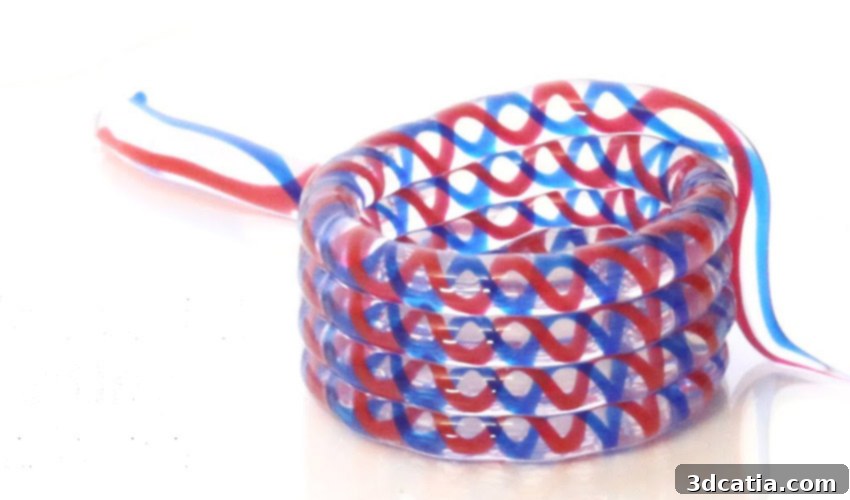
Unlocking Nature’s Secrets: Harvard’s Bio-Inspired Rotational Multimaterial 3D Printing Revolutionizes Additive Manufacturing
A groundbreaking innovation from the Harvard John A. Paulson School of Engineering and Applied Sciences, in collaboration with the Wyss Institute for Biologically Inspired Engineering at Harvard University, is poised to redefine the landscape of additive manufacturing. Researchers have unveiled a novel 3D printing method that draws profound inspiration from the intricate and highly efficient helical structures pervasive throughout the natural world, particularly within plants. This cutting-edge approach introduces a sophisticated 3D printer capable of fabricating complex structures using four distinct materials, all facilitated by a unique rotating nozzle that precisely deposits a helical filament. The early results are nothing short of remarkable, with the team successfully printing structures exhibiting varying degrees of stiffness – a capability that promises transformative applications, especially within the burgeoning field of soft robotics.
Humanity’s reliance on nature’s elegant designs as a wellspring of innovation is a timeless practice, and the realm of 3D printing is no exception. The concept of biomimicry, which involves emulating biological forms and processes, is a frequently discussed and increasingly applied principle in additive manufacturing. Numerous projects worldwide are actively engaged in imitating the remarkably efficient and robust structures found in our environment. A classic example is the replication of lattice structures, renowned for their strength-to-weight ratio, inspired by the hexagonal patterns observed in beehives. However, this particular Harvard project ventures deeper, focusing on the fundamental helical shapes that are intrinsic to virtually all biological systems. From the growth patterns of climbing plants to the intricate arrangements within our own muscles and the very double helix of our DNA, nature consistently employs this coiled geometry for strength, flexibility, and controlled motion. Indeed, it is the self-assembly of our proteins into these helix shapes that enables muscle contraction – a fundamental biological mechanism. The ability to engineer structures that can mimic such dynamic properties, particularly contraction, through the intrinsic characteristics of materials, represents a significant stride forward. This is precisely the frontier that these pioneering Harvard researchers are exploring with their new technology.
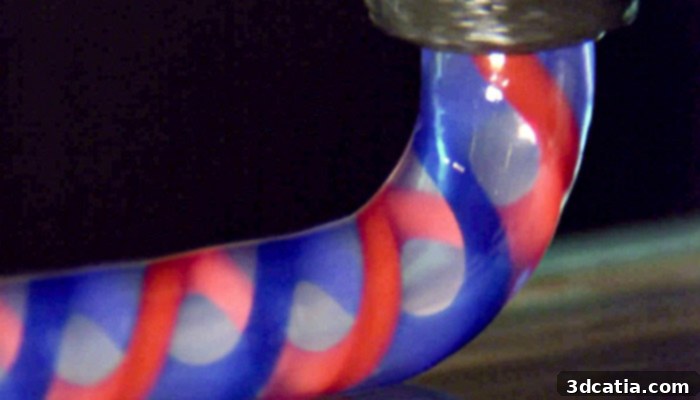
The helical shape is integrated into the deposited filament (photo credits: Harvard John A. Paulson School of Engineering and Applied Sciences)
The Ingenious Mechanism Behind Rotational Multimaterial 3D Printing
The innovative additive manufacturing solution conceived by the Harvard team operates on a principle that, while conceptually simple, required immense engineering ingenuity to realize. At its core, the system utilizes four distinct “ink” cartridges, which bear a resemblance to large, precision-controlled syringes. These cartridges house different materials, each chosen for specific properties such as flexibility, rigidity, or conductivity. The true marvel of the system lies in how these materials are processed: they are all fed into a highly complex, custom-designed rotating nozzle. As this nozzle moves across the printing platform, depositing material layer by layer, its rotational motion simultaneously imparts a helical twist to the extruded filament. This isn’t just a surface-level aesthetic; the helical properties are deeply integrated into the material’s internal architecture, fundamentally altering its mechanical response. Natalie Larson, a key author of the seminal study, elaborates on this precision, stating, “Rotational multimaterial printing allows us to generate functional helical filaments and structural lattices with precisely controlled architecture and, ultimately, performance.” This statement underscores the profound level of control the researchers have achieved over both the macro and micro-structure of their printed objects, opening up unprecedented possibilities for material design and functionality. The ability to integrate multiple materials and impart a specific internal geometry in a single printing step marks a significant leap from conventional 3D printing methods, which typically struggle with material transitions and complex internal structuring.
Transformative Applications and Future Prospects in Robotics and Beyond
The immediate and most exciting applications of this innovative rotational multimaterial 3D printing technology lie in the development of advanced robotic systems, particularly soft robotics. The researchers have demonstrated the ability to print structures that can precisely contract when subjected to an applied voltage. This programmable contraction is not a fixed property but can be carefully tuned according to the desired contractile response of the actuator filaments. Imagine soft robots that can delicately grasp fragile objects, or medical devices that can navigate complex anatomical pathways with unprecedented agility. This technology provides a pathway to creating highly responsive and adaptable robotic components that could revolutionize fields from healthcare to manufacturing.
Beyond programmable movement, the Harvard team has also showcased the ability to manipulate the rigidity of 3D printed structures with remarkable precision. Their approach allows for the creation of a flexible base matrix within which adjustable rigid inks can be strategically embedded. This concept can be visualized as a soft mattress containing finely tuned metal springs – the overall structure is pliable, but specific areas can be made to provide robust support or structural integrity where needed. This capacity is incredibly valuable for designing intricate mechanical components like hinges within soft robots, which require both flexibility for movement and sufficient rigidity for structural stability. Traditional soft robots often face challenges in achieving localized stiffness variations without compromising overall compliance. This new method elegantly solves that problem, enabling the fabrication of components with spatially varying mechanical properties, tailored precisely to functional requirements. This could lead to more durable, versatile, and safer soft robotic systems that can interact with dynamic environments more effectively.
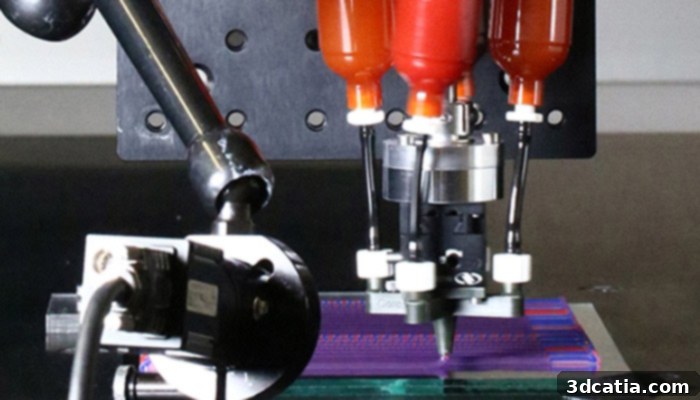
The 3D printing platform includes 4 cartridges (photo credits: Harvard John A. Paulson School of Engineering and Applied Sciences)
This research, while already demonstrating impressive capabilities, is still in its nascent stages, hinting at an expansive field of possibilities yet to be explored. The potential implications extend far beyond robotics, touching upon areas such as biomedical engineering for custom implants or tissue scaffolds, aerospace for lightweight and high-performance composite materials, and even consumer product design for customizable, adaptable items. Natalie Larson further emphasizes the future trajectory of this work, concluding, “By designing and building nozzles with more extreme internal features, the resolution, complexity, and performance of these hierarchical bioinspired structures could be further enhanced.” This vision suggests a future where 3D printers can produce materials with unprecedented micro-architectural control, leading to materials with properties that are currently unimaginable. Imagine materials that can self-repair, adapt to environmental changes, or even generate energy. The next developments from this team are eagerly anticipated, promising to push the boundaries of what is achievable through additive manufacturing.
While the technology holds immense promise, it is also important to consider the ongoing research challenges. These might include optimizing material compatibility between the four different “inks,” increasing printing speed for industrial scalability, and developing methods for even finer control over the helical geometry at the micro-scale. The economic implications are also a consideration, as the development of advanced materials and specialized printing hardware can be costly. However, as with many pioneering technologies, initial challenges are often overcome through continued research and development, leading to more accessible and widespread applications.
The Harvard team’s work serves as a powerful reminder of nature’s endless capacity to inspire technological breakthroughs. By dissecting the fundamental principles of biological design and ingeniously translating them into engineering solutions, they are not just creating new materials; they are forging a new paradigm for how we conceive and construct the physical world around us. This bio-inspired approach to additive manufacturing is a testament to the synergy between biology and engineering, a partnership that holds the key to solving some of humanity’s most pressing challenges. For more in-depth information about this fascinating research, you can find further details HERE.
What are your thoughts on this revolutionary rotational multimaterial 3D printing process and its potential to mimic nature’s most efficient designs? We invite you to share your perspectives in a comment below or join the conversation on our LinkedIn, Facebook, and Twitter pages! Don’t forget to sign up for our free weekly Newsletter here for the latest 3D printing news delivered straight to your inbox! You can also explore all our compelling videos on our YouTube channel, where innovation comes to life.
*Cover Photo Credits: Harvard John A. Paulson School of Engineering and Applied Sciences