
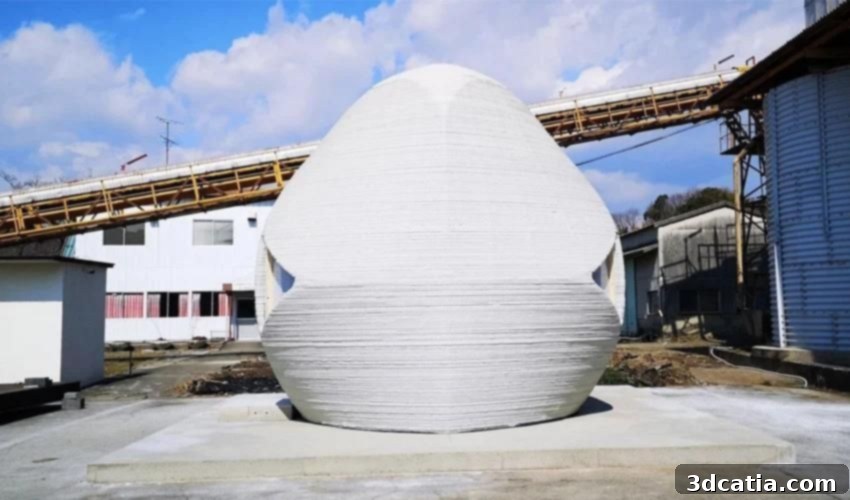
Revolutionizing Rapid Construction: Serendix’s Sub-$25,500 3D Printed Spherical Home Unveiled
In an astounding leap for architectural innovation and construction technology, the Japanese company Serendix has transformed what once seemed like science fiction into tangible reality. Imagine a house, fully constructed and functional, in less than 24 hours and for an astonishingly low price point of under $25,500. This seemingly impossible feat was not merely a challenge but a triumphant achievement for Serendix, which successfully 3D printed a small, spherical concrete structure in precisely 23 hours and 12 minutes. This breakthrough marks a significant milestone in the quest for affordable, rapid, and resilient housing solutions, particularly vital in regions prone to natural disasters.
Serendix’s journey to this remarkable accomplishment began years ago. The company first showcased a prototype in 2015, a design that garnered international recognition by securing first place in NASA’s prestigious 3D Printed Habitat Challenge. This early success underscored the immense potential of their vision. Fast forward to today, Serendix has meticulously refined its approach, culminating in this weather-resistant, 20-ton concrete sphere. Despite its modest footprint, encompassing a surface area of just 10 square meters, the architect behind the innovative concept envisioned this structure as a transportable solution, perfectly suited to address critical emergency housing needs with unparalleled speed and efficiency.
The Transformative Promise of 3D Printing in Construction
The allure of 3D printing within the construction industry captivates innovators and developers worldwide. Industry players are increasingly investing in this technology, drawn by its capacity to create complex geometries, dramatically slash construction lead times, and significantly reduce labor intensity. These advantages promise to reshape traditional building paradigms, offering solutions that are not only faster and more economical but also potentially more sustainable. However, the rapid evolution of this sector often makes it challenging to discern true innovation from mere hype. A pertinent question arises: can we genuinely depend on 3D technologies to construct our future homes, or is it primarily a “wow effect” rather than a sustainable, long-term solution?
While skepticism naturally accompanies such disruptive technologies, numerous machine manufacturers and construction startups are demonstrating robust growth and revealing a continuous stream of groundbreaking projects. A prime example is the American company ICON, a leader in large-scale additive manufacturing for construction. ICON’s impressive trajectory is highlighted by its ability to raise $207 million in funding just last year, signaling strong investor confidence and market validation. On the Asian continent, the construction landscape is equally dynamic, with firms like Serendix driving significant advancements and showcasing the practical applications of 3D printing in real-world scenarios.
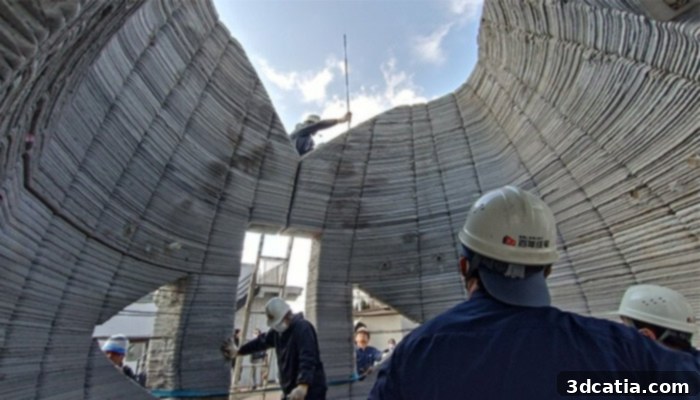
Layer by layer, the concrete was meticulously deposited to form the resilient walls of this innovative spherical structure (photo credits: Serendix)
The Genesis of a Resilient Design: Serendix’s Spherical Concept
The conceptualization of this groundbreaking 3D printed sphere officially took shape in 2020 when Serendix filed patents for the innovative design. At its core, the idea was to develop a frameless housing solution that could be built with exceptional speed and remain highly accessible in terms of cost. Crucially, given Japan’s geographical vulnerability, the structure was engineered to withstand the severe impacts of earthquakes and typhoons, which are alarmingly frequent and intense in the region. The primary strategic objective was clear: to provide immediate, robust, and deployable emergency housing during times of crisis, offering a lifeline to communities affected by natural disasters.
Two years of dedicated research, development, and iterative refinement culminated in a monumental achievement. Serendix proudly unveiled its 3D printed construction, a pioneering accomplishment that marked it as the very first such structure to be realized in Japan. This event was not just a company milestone but a national triumph, demonstrating the country’s commitment to leveraging advanced technologies for societal benefit and setting a new precedent for rapid, resilient housing development in a seismically active nation.
Understanding the Serendix Spherical Dwelling: Design and Compliance
It is essential to clarify that the Serendix spherical dwelling, while revolutionary, is not intended as a conventional, multi-room family home in the traditional sense. Its unique interior structure spans an efficient 10 square meters, featuring a robust 20-ton concrete frame. This compact size plays a critical role in its rapid deployment capabilities and regulatory compliance. Due to its specific dimensions and design, this small area allows the structure to bypass certain stringent Japanese building regulations that typically apply to larger residential properties, thereby streamlining the approval and construction processes. This strategic approach enables Serendix to deliver functional housing solutions with unprecedented speed.
The structural integrity and safety of the sphere are paramount, especially given its intended use in disaster-prone areas. The walls of the dwelling are ingeniously reinforced with internal ribs. These ribs serve a dual purpose: they enhance the thermal insulation properties of the sphere, ensuring a more comfortable interior environment, and, more critically, they significantly boost its seismic performance. This meticulous engineering ensures that the structure not only meets but often exceeds the rigorous seismic standards mandated by Japan, providing critical safety and peace of mind for its occupants during emergencies. The spherical shape itself inherently offers superior structural stability against external forces, further enhancing its resilience against high winds and ground tremors.
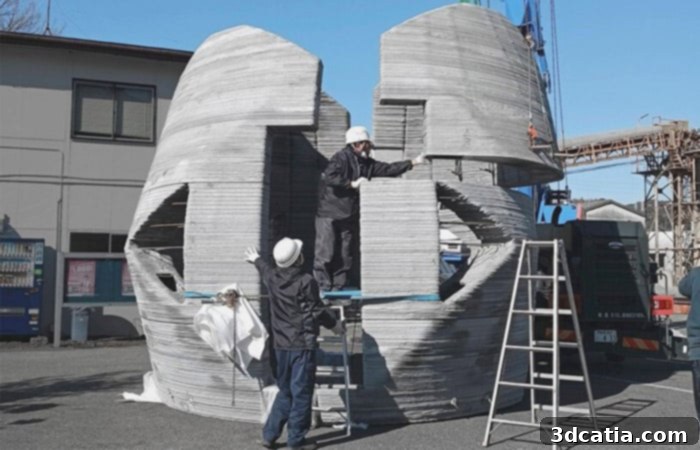
The incredibly efficient assembly process for the Serendix 3D printed house reportedly took only 3 hours (photo credits: Serendix)
Unprecedented Speed: The 23-Hour Construction Miracle
One of the most astonishing aspects of the Serendix project is the sheer speed of its construction. While the specific model of the concrete extrusion machine employed for this pioneering build has not been publicly disclosed, the efficiency of the additive manufacturing process speaks volumes. The core assembly of the spherical structure was completed in an incredibly brief three hours. This rapid foundational construction highlights the transformative potential of 3D printing in drastically shortening project timelines compared to conventional building methods, which typically involve weeks or months of labor for similar structures.
Beyond the initial printing phase, the subsequent steps, including the precise creation of essential openings for doors and windows, and the critical waterproofing phase to ensure weather resistance, were executed with remarkable swiftness. In total, from the very first layer of concrete to a fully functional and habitable structure, the entire process was finalized in an astonishing 23 hours and 12 minutes. This timeframe encompasses all major construction stages, delivering a complete, resilient dwelling in less than a single day. Such an achievement is not merely impressive; it represents an incredible, paradigm-shifting feat in the field of construction, setting a new benchmark for rapid deployment and efficiency that could redefine disaster relief and affordable housing globally.
The Broader Implications: Beyond Emergency Housing
While Serendix’s spherical home is primarily envisioned for emergency housing and disaster relief, its implications extend far beyond this immediate need. The ability to construct robust, affordable dwellings in under 24 hours opens up a myriad of possibilities for various sectors. Imagine rapidly deployable temporary shelters for remote research stations, eco-tourism units in natural reserves, or even modular add-ons for existing properties. The cost-effectiveness and speed of these 3D printed structures could also address chronic housing shortages in underserved communities worldwide, offering a dignifying alternative to makeshift shelters. This technology holds the promise of democratizing access to quality housing, making it available to a broader segment of the global population.
Moreover, the spherical design itself, chosen for its inherent strength and resistance to natural forces, hints at a future where architectural forms are optimized not just for aesthetics but for extreme environmental conditions. This approach is particularly relevant as climate change intensifies and unpredictable weather patterns become more common. Serendix’s pioneering work encourages architects and engineers to rethink traditional building constraints and embrace innovative shapes and materials that leverage the unique capabilities of 3D printing. The minimalist footprint of 10 square meters also champions efficient living, aligning with growing trends towards sustainable and compact urban design.
Sustainability and Future Outlook for 3D Printed Construction
Addressing the question of sustainability, 3D printing in construction offers several advantages. The precise, layer-by-layer deposition of material significantly reduces waste compared to conventional building methods, where material offcuts and excesses are common. Furthermore, the potential to use locally sourced or recycled aggregates in the concrete mix enhances the environmental profile of these structures. The ribbed walls designed for insulation also contribute to energy efficiency, reducing heating and cooling demands and thereby lowering the long-term environmental footprint of the dwelling. As research progresses, the integration of smart technologies for energy management and water recycling could further cement the sustainability credentials of 3D printed homes.
The success of Serendix serves as a powerful testament to the maturity and practical viability of 3D construction printing. It demonstrates that the technology is past the experimental phase and is now capable of delivering real-world, impactful solutions. As more companies like ICON and Serendix push the boundaries, we can expect to see wider adoption, further cost reductions, and even more diverse applications of this technology. Regulatory frameworks will likely adapt to accommodate these new building methods, paving the way for 3D printed structures to become a common sight in our urban and rural landscapes. The future of housing, characterized by speed, affordability, resilience, and sustainability, appears to be increasingly shaped by the remarkable innovations in additive manufacturing.
What are your thoughts on this groundbreaking 3D printed spherical home and its potential to redefine future construction? We invite you to share your insights and comments below, or engage with us on our social media channels: LinkedIn, Facebook, and Twitter! To stay updated with the very latest developments in the world of 3D printing, don’t forget to sign up for our free weekly Newsletter here. You can also explore our extensive library of videos on our YouTube channel for more fascinating insights and demonstrations.