
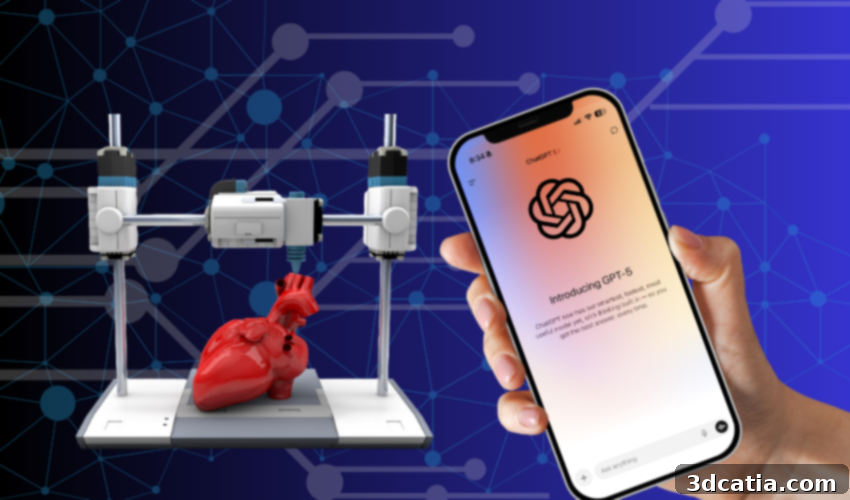
GPT-5: Revolutionizing Additive Manufacturing and 3D Printing with Advanced AI
OpenAI recently unveiled GPT-5, the latest iteration of its groundbreaking language model, which CEO Sam Altman succinctly described as “having an expert with a doctorate in your pocket.” This monumental update introduces profound advancements across several key areas, including reasoning capabilities, customization options, and overall reliability, setting a new benchmark for artificial intelligence. Crucially, this powerful new model is already accessible to all ChatGPT users, including those utilizing the free plan, democratizing access to cutting-edge AI technology.
While much of the initial discourse surrounding GPT-5 naturally gravitates towards its implications for established sectors like the healthcare and software industries, its enhanced capabilities are poised to create significant waves in a broader spectrum of fields. Among these, additive manufacturing stands out as an area ripe for transformation. GPT-5’s superior reasoning prowess and its self-described “agentic” functionalities in coding and data analysis are expected to elevate artificial intelligence into an even more indispensable tool for optimizing every facet of 3D printing processes, from design to production and quality assurance.

The new GPT-5 model promises stronger coding, reasoning, and creative writing skills, expanding its potential applications. (Photo Credit: OpenAI)
The Evolving Role of AI in Additive Manufacturing
Even before the advent of GPT-5, artificial intelligence had already cemented its role as a burgeoning force within the additive manufacturing landscape. Its applications range from sophisticated generative design and intricate simulations that predict material behavior, to real-time print monitoring and highly accurate defect detection systems. The integration of the new GPT-5 model promises to supercharge these existing functions, enabling AI to tackle even more complex tasks with remarkably minimal human intervention or prompting. This leap forward empowers engineers to not only significantly streamline design workflows but also to analyze colossal volumes of data with unprecedented speed and precision. Furthermore, GPT-5’s advanced capabilities could facilitate the creation of custom software tools, purpose-built for highly specific print process optimization challenges.
Accelerating Design Optimization with GPT-5
Design optimization stands out as one of the most immediate and impactful areas where GPT-5 is poised to deliver immense value within the additive manufacturing industry. Generative design algorithms, driven by AI, are already indispensable for creating lightweight yet robust parts, especially for demanding sectors such as the aerospace and automotive industries, where material efficiency and structural integrity are paramount. With GPT-5’s unparalleled ability to rapidly generate, iterate, and refine code, the development and adaptation of AI-driven design tools can be dramatically accelerated. This allows engineers to explore a much wider array of innovative geometries, material combinations, and manufacturing strategies in a fraction of the time previously required. Imagine the possibilities of instantly generating optimal lattice structures for biomedical implants, or designing highly efficient heat exchangers with intricate internal geometries – all optimized for specific performance criteria and manufacturability.
The advanced reasoning of GPT-5 means it can not only understand design constraints but also propose novel solutions that might elude human intuition or traditional computational methods. This could lead to breakthroughs in material science, enabling the discovery of new alloys or composite structures tailored precisely for additive processes. Furthermore, its capacity for multi-objective optimization can balance conflicting design goals, such as maximizing strength while minimizing weight and cost, simultaneously ensuring printability. This level of comprehensive, intelligent design assistance will significantly shorten development cycles and drive innovation across various product categories, from high-performance industrial components to personalized consumer goods.
Enhancing Quality Assurance and Process Control
Quality assurance, a critical component of any manufacturing process, is another domain set to benefit profoundly from GPT-5’s introduction. In additive manufacturing, defects often manifest at a microscopic or microstructural level, making them notoriously challenging to detect through conventional methods, especially during the production process itself. Here, GPT-5 can forge a powerful synergy with advanced computer vision systems and other sensor technologies. By interpreting vast streams of inspection data—from thermal imaging and acoustic sensors to optical scans—in real time, the AI program can swiftly identify even the most subtle irregularities. More importantly, it can go beyond mere detection to provide actionable recommendations for corrective measures before a print run is even completed or significantly advanced.
This proactive approach to quality control has immense implications. It promises to drastically reduce material waste, a perennial concern in high-value additive manufacturing, and concurrently lower overall production costs by preventing failed prints. Crucially, it will significantly enhance the reliability and consistency of the parts produced, which is vital for industries where component failure can have severe consequences, such as aerospace and medical device manufacturing. GPT-5’s ability to learn from past defects and successfully implemented corrective actions can continuously refine the quality control process, moving towards a truly autonomous and self-optimizing manufacturing environment. This leads to a higher yield of perfectly formed components and a deeper understanding of process dynamics.
Artificial intelligence increasingly influences decision-making processes within the additive manufacturing sector. (Photo Credit: Reuters)
Building Trust and Transparency in AI-Assisted Manufacturing
One of the most significant barriers to the widespread adoption of AI in critical industrial applications like additive manufacturing has been the inherent “black box” problem – a lack of transparency and trust in AI-driven decisions. Engineers and operators often hesitate to fully rely on systems that cannot clearly explain their reasoning. With this specific update, GPT-5 addresses this glaring issue directly. Its improved reliability, coupled with an enhanced ability to understand nuanced context, helps bridge the trust gap. The model is designed to provide clear, understandable explanations for its reasoning and recommendations. Furthermore, when a task or query falls outside its current capabilities or knowledge domain, GPT-5 is programmed to offer safe alternatives or explicitly state its limitations, rather than attempting to provide an unreliable answer.
This newfound level of transparency and accountability could be a game-changer for AI adoption in AM. By making AI-assisted decision-making more comprehensible and accessible, GPT-5 empowers human operators to validate and learn from AI insights, fostering a collaborative environment rather than one of blind reliance. This partnership between human expertise and advanced AI intelligence can lead to more robust, reliable, and ultimately, more trusted manufacturing processes. It transforms AI from a mysterious oracle into a highly capable and trustworthy colleague, capable of explaining its thought process and acknowledging its boundaries.
Overcoming Implementation Challenges for Industrial Integration
As with many cutting-edge advancements in the rapidly evolving realm of artificial intelligence, the integration of GPT-5 into complex industrial environments like additive manufacturing will undoubtedly present a unique set of challenges. Successful implementation demands more than just technical prowess; it necessitates a multifaceted approach involving close collaboration between a diverse group of stakeholders. AI developers must work hand-in-hand with equipment manufacturers to ensure seamless hardware-software integration, addressing issues such as data compatibility, sensor interoperability, and the creation of robust APIs. Key industry stakeholders, including end-users, material scientists, and process engineers, must also be deeply involved to guide the development of AI tools that are genuinely useful, practical, and tailored to real-world production needs.
Beyond technical hurdles, there are significant considerations around data infrastructure. Additive manufacturing processes generate immense amounts of data, and effectively collecting, storing, and labeling this data to train and fine-tune AI models like GPT-5 will be crucial. Furthermore, the workforce will require training and upskilling to effectively interact with and leverage these advanced AI systems. Addressing ethical considerations, ensuring data privacy, and developing clear guidelines for responsible AI deployment will also be paramount to fostering long-term success and widespread acceptance within industrial settings. The journey from innovative AI model to fully integrated industrial solution is complex, but the potential rewards are substantial.
The Transformative Future of AI-Driven 3D Printing
If GPT-5 can be effectively integrated and optimized within the additive manufacturing ecosystem, its impact could be truly transformative. It has the potential to dramatically accelerate the ongoing trend towards designing materials and parts specifically with 3D printing in mind, rather than laboriously adapting designs conceived for older, more traditional manufacturing methods. This fundamental shift in design philosophy, driven by intelligent AI, could unlock unprecedented levels of efficiency, pushing the boundaries of what is possible in terms of part complexity, material utilization, and performance. Such an evolution promises to make production far more efficient, significantly more sustainable through reduced material waste and optimized energy consumption, and inherently better suited to meet the rapidly evolving and increasingly customized needs of modern industry.
Envision a future where AI autonomously designs parts based on functional requirements, simulates their performance under various conditions, optimizes print parameters in real-time, and proactively identifies and corrects potential defects – all with minimal human oversight. This vision of an AI-driven smart factory in additive manufacturing is not a distant dream but an imminent reality, brought closer by the capabilities of models like GPT-5. It promises to usher in an era of unparalleled innovation, enabling the rapid development of new products, personalized solutions, and highly resilient supply chains, fundamentally redefining the landscape of manufacturing for generations to come.
What are your thoughts on GPT-5’s potential role in shaping the future of 3D printing and additive manufacturing? Share your insights and predictions in a comment below, or join the conversation on our LinkedIn and Facebook pages! Don’t miss out on the latest advancements and sign up for our free weekly Newsletter here, delivering the most relevant 3D printing news directly to your inbox. You can also explore all our in-depth videos and content on our YouTube channel.
*Cover Photo Credit: OpenAI, Reuters, & Canva