
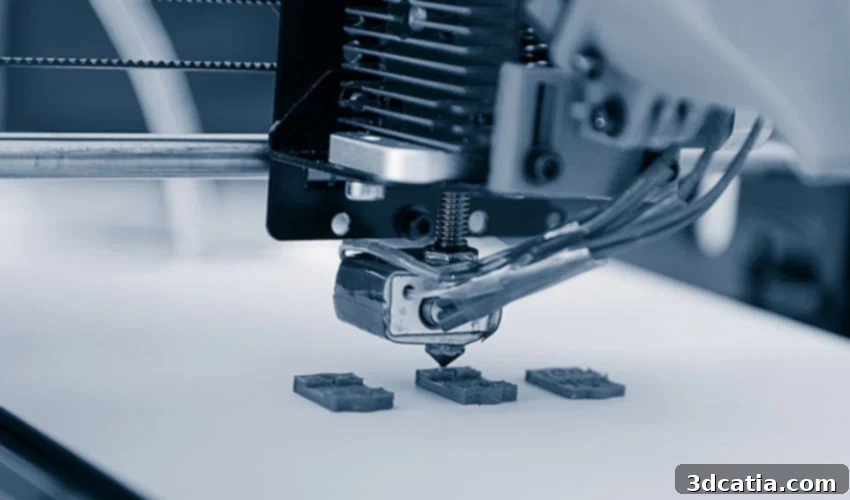
Revolutionary Smart Ink: Dartmouth Researchers Unveil 3D Printing Material That Changes Shape and Color
The landscape of additive manufacturing is on the cusp of a profound transformation, moving beyond static objects to dynamic, adaptive materials. Researchers at Dartmouth College have made a groundbreaking stride in this direction, successfully developing a novel 3D printing material that promises to redefine the capabilities of printed parts. Their innovation comes in the form of a ‘smart ink’ that enables 3D printed objects to autonomously change both their shape and color over time in response to external stimuli. This pioneering research is poised to significantly impact various sectors, most notably biomedicine, where customized, responsive implants could revolutionize patient care, and the energy industry, which could benefit from self-adjusting or self-repairing components.

Chenfeng Ke
While the concept of adaptive 3D printed materials is not entirely new, Dartmouth’s contribution marks a significant leap forward. Just a few months prior, a team at MIT introduced its own 3D printable ink, capable of changing the color of printed parts. This process, dubbed “ColorFab,” captured considerable interest from users seeking to add dynamic aesthetics to their creations, even as the market sees an increasing number of 3D printers offering multi-color printing capabilities. However, the researchers at Dartmouth College have advanced this concept further, not only by developing a material that can change color but critically, one that can also alter the physical shape of the printed object itself. This dual functionality opens up an entirely new realm of possibilities for smart objects and adaptive structures.
“This technique truly brings 3D printed objects to life,” explains Chenfeng Ke, an assistant professor of chemistry at Dartmouth and a leading figure in this research. He elaborates on the conventional limitations of 3D printing, stating, “Although many 3D printed structures are merely static shapes that do not inherently reflect the complex molecular properties of the material, these innovative inks introduce functional molecules directly into the 3D printing world. We can now print genuinely smart objects designed for a vast array of sophisticated uses.” Professor Ke further highlighted that a primary objective for his team was to achieve unprecedented levels of control over the molecular structure of 3D printed parts, allowing for engineered responses at a macroscopic scale.
The Science Behind Adaptive Materials: How Smart Ink Works
The creation of this revolutionary intelligent ink involved a sophisticated polymer-based solution meticulously designed to integrate smart molecular systems directly into a printing gel. This innovative approach allows the intrinsic functions of these molecular systems to be transferred from the nanoscale to the macroscopic scale, enabling observable changes in the final printed object. Unlike traditional 3D printing materials that simply harden and retain their form after the printing process, this smart material is engineered to undergo subsequent chemical reactions. These reactions are crucial; they are designed to lock in specific active molecular ingredients, which then trigger the desired transformations.
The profound result is a 3D printed object endowed with a precisely programmed molecular design. This design dictates how the object will transform itself post-printing. For instance, the material could be programmed to dynamically change its shape in response to a specific chemical stimulus, or to alter its color when exposed to certain light conditions. This programmable adaptability means that the material doesn’t just exist as a static form but as a dynamic entity capable of interacting with and responding to its environment in a controlled and predictable manner. This level of molecular-level control paves the way for a new generation of functional and responsive objects.
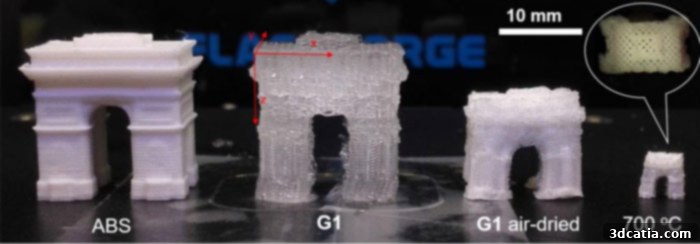
The different stages of narrowing the 3D printed part with intelligent ink, compared to ABS (photo credits: Chenfeng Ke)
Unprecedented Resolution and Scalability
The Dartmouth team’s innovations extend beyond just the material itself. They also engineered a combination of novel pre- and post-print techniques that allow for the manipulation of printed objects with extraordinary precision. These methods have enabled researchers to reduce the size of 3D printed objects by an astonishing factor of up to 100 times, while simultaneously achieving a 10-fold increase in resolution. This breakthrough in miniaturization and detail means that incredibly intricate and complex structures can now be fabricated with a level of fidelity previously unattainable.
Furthermore, the researchers have demonstrated the material’s ability to undergo cycles of dilation and contraction multiple times without degradation, showcasing its remarkable robustness and functional longevity. “It’s something we’ve never seen before,” Ke emphasized. “Not only can we print objects in 3D, but we can also instruct the molecules within these objects to rearrange themselves to a level visible to the naked eye after printing.” This capability signifies a departure from passive materials to active, molecularly controlled systems that promise to revolutionize various engineering and scientific fields by enabling the creation of self-assembling, self-adjusting, and responsive structures at an unprecedented scale and resolution.
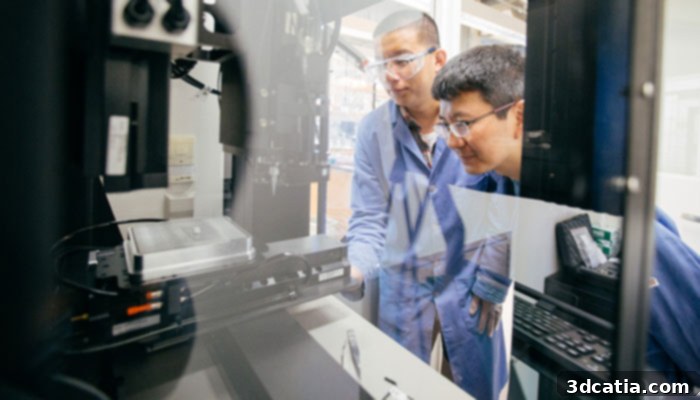
Professor Chenfeng Ke and his assistant Pengfei Zhang (Photo credits: Robert Gill)
Democratizing Advanced 3D Printing Technology
Perhaps one of the most compelling aspects of this research is its potential to democratize access to advanced manufacturing capabilities. Professor Ke highlights the economic implications, explaining that this innovative process can be effectively utilized on a standard $1,000 3D printer to achieve results that would typically demand a high-end machine costing upwards of $100,000. This drastic reduction in the entry barrier means that sophisticated, high-resolution 3D printing, combined with adaptive material functionality, could become accessible to a much broader audience, from small businesses and educational institutions to individual innovators and researchers.
Such a significant decrease in cost, coupled with an increase in functional resolution and adaptive capabilities, promises to spur innovation across diverse industries. It removes a major financial hurdle, encouraging more widespread experimentation and development of smart objects. The ability to achieve premium results with relatively inexpensive equipment could accelerate the adoption of adaptive materials in prototyping, product development, and even small-batch manufacturing, fostering an environment where ingenuity is limited less by budget and more by imagination.
Future Applications and the Horizon of Adaptive Manufacturing
While this research project is still in its nascent stages, the initial results are undeniably promising, pointing towards a future where intelligent, adaptive materials are commonplace. The researchers envision that their smart ink technology will initiate the development of 3D printing materials capable of dynamically adapting to their environment, offering immense potential across various fields:
- Biomedicine: Imagine medical implants that can change shape to better conform to a healing body, drug delivery systems that release medication based on specific biological cues, or surgical instruments that adapt their form during minimally invasive procedures.
- Energy Industry: Adaptive solar panels that self-adjust their angle to maximize sun exposure, self-healing components for critical infrastructure, or smart sensors that respond to environmental changes to optimize energy consumption.
- Consumer Goods: Products like self-adjusting footwear that mold to the wearer’s foot throughout the day, reconfigurable smart devices, or even clothing that changes texture or color based on temperature or personal preference.
- Aerospace and Automotive: Lightweight, adaptive structures that can alter their aerodynamic properties or change their rigidity in response to stress, enhancing both performance and safety.
- Soft Robotics: Creating robots that can change their form to navigate complex environments, grasp delicate objects, or mimic biological movements with unprecedented flexibility and control.
- Architecture: Responsive building materials that could enable self-shading facades, dynamic interior spaces, or structures that can adapt to varying weather conditions.
The long-term vision is to create truly ubiquitous smart objects that are not only printed but are also capable of intelligent interaction with their surroundings. This represents a paradigm shift from passive material science to active, responsive engineering. The full study, detailing the methodology and initial findings of this transformative research, is available for those interested in delving deeper into the scientific specifics. You can find the entire research paper and its results here.
What are your thoughts on this groundbreaking new 3D printing material and its potential? We invite you to share your insights in a comment below or join the conversation on our Facebook and Twitter pages! Don’t forget to sign up for our free weekly Newsletter to receive all the latest news in 3D printing directly in your inbox!