
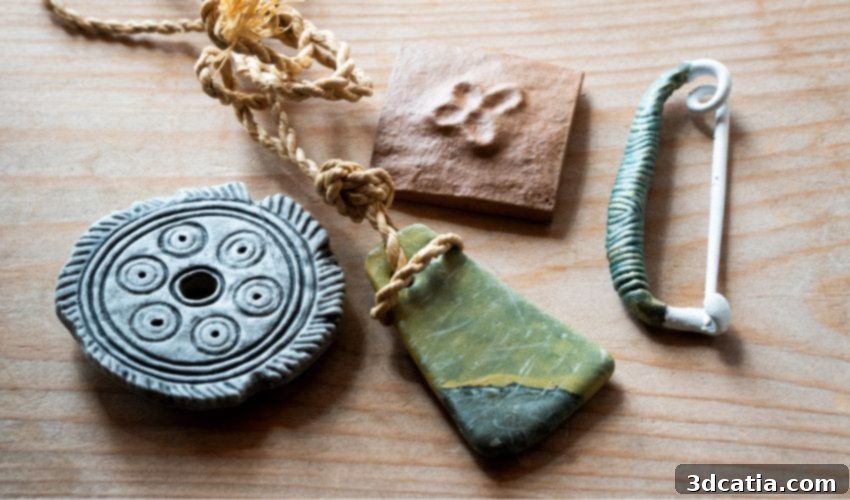
Embracing Innovation: How 3D Printing Revolutionizes Cultural Heritage Preservation and Accessibility
The intersection of cutting-edge additive manufacturing technologies and the venerable world of art and cultural heritage is generating unprecedented opportunities. Far from being a niche application, the use of 3D printing in this sector is remarkably diverse, spanning from the creation of specialized museum tools to the meticulous reproduction of ancient artifacts and the crafting of precise casts for intricate restoration projects. This transformative potential has been highlighted in various discussions, including detailed infographics on 3D technologies in art and comprehensive articles dedicated to cultural heritage preservation. To delve deeper into these fascinating developments, we sought insights from professionals who actively harness these technologies daily, pushing the boundaries of what’s possible in preserving and presenting our shared past. Riccardo Bonina, CEO of the Sicilian company Hi.Stories, provides a compelling perspective on the tangible benefits of integrating 3D printing into cultural heritage initiatives and, crucially, how these advanced technologies are making art and heritage more engaging and accessible to a wider audience than ever before.
An Introduction to Riccardo Bonina and His Journey into 3D Printing
Riccardo Bonina
“I am Riccardo Bonina, and I lead Hi.Stories, a company headquartered in Catania, Italy, singularly focused on leveraging the power of 3D technologies for the enhancement and preservation of cultural heritage,” Riccardo begins, introducing himself. “My partners and I were initially drawn to 3D printing out of a profound curiosity for its potential, but more importantly, by its inherent capacity to bring about significant social impact within the cultural sector. We recognized that this nascent technology offered a unique pathway to not only preserve historical artifacts but also to democratize access to art and history, making it palpable and understandable for diverse communities. This vision of combining technological innovation with a strong social mission became the bedrock of Hi.Stories.” This early conviction in the transformative power of 3D printing, especially in a region as historically rich as Sicily, underscores the core philosophy behind their work: using technology as a bridge to connect people with their heritage in meaningful and impactful ways.
The Genesis and Enduring Mission of Hi.Stories
Hi.Stories officially embarked on its journey in 2017, emerging from a successful participation in the “Cultura Crea” call for proposals. This pivotal initiative, promoted by Invitalia as part of the PON Culture and Development ERDF 2014/2020 program, aimed to catalyze the birth of new cultural and creative enterprises across Italy. “Our initial concept was clear: to develop an enterprise dedicated to elevating cultural heritage through the strategic application of advanced technology,” Riccardo explains. “We envisioned harnessing technology’s immense potential to craft engaging and interactive experiences within cultural centers and museums, moving beyond traditional, passive viewing. This meant creating environments where visitors could interact more directly with exhibits, fostering a deeper understanding and appreciation.”
Looking ahead, Hi.Stories is committed to even greater societal engagement. “From next year, we are proud to announce that we will transition into becoming a benefit company,” Riccardo shares. “This significant step reinforces our commitment to balancing profit with purpose. As a benefit company, we will actively promote a range of social impact initiatives. These efforts are designed to heighten public awareness and communicate the immense value of integrating digital tools, including 3D printing, not only for enhancing accessibility within cultural institutions but also for the broader enrichment and appreciation of cultural heritage. Our mission is deeply rooted in fostering a more inclusive and technologically empowered cultural landscape for everyone.” This evolution underscores Hi.Stories’ dedication to pioneering social responsibility alongside technological innovation in the cultural sector.
Diverse Applications of 3D Printing at Hi.Stories
“3D printing has always been a cornerstone of the services we offer at Hi.Stories, precisely because it embodies our core belief in digital technology as a powerful facilitator for understanding cultural heritage,” Riccardo states. In the nuanced realm of cultural preservation and engagement, 3D printing shines brightest in several key applications. Paramount among these is the creation of tactile pathways specifically designed for the visually impaired. These meticulously crafted 3D prints transform museum visits into a richly sensory experience, significantly enhancing accessibility. By providing physical, three-dimensional reproductions of artifacts, often accompanied by Braille captions, visually impaired visitors can directly engage with the textures, contours, and intricate details of items that would otherwise be inaccessible. This tactile interaction allows for a profound appreciation of the art’s form and, in many cases, the delicate reliefs present in original collection pieces, fostering a truly inclusive museum environment.
Beyond accessibility, 3D printing serves as an invaluable tool for educational outreach. Artifacts can be precisely replicated to serve as hands-on teaching aids, allowing students and educators to safely handle and examine historical objects without risking damage to priceless originals. These robust, detailed replicas bring history to life in classrooms and workshops, offering an interactive learning experience that static images or traditional models cannot match. Furthermore, 3D printing provides a crucial solution for cultural institutions when original artifacts are temporarily on loan. For objects of significant importance, having a high-fidelity 3D printed copy ensures that the institution can maintain its display and continuity, preventing gaps in exhibitions. This capability allows for greater flexibility in managing collections, supporting both inter-institutional collaboration and continuous public engagement, while safeguarding the irreplaceable originals. These diverse applications underscore the versatility and indispensable role of 3D printing in modern cultural heritage management.
Additive Technologies and Materials Utilized
“There isn’t a singular, universally applicable material or printing method for every project; our choice is meticulously tailored to the specific demands of the client and the desired characteristics of the final output,” Riccardo explains regarding their material and technology selection. Hi.Stories employs a strategic approach, selecting additive technologies based on the intricacy and scale required. “We generally lean towards resin-based printing technologies, such as Stereolithography (SLA) or Digital Light Processing (DLP), when the exhibit demands exceptional detail and a pristine surface finish,” he elaborates. This approach is particularly crucial for reproducing delicate features like the intricate filigree of a medieval skylight component or the finely sculpted elements of a pendant. Resin printers excel in capturing minute nuances due to their high resolution and ability to produce smooth, precise layers, making them ideal for museum-quality reproductions where fidelity to the original is paramount.
Conversely, for projects involving larger volumes or where the absolute finest detail is a secondary consideration to overall form and structural integrity, Hi.Stories favors extrusion-based printing, typically using Fused Deposition Modeling (FDM) technology. “Extrusion printing proves to be more cost-effective and efficient for objects requiring greater size or where the primary goal is a robust, functional replica,” Riccardo adds. Materials like PLA (Polylactic Acid) or ABS (Acrylonitrile Butadiene Styrene) are commonly used in FDM for their versatility and strength. This methodical selection ensures that each project benefits from the most appropriate technology and material, balancing factors like detail fidelity, structural requirements, production time, and cost-effectiveness to deliver optimal results for cultural heritage applications, from large-scale architectural elements to educational models that require durability.
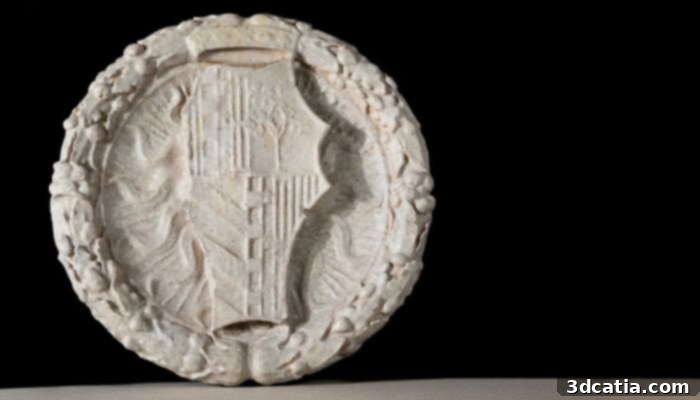
3D printing of coats of arms of the Rocca Roveresca fortress in Senigallia.
The Unmatched Benefits of Additive Manufacturing Over Traditional Methods
“Undoubtedly, the most significant advantage that additive manufacturing, specifically 3D printing, offers over more traditional, artisanal reproduction methods is the unparalleled speed with which prototypes and models can be created,” Riccardo asserts. Where traditional sculpting, molding, or casting could take weeks or even months of skilled labor, 3D printing can produce a preliminary model in a matter of hours or days. This drastically accelerates the design and development phases for exhibitions, educational tools, and restoration components, allowing for rapid iteration and refinement. While 3D printing might not be the most economical solution for mass-producing numerous identical copies of a simple subject, its true strength lies in its ability to create unique, complex, and highly detailed models with remarkable efficiency.
These sophisticated models are not only valuable as end products but also serve as excellent starting points for other creative professionals. “3D prints are exceptionally useful for artisans in the design field who wish to incorporate innovative approaches into their traditional craftsmanship,” Riccardo explains. A 3D printed model can guide a sculptor, a jeweler, or a set designer, providing a precise physical reference that allows them to experiment with different materials and finishes while maintaining the exact form. In the specific context of cultural heritage, the advantages are even more pronounced. “Given that our prints originate from previously 3D-scanned models of original artworks, there’s the profound benefit of being able to reproduce an artwork with virtual identity to its original state,” he highlights. This digital-to-physical workflow ensures extraordinary accuracy, capturing every minute detail, texture, and dimension of the original artifact. This precision is critical for conservation efforts, allowing for the creation of exact replicas for study, display, or even for use in virtual restoration processes where parts of a damaged artifact can be digitally reconstructed and then physically printed. It effectively bridges the gap between preserving the past and innovating for the future, offering solutions that were once unimaginable for complex heritage projects.
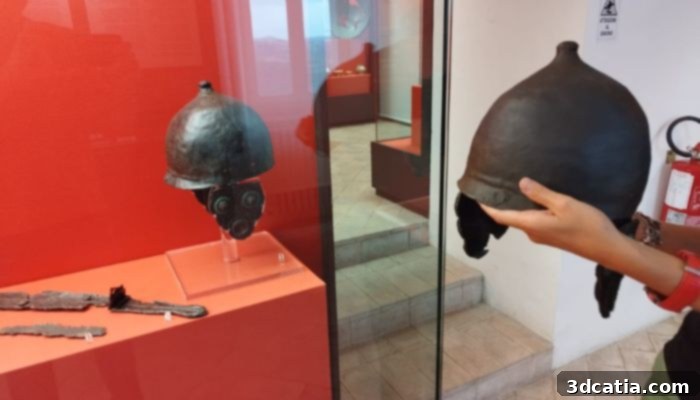
3D copy next to original (inside case) of Montefortino-type helmet (National Archaeological Museum in Arcevia – AN).
Current and Future Initiatives Leveraging 3D Printing
“At Hi.Stories, we are continually evolving, and our project pipeline is rich with exciting initiatives, particularly those centered around the crucial theme of museum accessibility,” Riccardo reveals. “This area currently represents perhaps the most significant demand and opportunity for 3D printing within the cultural heritage sector.” The company is actively developing new solutions to break down barriers to access, ensuring that art and history can be experienced and understood by everyone, regardless of physical ability. This includes expanding their work on tactile models for the visually impaired, perhaps incorporating more interactive elements or developing haptic feedback systems. Future projects are also exploring how 3D printing can be integrated with other immersive technologies, such as augmented reality (AR) and virtual reality (VR), to create multi-sensory museum experiences. Imagine visitors being able to hold a 3D printed replica of an ancient tool while simultaneously seeing an AR overlay demonstrating its use in historical context. These forward-thinking projects aim to redefine the museum experience, making it more dynamic, educational, and universally accessible, thereby solidifying 3D printing’s role at the forefront of cultural innovation.
The Transformative Future of 3D Technologies in Cultural Heritage
“In the cultural heritage sector, there is an ever-growing emphasis and profound recognition of the transformative power of 3D technologies, primarily due to their remarkable versatility across a multitude of applications,” Riccardo states, casting a vision for the future. The ability to create highly accurate reproductions of artifacts remains a cornerstone, significantly improving museum accessibility by allowing fragile originals to be safely stored while detailed, durable replicas are presented for public interaction, especially for tactile exploration by the visually impaired. These display copies also serve to enrich educational programs, providing tangible learning tools that bring history to life in classrooms and workshops. Beyond exhibition and education, 3D technologies are poised to revolutionize the delicate field of art restoration.
“3D scanning and printing can be instrumental in generating precise casts that can then be used to guide restorative interpolations,” Riccardo explains. This means that missing or damaged sections of an artifact can be digitally reconstructed from scan data, 3D printed, and then meticulously integrated by conservators. This process allows for extremely accurate repairs that minimize intervention on the original material while maintaining historical fidelity. Furthermore, 3D technologies facilitate advanced research and documentation. Scholars can study highly detailed digital models of artifacts without the need for physical handling, reducing wear and tear on fragile items. This also opens up possibilities for virtual exhibitions, digital archiving, and even reverse engineering of ancient technologies, providing invaluable insights into past cultures. The future envisions a cultural heritage sector where 3D technologies are not just tools, but indispensable partners in preservation, education, and innovative engagement, unlocking new dimensions for interacting with our collective past.
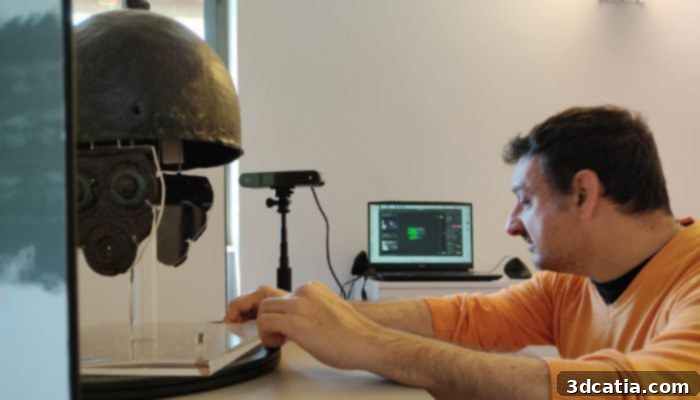
On-site survey work.
The Indispensable Role of Craftsmanship in 3D Printed Cultural Heritage
“Before we conclude, I would like to underscore a crucial aspect that often goes unnoticed amidst the enthusiasm for cutting-edge technology: the creation of high-quality 3D prints, especially in the context of cultural heritage, fundamentally involves a significant degree of craftsmanship,” Riccardo emphasizes. The perception that a 3D printer delivers a perfectly finished product ready for display is far from reality. What emerges directly from the machine is, in many instances, a raw output that requires substantial post-processing and artistic intervention to reach its final, museum-worthy state. This intricate finishing phase is where true artistry and skill come into play.
“In our specific line of work, dealing with the replication of invaluable cultural heritage, the task often transcends mere technical refinement; it’s about transforming a resin print into a genuine artistic object,” Riccardo elaborates. This transformation involves a series of meticulous steps: sanding to achieve a smooth surface, priming for uniform adhesion, and then often, the painstaking process of manually reproducing intricate reliefs, delicate textures, or faded decorations. In many cases, this even extends to freehand painting, where artists carefully match historical color palettes and patinas to ensure the replica is virtually indistinguishable from the original. Therefore, while a precise digital model, capturing every engraving and bas-relief, is an essential starting point, “having an artistically trained individual or team on board proves to be an absolutely critical element that can make all the difference in the creation of a truly exceptional finished product,” he concludes. This blend of high-tech additive manufacturing with traditional artistic skill ensures that 3D printed reproductions are not just copies, but new iterations of art that honor the original’s legacy and beauty.
To explore more about Hi.Stories’ pioneering work in cultural heritage and 3D printing, visit their official website HERE.
What are your thoughts on Hi.Stories’ innovative approach to preserving and enhancing cultural heritage with 3D printing? Share your opinions in a comment below or join the conversation on our LinkedIn or Facebook pages! Moreover, ensure you subscribe to our free weekly Newsletter to receive the latest updates in 3D printing directly to your inbox. You can also discover all our engaging videos and exclusive content on our YouTube channel.
*All Photo Credits: Hi.Stories