

LEGO Embraces 3D Printing: A New Era for Toy Manufacturing and Customization
The LEGO Group, a name synonymous with creativity and high-quality play for generations, is embarking on a significant journey into 3D printing technology. This strategic move marks a potentially transformative moment for the global toy industry, signalling a shift towards more innovative and flexible manufacturing methods. As part of an ambitious pilot project, LEGO recently unveiled its 3D-printed duck toy. This unique product is not merely a new item; it serves as a crucial experiment to gauge the appeal and viability of additive manufacturing among LEGO’s vast customer base. The duck will be available for a limited period in November exclusively at the LEGO Store in Denmark, making it a collector’s item and a piece of toy history. Notably, this 3D-printed duck represents the company’s first standalone additive manufacturing product to be sold directly to consumers. Prior to this, in 2019, LEGO had integrated a 3D-printed part into a drawing machine as part of a special opening ceremony for their System House, hinting at their long-term interest in the technology.
This pilot project is a clear indication of LEGO’s forward-thinking approach. The company aims to meticulously collect data regarding the usability, perceived value, and overall allure of toys produced through 3D printing. The insights gathered will be instrumental in shaping LEGO’s future manufacturing strategies. While their traditional injection molding technology remains a cornerstone, LEGO envisions leveraging additive manufacturing within their factories to produce smaller volumes of highly varied and complex pieces. This dual approach would allow for unprecedented design flexibility and the creation of niche products that might be impractical or uneconomical with conventional methods alone. To facilitate this crucial research, customers who purchase the 3D-printed duck will be encouraged to complete a user survey. Their feedback, encompassing everything from tactile experience to playability and durability, will directly aid LEGO’s understanding and refinement of 3D printing applications for toys. Ronen Hadar, Head of the LEGO Group’s Additive Design & Manufacturing team, expressed the company’s enthusiasm: “We are excited by the possibilities of additive manufacturing and can’t wait to hear from our fans. We will use their feedback to help shape future innovation as we continue to test the limits of 3D-printing technology.” This statement underscores LEGO’s commitment not just to adopting new technology, but to doing so in collaboration with its dedicated community, ensuring that future innovations resonate deeply with their users.
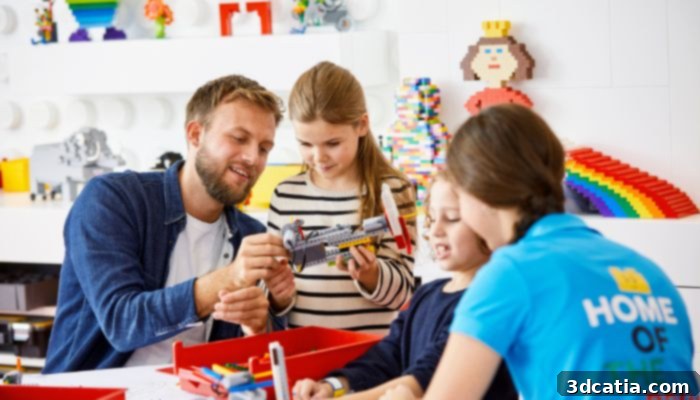
LEGO has inspired children for generations
The broader toy market has already seen significant integration of 3D printing, albeit largely in specialized niches or in the maker community. For instance, the Canadian company Little You offers a compelling example of personalization, enabling users to design, customize, and print their own unique figures based on a selection of digital models. This exemplifies how additive manufacturing empowers consumers to become co-creators, fostering a deeper connection with their toys. Beyond companies offering comprehensive services, a vibrant ecosystem of user-generated content thrives online. Platforms like Thingiverse and My Mini Factory host countless STL files, allowing individuals with home 3D printers to produce an array of toys based on community-shared designs. This accessibility has democratized toy creation, enabling hobbyists and small businesses to innovate rapidly. However, the entry of LEGO, a titan known for its meticulously engineered traditional wooden toys and later its globally iconic plastic bricks, into the 3D printing space represents a monumental shift. LEGO’s move could serve as a powerful catalyst for the entire toy industry, potentially encouraging other similarly sized manufacturers to explore and adopt additive manufacturing, thereby legitimizing the technology on a much grander scale and accelerating its widespread integration into mainstream production.
The adoption of 3D printing by a company with LEGO’s legacy is particularly noteworthy when considering its historical context. From its humble beginnings with wooden toys to the revolutionary introduction of interlocking plastic bricks, LEGO has consistently adapted and innovated its manufacturing processes. Each transition, including the shift to plastic injection molding in the 1950s, brought new possibilities for complexity, durability, and mass production. Now, 3D printing offers another leap forward, potentially allowing for intricate geometries and customization capabilities that are simply not feasible with traditional molding techniques. This technological evolution allows LEGO to explore new frontiers in toy design, perhaps leading to more organic shapes, highly detailed components, or even functionally integrated mechanisms within single printed parts. The pilot project with the duck is therefore not just about a single toy; it’s about pioneering a new manufacturing paradigm that could redefine how LEGO products are conceived, designed, and produced in the future.
Mr. Hadar further elaborated on a crucial aspect for any toy manufacturer, especially one with LEGO’s reputation:
We’ve worked incredibly hard to make sure our 3D-printed elements meet our very strict quality, safety and durability requirements. And as for this duck, it’s gone through extra quality checks to ensure its beak smoothly opens and closes!”
This emphasis on stringent quality, safety, and durability standards is paramount for LEGO. For decades, parents and children have trusted the LEGO brand for its robust and safe products. Translating these non-negotiable standards to 3D-printed elements presents unique challenges. Unlike injection molding, where material consistency and structural integrity are well-understood and controlled at scale, additive manufacturing introduces variables related to print orientation, layer adhesion, and material properties that require meticulous attention. Ensuring that a 3D-printed toy can withstand rigorous play, remain free of hazardous sharp edges, and contain no small, easily detachable parts that could pose choking hazards, demands advanced material science and sophisticated post-processing techniques. The specific mention of the duck’s beak opening and closing smoothly highlights LEGO’s dedication to functional integrity and user experience, demonstrating that even in this experimental phase, no compromise is made on the expected level of quality. This commitment is vital for building consumer confidence in 3D-printed toys and is likely a key factor in LEGO’s measured approach to integrating this technology.
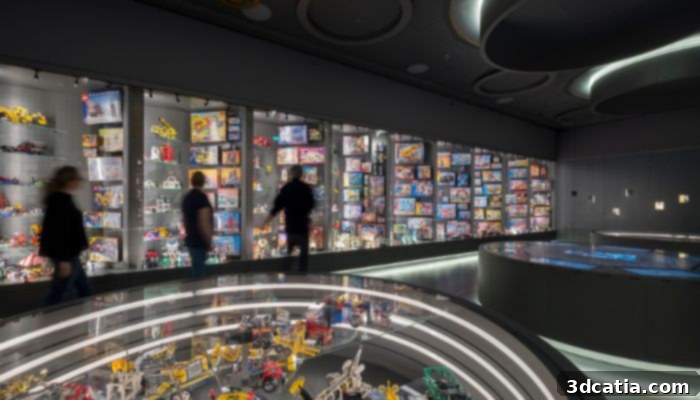
LEGO House is a 12,000 square meter installation in Denmark.
The implications of LEGO’s venture into additive manufacturing extend far beyond a single 3D-printed duck. This pilot project opens the door to a myriad of future possibilities for the company and the toy industry at large. Imagine a future where consumers can custom-design unique LEGO elements, perhaps personalized minifigure accessories or specialized bricks for architectural models, and have them 3D printed on demand. This level of mass customization could revolutionize how fans interact with the brand, fostering an even deeper sense of ownership and creative expression. Furthermore, 3D printing could enable LEGO to produce extremely limited-edition sets or niche parts that would be economically unfeasible to produce via traditional injection molding due to high tooling costs. This would greatly expand the range of products LEGO could offer, catering to specific collector markets or specialized builders without over-committing to large production runs. It also presents an exciting opportunity for rapid prototyping within LEGO’s design process, allowing designers to quickly iterate and test new concepts with functional models, significantly accelerating product development cycles. From a sustainability perspective, on-demand 3D printing could reduce material waste associated with overproduction and allow for localized manufacturing, potentially shortening supply chains and reducing environmental impact. While the iconic LEGO brick, produced by injection molding, will undoubtedly remain central to the brand’s identity, additive manufacturing offers a powerful complementary technology that promises to push the boundaries of design, customization, and efficient production for the next generation of LEGO innovations.
For those eager to delve deeper into this groundbreaking project and explore additional media content, the official LEGO press release can be consulted HERE. This initiative represents a fascinating intersection of tradition and cutting-edge technology, and we’re incredibly keen to hear your thoughts. What do you make of LEGO’s strategic foray into 3D printing? Would you be inclined to purchase a 3D-printed duck or other custom LEGO elements? Share your perspectives and join the conversation in the comments section below, or connect with us on our vibrant social media platforms, including LinkedIn,Facebook, andTwitter. For the very latest updates in the dynamic world of 3D printing, remember to sign up for our free weeklyNewsletter here, delivering breaking news directly to your inbox. You can also explore all our insightful videos and content on our dedicatedYouTube channel, where we continually explore the innovations shaping the additive manufacturing landscape.
*All photo credits: LEGO Group