
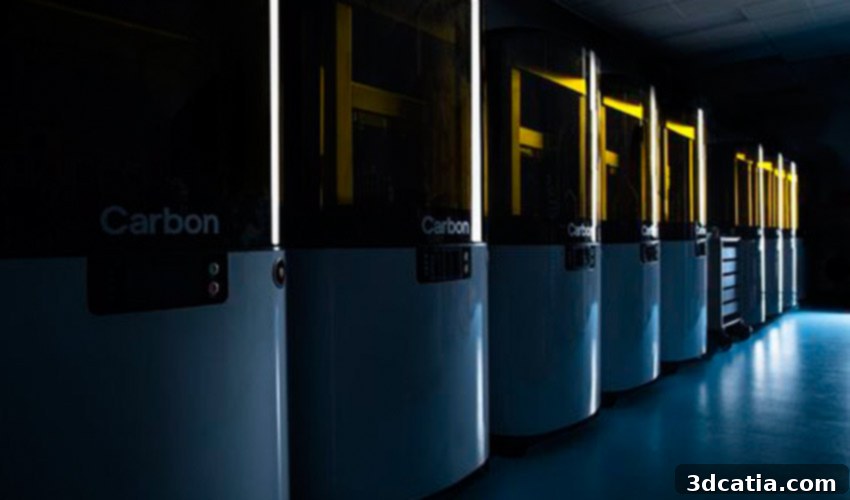
Carbon Secures $260 Million to Accelerate Global Digital Manufacturing and Transform Industrial 3D Printing
Carbon, a global leader and pioneer in digital manufacturing solutions, recently announced a significant milestone, securing over $260 million in growth funding. This substantial investment round, co-led by prominent firms Madrone Capital Partners and Baillie Gifford, marks a pivotal moment for the company. It is poised to fuel the aggressive global expansion of Carbon’s groundbreaking platform, extending its reach and impact across various industries worldwide. Dr. Joseph DeSimone, Carbon’s visionary CEO and Co-Founder, emphasized the transformative power of their technology: “With the Carbon Platform, powered by our innovative Digital Light Synthesis technology, companies are now empowered to transcend the conventional limitations of traditional polymer manufacturing methods. This enables them to rapidly innovate and produce next-generation products at unprecedented speeds and volumes, pushing the boundaries of what was previously considered possible in advanced manufacturing.”
Since its inception, Carbon has been driven by an ambitious mission: to fundamentally reinvent the entire lifecycle of polymer product development. This encompasses how these products are meticulously designed, precisely engineered, efficiently manufactured, and ultimately delivered, all with an eye towards a truly digital and sustainable future. Carbon’s proprietary Digital Light Synthesis (DLS) technology represents a significant departure from the more common layer-by-layer approach found in most conventional 3D printing techniques. Instead, DLS draws strong parallels with injection molding technology, offering a process that is both more efficient and capable of producing higher-quality parts. This revolutionary method leverages a sophisticated combination of digital light projection, unique oxygen-permeable optics, and exquisitely programmable liquid resins. The result is the production of parts boasting exceptional mechanical properties, superior resolution, and an impeccable surface finish – attributes critical for high-performance applications across diverse sectors.
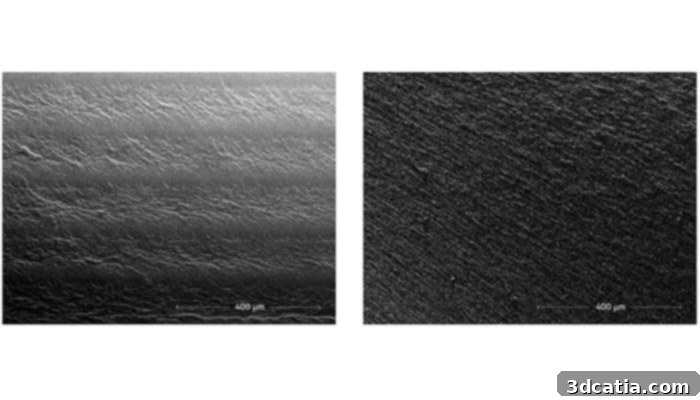
Example of the difference between Carbon’s technology (right) and traditional polymer 3D printing (left) | Credits: Carbon
The Digital Light Synthesis process at the heart of Carbon’s platform is a continuous, rather than a stepwise, operation. This ‘continuous liquid interface production’ (CLIP) method is achieved by projecting a continuous sequence of UV images through an oxygen-permeable window into a reservoir of liquid resin. The oxygen layer beneath the resin prevents the resin from curing directly onto the window, creating a “dead zone” that allows for continuous material flow and curing. This ingenious approach eliminates the layer-by-layer adhesion typical of other 3D printing methods, which often introduces structural weaknesses and visible striations. Consequently, DLS produces isotropic parts with consistent mechanical properties in all directions, akin to injection-molded components. This consistency, combined with rapid production speeds, is what truly sets Carbon apart and positions its technology as a viable alternative for scaled manufacturing, not just prototyping.
Since its establishment in 2013, Carbon has experienced remarkable growth, expanding its workforce to over 400 dedicated employees. The Carbon Platform is now operational in an impressive 14 countries, demonstrating its rapidly increasing global footprint. The past 12 months have been particularly illustrative of Carbon’s accelerating market adoption and technological impact, with the platform experiencing an astounding 33X increase in print volumes. This exponential rise in production is complemented by more than a 5X increase in total print hours, underscoring the growing utilization of Carbon’s systems for industrial-scale manufacturing. Furthermore, the company has significantly expanded its material ecosystem, releasing 17 new third-party resins and three new first-party resins over the past year. This continuous development of diverse materials – from rigid and durable to flexible and biocompatible – allows Carbon’s customers to address a wider array of application requirements across various industries, further solidifying its versatility and market relevance.
The strategic importance of this funding round and Carbon’s market position was eloquently articulated by Greg Penner, Founder and General Partner at Madrone Capital Partners and Chairman of Walmart. He stated, “What impresses me most about Carbon is their remarkable diversification across numerous markets and industries. Through their strategic partnerships with leading large-scale manufacturers in critical sectors such as automotive, healthcare, and consumer goods, they are unequivocally demonstrating that, with their innovative Digital Light Synthesis™ technology, additive manufacturing in larger scale production is not just a concept, but a tangible reality across a multitude of industry sectors. This period represents a significant inflection point for the company, and we are immensely proud to be able to contribute to Carbon’s future success and continued leadership in this transformative space.” This endorsement highlights Carbon’s ability to move beyond niche applications, proving that DLS is a robust solution for mainstream industrial production.
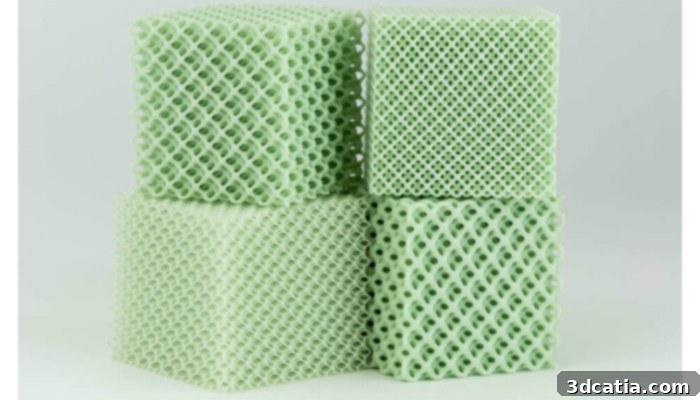
3D printed lattice structures in collaboration with Adidas thanks to Carbon’s technology | Credits: Carbon
What Lies Next for Carbon: Strategic Investments and Global Ambition
With this fresh infusion of capital, Carbon is setting an ambitious agenda for its future development and global footprint. A primary focus will be significantly expanding its research and development (R&D) efforts. A cornerstone of this expansion is the establishment of its Advanced Development Facility (ADF). The ADF will serve as a crucial innovation hub, empowering Carbon’s engineering teams to continuously refine and enhance the Carbon platform and its associated workflows. The goal is to optimize these systems for even more scaled-up manufacturing environments, thereby providing unparalleled support to its growing base of customers and strategic partners. This investment in core technology and infrastructure underscores Carbon’s commitment to staying at the forefront of digital manufacturing innovation.
Beyond domestic R&D, Carbon is also allocating substantial resources to fuel its international growth and expansion, particularly targeting key markets in Europe and Asia. These regions represent vast opportunities for industrial additive manufacturing, and Carbon aims to establish stronger localized presence and support structures to serve a diverse global clientele. The strategy involves not only deploying more DLS platforms but also building out robust service and support networks to ensure seamless integration and operation for international partners. This global outreach is critical for Carbon to cement its position as the world’s leading digital manufacturing platform, bringing its transformative technology to new markets and industries.
In a move that highlights its commitment to sustainability and advanced applications, Carbon plans to significantly invest in the development of both recyclable and biocompatible materials. The creation of such advanced materials is paramount for applications in sectors like medical devices, where biocompatibility is non-negotiable, and consumer goods, where environmental responsibility is increasingly demanded. This initiative aligns with a broader industry trend towards more sustainable manufacturing processes and products. Furthermore, Carbon is set to accelerate the expansion of its sophisticated software capabilities, including enhancements to its Digital Manufacturing Cloud. This cloud-based ecosystem is designed to streamline the entire manufacturing process, from design to production. The software development will specifically focus on improving design tools for algorithmic lattice generation, allowing for the creation of incredibly complex, lightweight, and performance-optimized structures. Additionally, it will enhance digital factory workflows, enabling better integration, automation, and real-time monitoring across distributed manufacturing operations. These software advancements are crucial for unlocking the full potential of digital manufacturing, offering unprecedented levels of control and efficiency to users.
Peter Singlehurst, Investment Manager at Baillie Gifford, echoed the sentiment of confidence in Carbon’s trajectory, emphasizing the company’s dual innovation approach. He remarked, “Through a powerful combination of both technical prowess and innovative business model strategies, Carbon is not just promising the future of additive manufacturing; it is actively delivering on that promise. In the process, the company is rapidly expanding into an enormous market opportunity. The thoughtful and deliberate way in which the team at Carbon is building the company, coupled with their strong emphasis on maintaining a positive culture and core organizational values, makes us incredibly proud to support the company in this pivotal growth round. Their success is a testament to their holistic approach to innovation.”
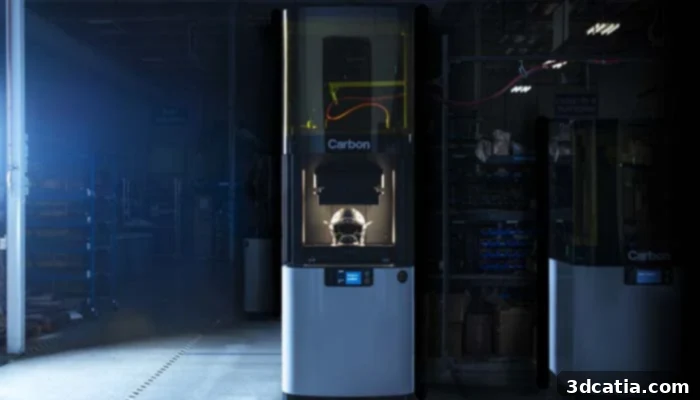
Carbon’s L1 3D printer was used to creature in-liners for Riddell’s helmets | Credits: Carbon
Jim Goetz, Partner at Sequoia Capital, lauded Carbon’s ability to scale 3D printing for real-world production. He observed, “Carbon has decisively cracked the code on achieving 3D printing at an industrial scale. This is abundantly evidenced by its impressive growth in implementation and the remarkable array of innovative products successfully brought to market with globally recognized companies such as adidas, Ford, Lamborghini, and Riddell.” These collaborations are not mere prototypes but represent actual high-volume production parts that are integrated into commercial products, from performance footwear with Adidas’ Futurecraft 4D midsoles to complex automotive components for Ford and Lamborghini, and protective helmet liners for Riddell. Carbon’s DLS technology allows these industry giants to innovate rapidly, reduce lead times, and create products with geometries and performance characteristics unachievable with traditional manufacturing. Goetz concluded, “They are truly delivering on their ambitious vision to provide the world’s first fully integrated digital manufacturing platform specifically designed for high-volume production. In doing so, they are well on their way to fundamentally transforming the entire 3D printing world and beyond, making digital manufacturing a mainstream reality.”
This significant funding round not only validates Carbon’s technological prowess and business model but also underscores the growing confidence in digital manufacturing as a cornerstone of future industrial production. As Carbon continues to expand its R&D, materials science, software capabilities, and global reach, its influence on how products are made and brought to market will only intensify. The era of truly digital and sustainable manufacturing is here, and Carbon is leading the charge, empowering industries to innovate faster, produce more efficiently, and design for a better tomorrow.
You can find more information about Carbon’s journey and innovations HERE.
What are your thoughts on Carbon’s latest funding round and its impact on the future of digital manufacturing? Share your insights and comments below, or connect with us on our Facebook and Twitter pages! Don’t miss out on the latest 3D printing news – sign up for our free weekly Newsletter here, delivered straight to your inbox!