
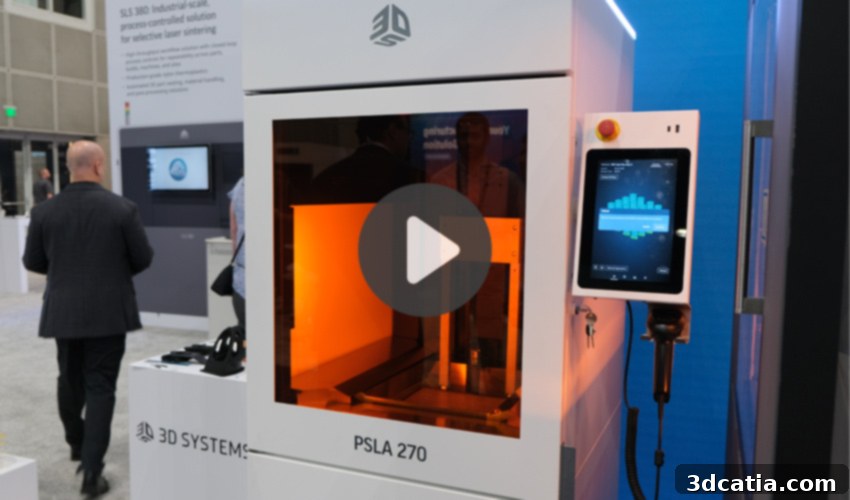
3D Systems PSLA 270: Redefining Industrial Resin 3D Printing with Speed, Precision, and Scalability
The world of additive manufacturing is constantly evolving, with new innovations pushing the boundaries of what’s possible in industrial production. Among the most exciting recent developments is the introduction of the PSLA 270 resin 3D printer from 3D Systems. This groundbreaking solution, specifically engineered to address the rigorous demands of modern industrial manufacturing environments, made its highly anticipated debut earlier this year at the prestigious RAPID + TCT 2024 event. The PSLA 270 represents a significant leap forward, meticulously combining the established strengths of Stereolithography (SLA) with advanced projection technologies. According to 3D Systems, this innovative mid-size printer sets a new benchmark, offering an unparalleled blend of speed and precision that promises to transform various industrial applications.
The launch of the PSLA 270 signals 3D Systems’ continued commitment to pioneering advanced additive manufacturing solutions that cater to high-stakes industrial needs. Its unique technological fusion aims to overcome traditional limitations, providing manufacturers with a versatile tool capable of producing high-quality parts rapidly and consistently. This article delves deeper into what makes the PSLA 270 a game-changer, exploring its core technology, benefits, ideal applications, and the strategic vision behind its development.
Unpacking the PSLA Technology: A Hybrid Approach to Additive Manufacturing
At the heart of the PSLA 270 lies its innovative PSLA (Projection Stereolithography) technology. This hybrid approach ingeniously merges the benefits of traditional SLA — renowned for its exceptional surface finish and isotropic properties — with the speed and efficiency of projection-based systems. Unlike conventional SLA printers that use a single laser to draw layers point by point, PSLA utilizes a high-resolution projector to cure entire layers of photopolymer resin simultaneously. This parallel processing capability is the fundamental driver behind the PSLA 270’s impressive speed, significantly reducing print times for complex geometries and large batches.
The integration of projection technology allows for faster build speeds without compromising the intricate detail and dimensional accuracy that SLA is known for. This means industrial users can achieve high throughput for production-grade parts, prototypes, and tooling, all while maintaining the stringent quality standards required in demanding sectors such as automotive, aerospace, medical devices, and consumer electronics. The mid-size build platform of the PSLA 270 is optimized for a range of part sizes, offering flexibility for both smaller, highly detailed components and larger functional prototypes. This balance of speed and precision, packaged in a robust industrial system, positions the PSLA 270 as a vital asset for manufacturers seeking to enhance their additive capabilities.
Exclusive Insights: An Interview with Martin Johnson
To truly grasp the potential and strategic importance of the PSLA 270, we had the distinct privilege of sitting down with Martin Johnson, Vice President of Product & Technical Fellow at 3D Systems. During our comprehensive interview, Mr. Johnson offered invaluable insights into the printer’s unique capabilities, elucidated its ideal industrial applications, and detailed the comprehensive ecosystem of materials and accessories designed to maximize the PSLA 270’s performance.
Mr. Johnson emphasized that the PSLA 270 was not merely an incremental upgrade but a thoughtfully engineered system developed in direct response to evolving industry needs for faster cycles, higher precision, and greater material versatility. He highlighted several core aspects that differentiate the PSLA 270 in a competitive market:
- Unmatched Speed and Throughput: The projection-based curing significantly accelerates print times, making low-to-mid volume production feasible with additive manufacturing. This capability is critical for reducing lead times and increasing operational efficiency.
- Exceptional Precision and Accuracy: Leveraging 3D Systems’ long-standing expertise in SLA, the PSLA 270 delivers parts with tight tolerances and superior surface finish, significantly reducing the need for extensive post-processing and ensuring fit-for-purpose components.
- Robust Industrial Design: Built for continuous operation in demanding manufacturing environments, the PSLA 270 ensures reliability, consistent performance, and long-term durability, minimizing downtime and maintenance.
- Material Versatility: A growing portfolio of high-performance resins is tailored for diverse industrial applications, ranging from rigid prototypes to flexible functional parts and high-temperature tooling, unlocking new design and application possibilities.
- Integrated Workflow: Seamless integration with 3D Systems’ cutting-edge software solutions and advanced post-processing equipment streamlines the entire additive manufacturing process, from initial design to finished part, enhancing overall productivity.
For a deeper dive into Mr. Johnson’s perspectives and a visual introduction to the printer, be sure to watch the insightful video interview below. This segment provides a firsthand look at the PSLA 270 in action and offers a glimpse into what industrial users can expect from this transformative technology.
Transforming Industrial Applications with the PSLA 270
The PSLA 270 is poised to significantly impact a wide array of industrial sectors, offering solutions to long-standing manufacturing challenges. Its compelling combination of speed, precision, and material adaptability makes it an ideal choice for:
- Rapid Prototyping: Accelerating design iteration cycles by producing highly accurate and functional prototypes faster than ever before. This is crucial for industries requiring quick validation of new designs and speeding up product development timelines.
- Production of Functional Parts: With advanced materials offering properties like high strength, flexibility, or chemical resistance, the PSLA 270 can produce end-use parts for various applications, including jigs, fixtures, custom connectors, and specialized enclosures.
- Tooling and Molds: Enabling the creation of high-precision tools, molds, and patterns for injection molding, vacuum casting, and other traditional manufacturing processes, drastically reducing lead times and costs associated with conventional tooling.
- Medical and Dental Devices: Producing custom anatomical models for surgical planning, highly accurate surgical guides, and certain patient-specific medical and dental components with the necessary precision and biocompatibility, leveraging specialized resins.
- Aerospace and Automotive: Fabricating lightweight, complex geometries for non-critical parts, interior components, or aerodynamic testing models, where speed, precision, and material performance are paramount.
- Consumer Goods: Facilitating agile product development, personalized customization, and small-batch production for consumer electronics, eyewear, and other intricate products, responding rapidly to market trends.
- Research and Development: Providing a flexible and powerful platform for material science exploration, the development of new additive manufacturing processes, and experimental design validation across various scientific and engineering disciplines.
The printer’s ability to maintain high resolution and exceptional surface quality at increased speeds ensures that parts produced are not just fast, but also aesthetically pleasing and functionally robust, consistently meeting the rigorous standards of industrial environments.
The PSLA 270 Ecosystem: Materials, Software, and Support
A printer’s capabilities are only as strong as its supporting ecosystem, and 3D Systems has meticulously developed a comprehensive suite of materials, software, and services for the PSLA 270. This integrated approach ensures that users can extract maximum value and performance from their investment, streamlining operations and maximizing productivity.
Advanced Materials for Diverse Applications
3D Systems offers a robust portfolio of advanced photopolymer resins specifically optimized for the PSLA 270. These materials are engineered to deliver specific mechanical, thermal, and chemical properties, enabling a broad spectrum of industrial applications:
- Accura Composite P: A high-performance composite for stiff, strong parts requiring excellent thermal stability and stiffness, ideal for demanding functional components.
- Accura AMX Tough: An extremely durable resin perfect for functional prototypes and end-use parts needing high impact strength and resilience in challenging conditions.
- Accura Elastomeric: Designed for flexible, rubber-like parts used in gaskets, seals, ergonomic components, and applications requiring material elasticity and rebound.
- Accura ClearVue: For transparent components requiring exceptional clarity, fine detail, and smooth surface finish, suitable for fluid flow analysis, lenses, or visual prototyping.
Each material is rigorously tested and validated by 3D Systems, guaranteeing consistent print quality, reliability, and predictable part performance, which is absolutely critical for industrial applications where material properties directly impact product integrity, safety, and regulatory compliance.
Intelligent Software and Streamlined Workflow
The PSLA 270 is complemented by 3D Systems’ powerful software solutions, including 3D Sprint® for print preparation and management, and 3D Connect™ for remote monitoring. 3D Sprint streamlines the entire preparation process, from CAD import to print job queuing, offering advanced tools for part orientation, intelligent support generation, and build optimization. This ensures efficient use of materials and build time. 3D Connect provides secure, cloud-based monitoring, predictive maintenance, and remote diagnostics, ensuring maximum uptime and proactive issue resolution for continuous industrial operations.
The seamless integration of hardware, materials, and software creates an intuitive and highly efficient workflow. This minimizes manual intervention, reduces the potential for errors, and allows operators to focus on maximizing productivity rather than troubleshooting complex processes. Furthermore, 3D Systems provides extensive technical support, comprehensive training programs, and expert consulting services to help customers fully leverage the PSLA 270’s capabilities and integrate it effectively into their existing manufacturing workflows, ensuring a smooth transition and rapid return on investment.
The PSLA 270’s Impact on Industrial Additive Manufacturing
The introduction of the PSLA 270 marks a pivotal moment for industrial additive manufacturing. By successfully bridging the gap between the ultra-high precision of traditional SLA and the high-speed throughput of projection-based systems, 3D Systems is empowering industries to fundamentally reconsider traditional manufacturing constraints. It facilitates faster time-to-market for new products, enables greater design freedom for complex geometries, and opens up new possibilities for mass customization and decentralized production at a quality level previously unseen at these speeds.
This printer is set to significantly accelerate the adoption of additive manufacturing for serial production, especially in applications where intricate details, excellent surface finish, and tight tolerances are as crucial as rapid turnaround times. Its “mid-size” designation is strategically chosen, hitting a sweet spot that offers substantial build volume without the massive footprint and higher capital investment often associated with very large industrial systems. This makes advanced additive manufacturing more accessible and economically viable for a broader range of enterprises, from large corporations to specialized design and manufacturing firms.
An in-depth look at how the PSLA 270 is specifically transforming industrial additive manufacturing workflows, complete with forthcoming case studies and practical application examples, is anticipated to be released shortly after the RAPID + TCT show. We highly encourage you to stay tuned for this comprehensive analysis, which will further illuminate the printer’s real-world impact and demonstrate its transformative potential across various industrial landscapes.
Join the Conversation and Stay Informed
What are your initial thoughts on the PSLA 270 resin 3D printer from 3D Systems? Did you have the opportunity to witness its capabilities firsthand at the 3D Systems booth during RAPID + TCT 2024? We are eager to hear your opinions, experiences, and predictions for how this technology will shape the future of industrial production! Share your insights in a comment below or connect with us across our social media channels to participate in the discussion.
You can find us and engage with the latest industry discussions on our LinkedIn, Facebook, and Twitter pages. Don’t miss out on crucial updates, breaking news, and exclusive content – be sure to sign up for our free weekly newsletter here to receive the latest 3D printing news, innovations, and expert analyses directly in your inbox! Additionally, you can explore all our in-depth video content, including interviews, product reviews, event highlights, and technical deep-dives, on our dedicated YouTube channel.