
3D Printing Brings the Jurassic Pliosaur ‘Sea Monster’ to Life: A Deep Dive into Paleontology and Additive Manufacturing
The scientific community and the public alike were captivated in December 2023 by the astounding discovery of a colossal fossil on the dramatic cliffs of Dorset’s Jurassic Coast in the UK. This globally renowned UNESCO World Heritage site, famous for its rich geological record spanning the Triassic, Jurassic, and Cretaceous periods, yielded an unprecedented find: the skull of a pliosaur, an ancient and formidable marine reptile from the Jurassic era. The initial chance discovery was made by amateur fossil hunter Phil Jacobs, who stumbled upon the pliosaur’s snout after it had fallen onto the beach, setting in motion an extraordinary excavation. This remarkable event was not just a headline; it became the central focus of the captivating BBC documentary “Attenborough and the Giant Sea Monster,” which aired on January 1st. In this groundbreaking program, the esteemed naturalist Sir David Attenborough meticulously investigated the fossil, bringing the prehistoric world to life for millions. However, what many viewers might not realize is the critical role that cutting-edge 3D printing technology played in unraveling the mysteries of this so-called ‘sea monster,’ transforming ancient bone into dynamic, observable science.
Understanding the significance of 3D printing’s contribution first requires grasping the sheer importance of this paleontological discovery. The two-meter-long pliosaur skull, boasting an intimidating array of 130 teeth, represents one of the largest and most exceptionally complete specimens of its kind ever unearthed. Its preservation offers unparalleled insights into the anatomy and potential behavior of these majestic predators. Pliosauroidea, commonly known as pliosaurs, dominated the ancient oceans during the Jurassic and Cretaceous periods, earning them the apt nickname, the ‘Tyrannosaurus rex of the seas’ due to their immense size and predatory prowess. Despite their fearsome reputation, much mystery has historically surrounded these gigantic creatures, particularly concerning their locomotion. How did such an enormous, heavy-bodied animal propel itself efficiently through the water? This fundamental question regarding their movement patterns, especially given their colossal dimensions, is precisely why they have often been referred to as enigmatic ‘sea monsters.’ The fossil’s completeness provided a unique opportunity to address these long-standing scientific debates, and modern technology proved indispensable in this endeavor.
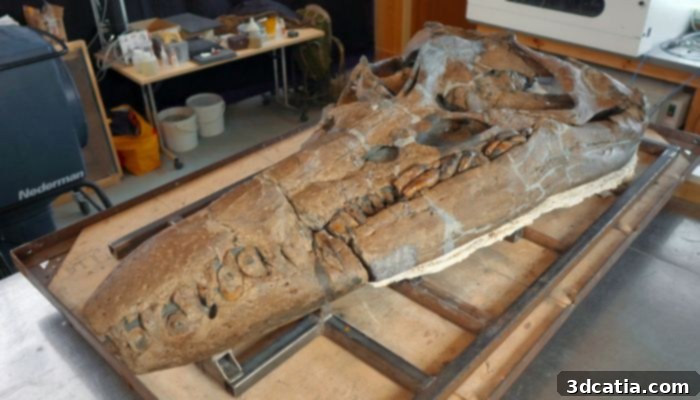
The impressive skull fossil of the pliosaur (photo credits: BBC Studios)
Reconstructing the Ancient Sea Monster: The Power of 3D Printing in Biomechanics
The pliosaur was an undisputed apex predator of its time, characterized by an incredibly powerful bite. Scientific analysis of the skull fossil, evident in its robust structure, suggests it could generate an astonishing 33,000 newtons of force. To put this into perspective, the saltwater crocodile, currently the animal with the most potent bite, manages ‘only’ about 16,000 newtons, while an average human bite force is a mere 700 newtons. This statistic alone paints a vivid picture of the pliosaur’s hunting capabilities. Beyond its formidable jaws, the pliosaur was also an agile and rapid swimmer, propelled by four powerful flippers. However, these flippers presented a significant biomechanical enigma for paleontologists. Given the creature’s massive size and weight, it remained unclear precisely how these four limbs coordinated to efficiently propel such an enormous bulk through the dense marine environment. This is where the pioneering work of Dr. Luke Muscutt and James Hogg became instrumental, bridging the gap between fossilized remains and dynamic biological function.
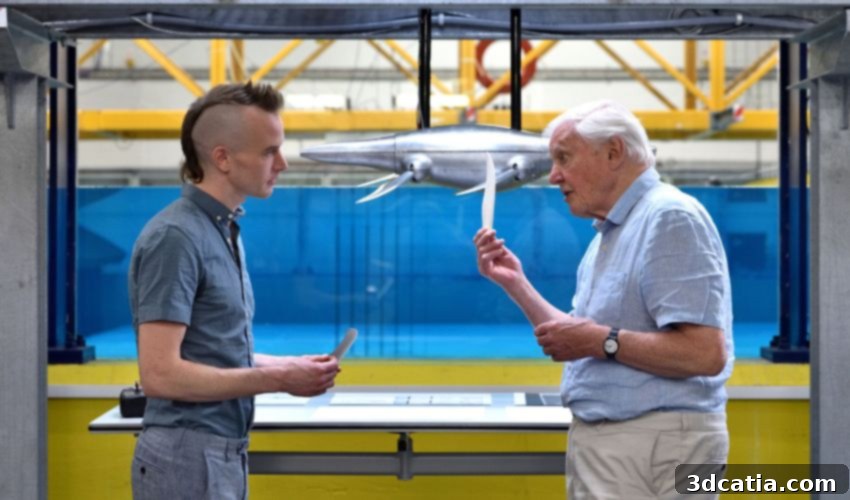
Dr. Luke Muscutt, a dedicated laboratory technician at Imperial College London, has long specialized in the study of plesiosaurs, the broader family to which pliosaurs belong. His doctoral research, culminating in critical findings in 2017, significantly advanced our understanding of how these ancient marine reptiles utilized their flippers for propulsion. Prior to his work, there was considerable debate within the paleontological community regarding their swimming mechanism. Dr. Muscutt definitively explained his breakthrough: “We found that plesiosaurs used a tandem flipper propulsion system, meaning the four flippers work together in a synchronized manner to push them through water. This system is truly unique in the animal kingdom, as almost all other flippered animals alive today, such as penguins and sea turtles, primarily use only their front two flippers for propulsion, reserving their back flippers or feet mainly for steering. Our research involved constructing a sophisticated tandem flapping flipper system, mounted on a gantry, which allowed us to isolate and study the flipper mechanics without the complexities of a full body.” This initial experimental setup was groundbreaking, yet Dr. Muscutt harbored a more ambitious vision: to create a fully formed, free-swimming robot that could replicate the pliosaur’s movement in a more complete and realistic manner, bringing his theories to tangible life.
Despite the promising early research, the aspiration to build a fully articulated, free-swimming robot remained a challenging endeavor, requiring significant resources and expertise. This pivotal project gained crucial momentum after Dr. Muscutt connected with James Hogg, the visionary founder of the recently established Yorkshire Natural History Museum in Sheffield. Hogg, impressed by Dr. Muscutt’s innovative research, enthusiastically agreed to provide the necessary support and facilities for the next phase of the project. This collaboration proved to be a turning point, allowing the theoretical science to transition into practical engineering. A significant portion of this incredible, free-swimming robot replica – specifically its outer body plates, often referred to as its ‘skin’ or hydrodynamic shell – was meticulously crafted using a state-of-the-art metal 3D printer housed at the Yorkshire Natural History Museum. Dr. Muscutt articulated precisely why the team opted for additive manufacturing for such a critical component, stating, “The sheer brilliance of 3D printing lies in the fact that the vast majority of the intricate work is done upfront, in the computer-aided design (CAD) phase. Once the digital model is perfected on the computer screen, you can simply send it to the printer. This eliminates the need for extensive, time-consuming manual adjustments or rework later – apart from the final assembly process and some essential finishing touches like sanding and painting. This precision and efficiency were paramount for accurately replicating the complex biomechanics of the pliosaur.” The ability to rapidly prototype, iterate designs, and produce custom parts with high accuracy made 3D printing an indispensable tool for bringing this ancient creature back to dynamic existence.
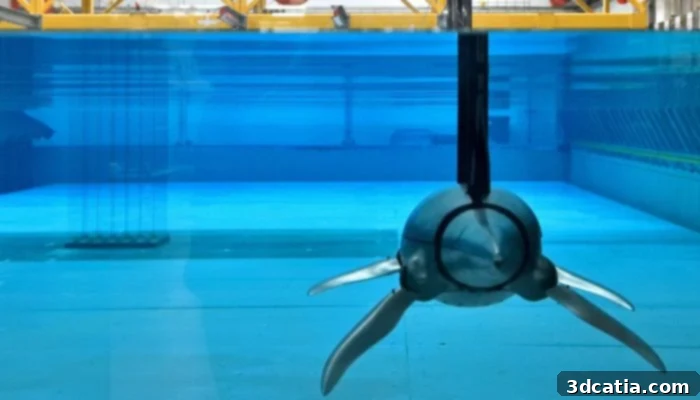
The impressive 3D printed ‘sea monster’ pliosaur robot swimming in action (photo credits: Jo Mieszkowski/Imperial College London)
The culmination of this innovative research and technological application was the successful testing of the final robot replica, affectionately nicknamed “Flip,” in Imperial College London’s cutting-edge wave tank facility. The results were astounding, providing tangible proof of Dr. Muscutt’s tandem flipper propulsion hypothesis. This breakthrough was not just confined to academic circles; it was brought directly to millions of viewers worldwide through the BBC broadcast featuring Sir David Attenborough. The sight of the 3D-printed pliosaur robot gracefully and powerfully navigating the water offered an unprecedented visual understanding of how this ancient ‘sea monster’ would have moved in its Jurassic habitat. It eloquently demonstrated how a blend of modern additive manufacturing and meticulous paleontological research can bridge millennia, bringing the distant past into the tangible present and offering profound insights into prehistoric life. But the journey of discovery and reconstruction is far from over. Dr. Muscutt and his team are already planning the next phase of development for Flip. Their ambitious plans include redesigning the pliosaur model to achieve even more realistic and nuanced flipper motions. Furthermore, they aim to precisely determine the creature’s potential swimming speed and investigate the crucial role its head and neck played in steering and overall hydrodynamics, building upon the initial success to refine their understanding.
To achieve these advanced objectives, 3D printing will once again be at the forefront of the research methodology. The next iterations of Flip will leverage the unparalleled precision of additive manufacturing to recreate the delicate and complex internal bone structures of plesiosaur flippers. This will allow for a more accurate emulation of the flippers’ natural flexibility and hydrofoil capabilities, which are essential for true-to-life biomechanical analysis. A significant enhancement for this next phase comes in the form of a change in 3D printing technology and materials. Dr. Muscutt has successfully secured sponsorship from FormLabs, facilitated through Creat3D, a leading provider of professional 3D printing solutions. This partnership means that subsequent versions of the pliosaur replica will likely be fabricated using advanced materials such as Thermoplastic Polyurethane (TPU) or other flexible polymers. These materials offer enhanced elasticity and resilience, critical properties for mimicking the dynamic movement of biological tissues and skeletal components, thereby ensuring even greater anatomical and functional accuracy in the models. This ongoing collaboration highlights how industrial partnerships and advancements in material science are accelerating scientific discovery, allowing researchers to push the boundaries of what’s possible in paleontological reconstruction and biomimicry. For those eager to delve deeper into this fascinating project and learn more about the making of the documentary, comprehensive details are available on Imperial College London’s dedicated website, accessible HERE.
What are your thoughts on the groundbreaking use of 3D printing to breathe life into this colossal ‘gigantic sea monster’ from the Jurassic period? Do you believe this fusion of ancient history and cutting-edge technology marks a new era for paleontological research and education? We invite you to share your insights in a comment below or join the conversation on our LinkedIn, Facebook, and Twitter pages! For the latest advancements and news in the additive manufacturing world, don’t forget to sign up for our free weekly Newsletter here, delivered straight to your inbox! You can also explore all our engaging videos and content on our YouTube channel.