
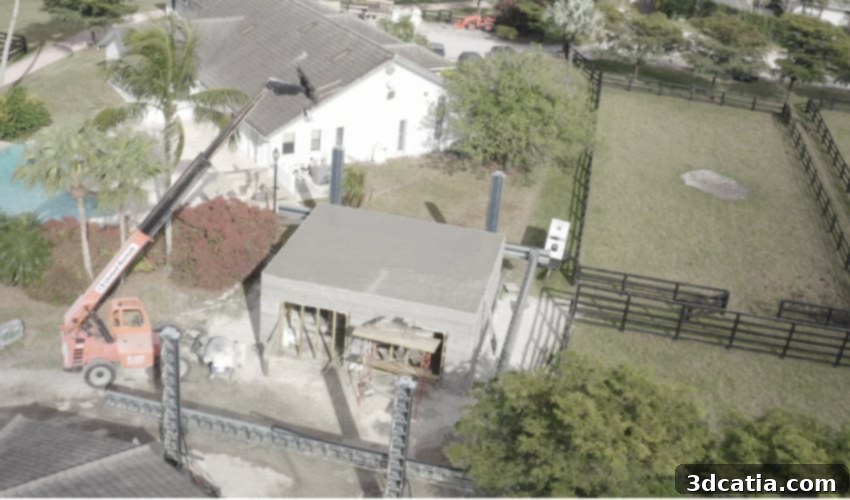
Florida’s First 3D Printed Building: Pioneering Sustainable, Hurricane-Resistant Construction with COBOD Technology
The future of construction is rapidly taking shape, and Florida is now at the forefront of this revolution. Printed Farms, an innovative Florida-based start-up, has successfully completed the 3D printing phase of the state’s very first 3D printed building. This groundbreaking project utilized a state-of-the-art COBOD BOD2 printer, a technology that has already proven its mettle in numerous construction endeavors globally over the past year. The adoption of 3D printing in construction is gaining unprecedented momentum, increasingly recognized as a viable and effective solution to the pressing worldwide affordable housing crisis. Beyond cost-efficiency, this advanced method also champions more sustainable building practices across the board. Printed Farms harbors ambitious aspirations, aiming to leverage the BOD2 printer for a multitude of future construction projects, thereby introducing hurricane and flood-resistant, environmentally friendly buildings to a state that desperately needs them.
The Global Ascent of 3D Printing in Construction
The construction industry worldwide is undergoing a significant transformation, with 3D printing emerging as a disruptive force. In recent months alone, we’ve witnessed the unveiling of numerous 3D printed structures in diverse international locations, with COBOD printers playing a pivotal role in pioneering projects across Europe, Africa, and India. These projects are not merely experimental; they are demonstrating the practical feasibility and immense potential of additive manufacturing for large-scale structures. Concurrently, the field has seen remarkable advancements in both construction techniques and the development of innovative materials. For instance, in Italy, the revolutionary TECLA eco-habitat was successfully 3D printed using solely local soil, representing a monumental leap forward in sustainable building practices that minimize environmental impact. Furthermore, researchers at the prestigious RMIT in Australia have discovered novel methods for strengthening 3D printed concrete, enhancing its structural integrity and broadening its application possibilities. These global innovations underscore the rapid evolution and growing sophistication of 3D printing technology in architecture and civil engineering.
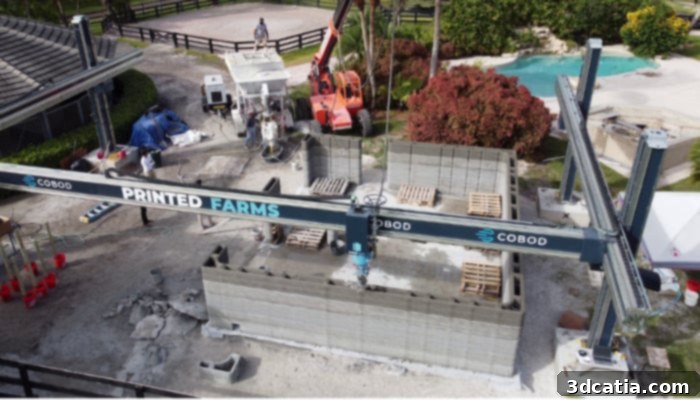
This is the first time a COBOD printer has been used in the US. However, they have already been used in other construction projects in other countries (photo credits: COBOD)
The surge in interest surrounding 3D printing for construction stems from a confluence of compelling factors. Perhaps most notably, 3D printing is increasingly viewed as a viable remedy for the escalating housing crisis, a challenge that is already impacting vast regions of the world, with the United States particularly affected. The ability to construct homes faster and at a lower cost offers a ray of hope for communities struggling with housing shortages. Beyond affordability, 3D printing also represents a significant stride towards more sustainable housing. The additive nature of the technology inherently produces significantly less waste during the building process compared to traditional construction methods, making it an eco-friendlier alternative. This reduction in material waste, coupled with the potential for optimized material usage, contributes to a smaller environmental footprint. Commenting specifically on the situation in the US, the Founder and General Manager of COBOD articulated the clear demand and their company’s readiness to meet it: “We are seeing a strong interest from the US market and have 3 more printers on the way to the US this year. The US is short of affordable quality housing and we have the technology to deliver precisely that in a fast and economical way using much less labor, than alternative methods.” This statement highlights not only the speed and cost-efficiency but also the reduced labor requirements, which can help address skilled labor shortages in the construction sector.
Innovating Homebuilding: The First 3D Printed Building in Florida Takes Shape
The inaugural 3D printed building in Florida, a 784 square foot (approximately 71 m2) storage unit, was meticulously constructed by Printed Farms using the advanced COBOD BOD2 printer. This gantry-based printer, measuring an impressive 50 x 42 x 33 feet (15 x 12.5 x 10 m), is one of the few machines globally capable of handling projects of this substantial size. Its modular design allows for scalability, making it suitable for a wide range of building dimensions. The completed structure stands as a testament to the robustness of 3D printed construction, having been systematically reinforced with rebar and integrated with an Insulated Concrete Form (ICF) platform system, all of which received the official sign-off from a qualified structural engineer. This rigorous approval process ensures the building’s compliance with safety and structural integrity standards, paving the way for wider acceptance of the technology. Building on this success, Printed Farms is already making plans to commence work on two 3D printed intercoastal villas in Florida, pushing the boundaries of what’s possible with additive manufacturing in residential development. The company confidently asserts that, with the BOD2, they possess the capability to produce 2000 square foot (180m2) floors across three stories, culminating in expansive 6000 square foot (540m2) buildings. This capacity demonstrates the scalability of 3D printing beyond mere accessory dwelling units, signaling its readiness for mainstream residential applications.
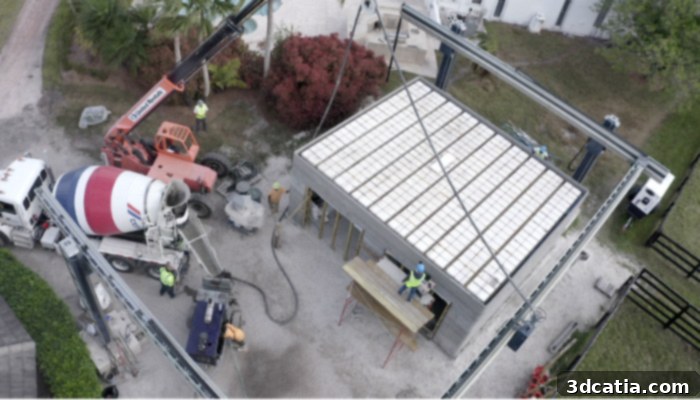
An insulated roof was put into the building (photo credits: COBOD)
Addressing Florida’s Unique Challenges with 3D Printing: Resilience and Sustainability
Printed Farms’ overarching goal extends far beyond merely establishing 3D printing as a standard for both small and large-scale construction projects across the United States. Their vision is deeply rooted in addressing the unique environmental challenges faced by Florida, the nation’s fastest-growing state. Given its geographical location, Florida is regrettably the state most frequently impacted by hurricanes in the US. These powerful storms inflict immense property and housing damage annually, displacing countless residents and costing billions in repairs and reconstruction. In this context, the ability to construct affordable, rapidly deployable, and inherently hurricane-resistant housing is not merely an advantage but a critical necessity for the region’s long-term resilience. 3D printing emerges as a compelling solution for this multifaceted challenge. The monolithic nature of 3D printed walls, formed by continuously extruded concrete layers, often results in structures with superior strength and wind resistance compared to conventionally built homes. This inherent structural integrity, combined with the speed of construction, means communities can rebuild faster and more robustly after natural disasters. Moreover, Printed Farms is committed to delivering “green buildings.” This commitment encompasses not only the reduction of construction waste, a core benefit of 3D printing, but also the potential for optimized designs that enhance energy efficiency and the exploration of sustainable, locally sourced materials. Such an approach reduces the environmental footprint of buildings throughout their lifecycle, contributing to Florida’s broader sustainability goals. By integrating these innovations, Printed Farms aims to provide durable, affordable, and eco-conscious housing solutions that can withstand the rigors of Florida’s challenging climate, setting a new benchmark for resilient construction. You can find out more about Printed Farms’ pioneering efforts and their vision for the future of building in Florida by visiting their website HERE.
The Future Landscape of 3D Printed Homes and Communities
The completion of Florida’s first 3D printed building signifies more than just a technological achievement; it marks a pivotal moment in the evolution of modern construction. This project, spearheaded by Printed Farms with COBOD’s advanced BOD2 printer, demonstrates the immense potential for creating not only cost-effective and sustainable housing but also homes engineered for enhanced resilience against natural disasters. The implications for regions like Florida, constantly battling hurricanes and floods, are profound. Imagine communities where homes are built quickly, with minimal waste, and designed to withstand extreme weather, offering security and stability to residents. The efficiency of 3D printing, particularly its ability to reduce labor dependency and accelerate construction timelines, positions it as a key player in solving global housing crises. As research continues to advance in materials science and printing techniques, the possibilities for customization, architectural innovation, and environmental performance will only expand. We are witnessing the dawn of a new era where buildings are not just erected but intelligently fabricated, promising a future of smarter, safer, and more sustainable living spaces for everyone.
What do you think about this significant milestone in 3D printed construction? Have you been following COBOD’s extensive worldwide projects and their impact? We invite you to share your thoughts and insights in a comment below or join the conversation on our Facebook, Twitter and LinkedIn pages! To stay informed with the very latest developments and news in 3D printing, remember to sign up for our free weekly Newsletter here, delivered straight to your inbox!
Thumbnail photo credits: COBOD