
Transforming Plastic Waste into New Possibilities: The Rise of 3D Printing for a Sustainable Future with Plast’if
In an era increasingly defined by environmental consciousness, innovative technologies are stepping up to address pressing ecological challenges. Among these, 3D printing, also known as additive manufacturing, has emerged as a powerful tool for promoting sustainability and tackling issues like plastic waste and resource depletion. Beyond creating intricate prototypes or complex industrial parts, this technology is now being leveraged to foster greater awareness about ecology and recycling, offering tangible solutions that bridge the gap between waste and valuable products. Numerous companies and initiatives are demonstrating how 3D printing can lead to more environmentally friendly objects, tackle social issues like homelessness by constructing affordable housing, or even aid in regenerating vital ecosystems by repurposing waste materials into new, useful items.
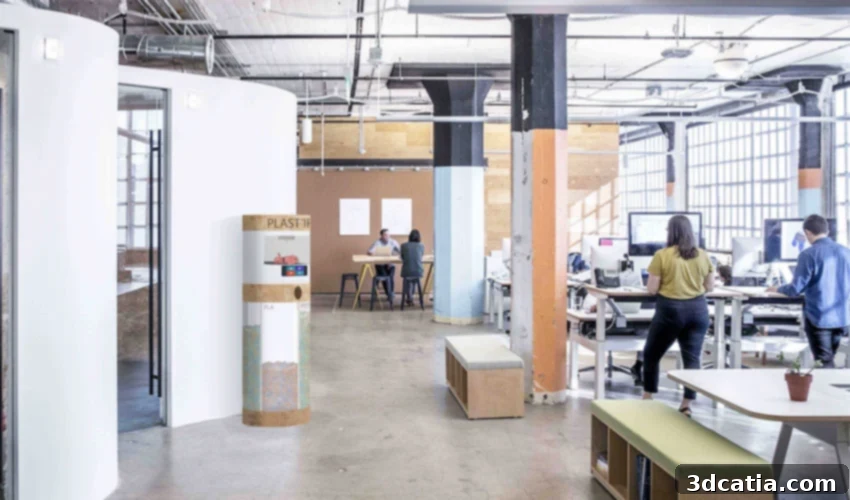
One such pioneering company at the forefront of this movement is Plast’if. They are ingeniously using 3D printing to revolutionize plastic recycling by developing a machine that transforms workplace plastic waste into new, functional 3D-printed objects. This innovative approach allows employees to actively participate in a circular economy, witnessing the direct impact of their recycling efforts. By converting discarded plastic directly into new creations, Plast’if not only diverts waste from landfills but also fosters a culture of sustainability, where recycling is not just valued but visibly rewarded. We recently had the opportunity to speak with Cassandra Delage, the visionary founder and CEO of Plast’if, to delve deeper into this remarkable ecological and collaborative innovation and understand its potential to reshape our approach to waste management.
3DN: Can you introduce yourself and explain your connection with 3D printing and sustainability?
 Hello, I’m Cassandra Delage, and I am the founder of Plast’if! My journey into 3D printing began with a strong desire to make a tangible difference in how we handle plastic waste. The core idea behind Plast’if is to make recycling a more engaging, transparent, and rewarding process, particularly within corporate environments. Our Plast’if machine is designed to recycle all plastic waste generated by employees within a company, and crucially, it enables them to directly 3D print new objects from this very waste. This creates a powerful, visible link between their recycling efforts and the creation of something new and useful.
This isn’t just about collecting plastic; it’s about creating a complete, on-site recycling ecosystem within a single machine, right in front of the employee. This immediate feedback loop is incredibly powerful. Employees are not just encouraged to recycle; they are motivated because each contribution is tangibly rewarded with the ability to create new 3D objects. This transforms the often-abstract concept of recycling into a concrete, interactive, and highly rewarding experience. At its heart, Plast’if is redefining the recycling process and experience, turning waste management into a valuable, integrated business practice that promotes a circular economy and corporate social responsibility.
3DN: How exactly does the Plast’if machine work? What are its key specifications and capabilities?
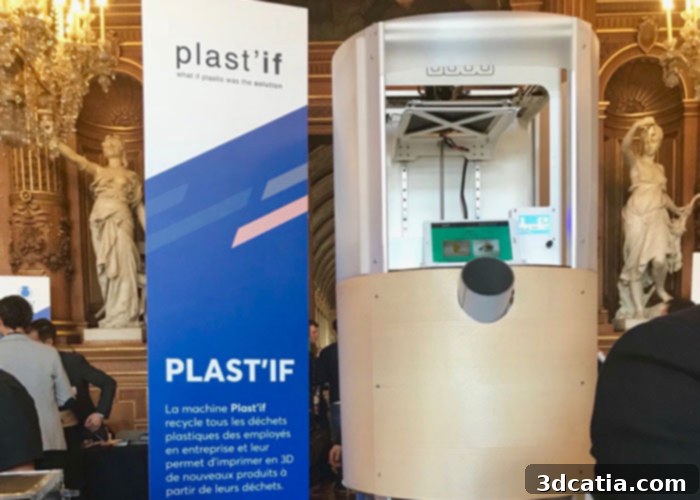
The Plast’if machine is an integrated, end-to-end recycling and 3D printing solution. It meticulously carries out the complete recycling process in a series of sophisticated steps. Firstly, our proprietary Artificial Intelligence (AI) system conducts a precise analysis of the incoming plastic waste, identifying types and ensuring suitability for processing. This smart sorting mechanism is crucial for maintaining the quality of the recycled material. Following analysis and sorting, the plastic undergoes a grinding process, reducing it into smaller, more manageable flakes. These flakes are then transformed into high-quality 3D printing filament, ready for use.
Once the filament is produced, the machine moves seamlessly into the 3D printing phase. Employees can then interact with a user-friendly touch screen interface, which displays a curated catalog of objects they can choose to print directly from the recycled plastic material. The range of printable objects is incredibly diverse and designed to cater to various needs and contexts. This includes practical items for individual employees, such as ergonomic computer stands, or collaborative projects for team-building sessions, like customizable office furniture. Furthermore, the machine supports community partnerships, allowing for the creation of socially impactful items such as prosthetics. We also collaborate with design schools, offering opportunities to print unique design objects, fostering creativity and practical application of recycled materials. This comprehensive process, from waste to a finished product, makes the Plast’if machine a powerful tool for on-site, sustainable manufacturing.
3DN: What is the fundamental link between 3D printing and plastic waste recycling, and why is this connection so crucial for our future?
Our primary goal at Plast’if is to fundamentally change the perception and experience of recycling. Traditionally, recycling can feel like a detached process; you put items in a bin, and their fate remains largely unseen. By creating a transparent, short-circuit system, where waste is transformed into a new product directly on-site, employees gain an immediate and powerful understanding that plastic is not merely waste, but a valuable resource. They can visually connect their act of recycling with the tangible creation of a new object.
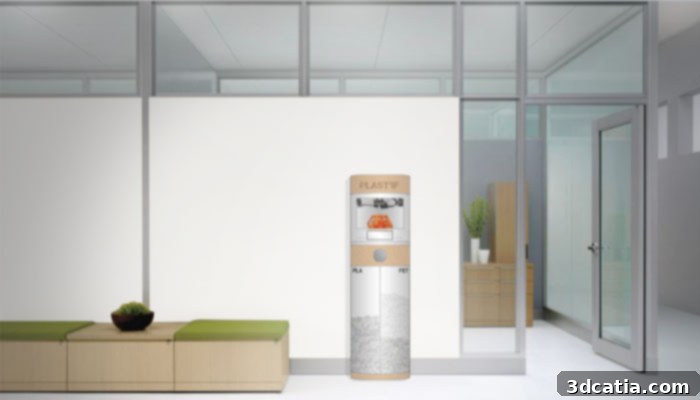
This direct engagement empowers every employee to see that their individual actions make a significant difference. The Plast’if machine doesn’t just recycle; it educates and inspires. It highlights the principles of the circular economy, where materials are kept in use for as long as possible, rather than being discarded after a single use. This hands-on experience demystifies the recycling process and demonstrates the incredible potential of transforming waste into useful items, fostering a deeper sense of responsibility and encouraging more sustainable habits both within and outside the workplace. It transforms passive participation into active creation, making sustainability a personal and rewarding endeavor.
3DN: What do you foresee as the future role of 3D printing, especially within work environments and corporate innovation?
I firmly believe that 3D printing is poised to take on a significantly larger and more integrated dimension, particularly within professional and corporate settings. We are already witnessing a trend where major corporations are incorporating internal ‘fablabs’ – fabrication laboratories equipped with 3D printers and other advanced manufacturing tools – directly into their offices and R&D departments. This strategic integration provides companies with an unprecedented level of agility, allowing them to operate with the speed and flexibility typically associated with startups.
This technology is already enabling companies to accelerate their prototyping cycles, test new ideas more rapidly, and iterate on designs with remarkable efficiency. The ability to quickly produce physical models from digital designs means that product development timelines are drastically shortened. This facility for rapid prototyping allows businesses to produce highly refined products that are far more responsive to evolving customer needs and market demands. Furthermore, it fosters a culture of innovation, experimentation, and problem-solving among employees, empowering them to bring their ideas to life quickly. Beyond prototyping, 3D printing also opens doors for on-demand manufacturing of custom tools, spare parts, and even personalized products, reducing reliance on external supply chains and minimizing waste from overproduction. This shift towards localized, agile manufacturing truly represents a significant leap forward for corporate innovation and operational efficiency.
3DN: Do you have a final message for our readers regarding sustainability and the potential of 3D printing?
My closing message to your readers is one of immense potential and empowerment. It’s truly remarkable what can be achieved today with recycled plastic. We often underestimate the value of what we consider ‘waste.’ Through technologies like 3D printing, we can unlock an incredible array of possibilities, transforming discarded materials into exciting and functional 3D objects. It’s important to recognize that every piece of plastic recycled is a step towards a more sustainable future.
I strongly encourage everyone to support and encourage people around them to recycle. Not only does it contribute to vital environmental conservation, but with innovations like the Plast’if machine, it also allows you to engage directly in the creation of unique and exciting items. Our machine is simply a tool to help facilitate this transformation, making it easier and more rewarding than ever before to turn plastic waste into valuable resources. We invite you to explore the possibilities and join us in this movement. If you’re inspired by our vision, please feel free to support our project for the Aviva Factory Contest!
The work of Plast’if exemplifies a growing trend where technological advancements are being harnessed for environmental good. By democratizing the recycling process and making it an engaging, rewarding activity, Plast’if is not just managing waste; it’s cultivating a new generation of eco-conscious individuals and businesses. This shift in mindset, coupled with the power of additive manufacturing, holds the promise of a future where resources are valued, waste is minimized, and sustainability is woven into the very fabric of our daily lives and industries. It’s a testament to how innovation can inspire meaningful change, proving that a better, more sustainable future is not only possible but actively being built, one recycled plastic object at a time.
What are your thoughts on the Plast’if machine and the potential of 3D printing for recycling? Let us know your insights and comments below, or connect with us on our official Facebook and Twitter pages! Don’t miss out on the latest news and innovations in 3D printing; sign up for our free weekly Newsletter to get all the cutting-edge updates delivered straight to your inbox!