
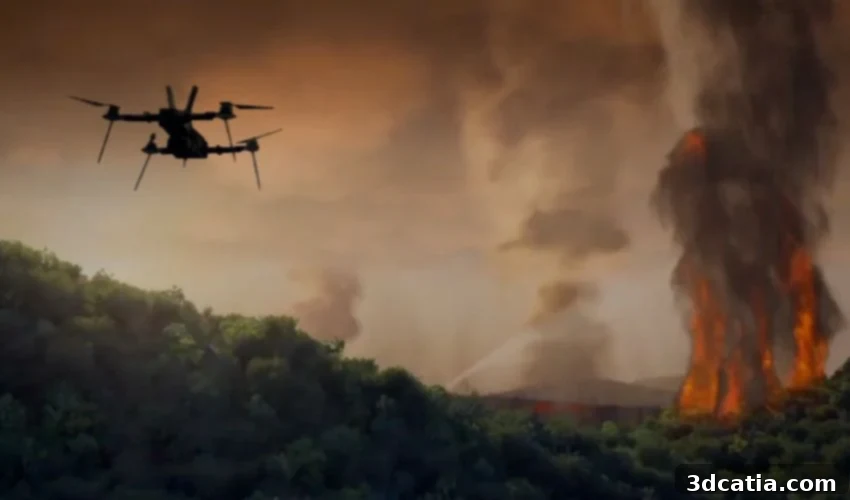
3D Printed Drones Revolutionize Wildfire Management: Axle Box and Essentium Pioneer Fire-Resistant Solutions
The escalating threat of wildfires has become a pressing global concern, devastating communities, destroying natural habitats, and inflicting billions of dollars in economic damages annually. In the United States alone, recent years have seen record-breaking wildfire seasons, with 2021 witnessing 8,619 wildfires that scorched nearly 2.6 million acres. These catastrophic events underscore an urgent need for advanced, resilient technologies to aid in prevention, management, and suppression efforts. Addressing this critical challenge head-on, public safety technology developer Axle Box Innovations has embarked on a groundbreaking initiative, leveraging the power of additive manufacturing to engineer state-of-the-art 3D printed drones specifically designed for fire management and protection. This innovative approach seeks to overcome the traditional obstacles of strength, speed, and cost often associated with creating specialized equipment capable of enduring the extreme conditions of active wildfires.
As the frequency and intensity of wildfires continue to grow, firefighters and emergency responders are increasingly relying on innovative technologies, such as advanced robotics and additive manufacturing, to enhance their operational capabilities. When confronting a nascent wildfire outbreak, obtaining an accurate, real-time assessment of the situation is paramount. This crucial initial phase requires specialized drones equipped to safely navigate close to the flames, meticulously analyze the fire’s extent, identify hot spots, and even precisely count the number of distinct fire zones within a given area. Unfortunately, conventional commercial drones are fundamentally unsuitable for such hazardous missions. Their standard materials and electronic components are simply not engineered to withstand the immensely high temperatures and harsh environmental conditions prevalent near active wildfires, leading to rapid material degradation and system failure.
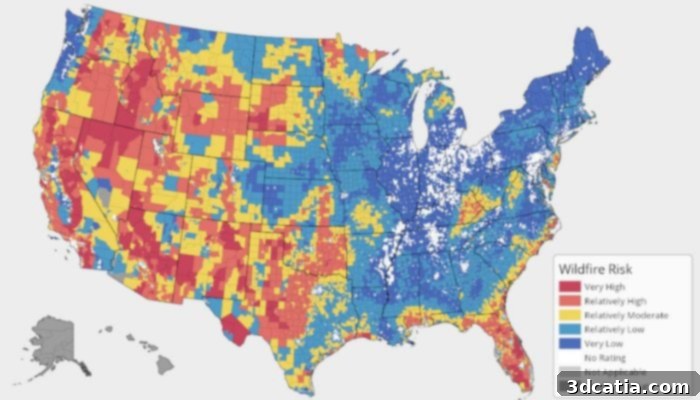
A map showing the areas with the highest risk of wildfires. Wildfires have increased over the years especially in dry areas like the West due to global warming (photo credits: FEMA)
Creating the Next Generation of Fire-Safe Drones with Additive Manufacturing
The quest for the right technologies and materials to develop genuinely heat-resistant and robust drones led the dedicated engineers at Axle Box Innovations to the cutting-edge solutions offered by Essentium, a leader in industrial additive manufacturing. This pivotal partnership marked a significant step forward in bringing these advanced firefighting drones to fruition. Blake Teipel, Ph.D., CEO of Essentium, emphasized the critical nature of this collaboration, stating, “As first responders gear up for fire season, firefighters need nimble remote-controlled drones to achieve visual oversight of wildfires in virtually every type of environment – from urban areas to rural deserts. We are excited Axle Box Innovations has chosen our 3D printing platform to enable the development of structurally rugged drones that can withstand these extremely harsh conditions.” This sentiment perfectly encapsulates the strategic alignment between Axle Box’s mission to enhance public safety and Essentium’s prowess in delivering high-performance additive manufacturing solutions.
The collaboration between Axle Box and Essentium extends beyond just materials; it encompasses an entire ecosystem designed for rapid iteration and production of specialized components. Essentium’s comprehensive additive manufacturing platform provides Axle Box with the tools to innovate at an unprecedented pace, transforming the landscape of drone design and deployment for emergency services. The synergy between a public safety technology developer and an industrial additive manufacturing specialist is proving instrumental in pushing the boundaries of what is possible in extreme environment robotics.
Advanced Materials: The Core of Heat-Resistant Drone Technology
The backbone of these innovative, fire-resistant drones lies in the selection and application of cutting-edge materials. For the crucial components requiring exceptional thermal stability and structural integrity, Axle Box is utilizing a high-temperature nylon reinforced with a 25% carbon fiber core. This advanced composite material is strategically employed for the drone’s mid-body and its protective side covers. The inherent properties of this material—specifically its remarkable heat resistance and robust mechanical strength—are critical in ensuring that the drone maintains its shape, structural integrity, and full operational functionality even when directly exposed to the intense temperatures encountered during wildfire reconnaissance missions. Unlike conventional plastics, this specialized carbon fiber-reinforced nylon is engineered to prevent warping, melting, or loss of strength under extreme thermal loads.
Beyond its impressive heat resistance, the material also facilitates the creation of drone bodies that are both incredibly lightweight and remarkably robust. This combination of attributes is paramount for the operational success and safety of these specialized aircraft. A lightweight design contributes significantly to extended flight times, improved maneuverability, and the ability to carry heavier sensor payloads, which are vital for comprehensive fire assessment. Concurrently, the material’s inherent robustness ensures that the drone can withstand the physical stresses of flight, potential impacts, and the harsh conditions of its operational environment. These critical characteristics are directly enabled by the precision and flexibility offered by additive manufacturing.
For the actual manufacturing process, Axle Box made the strategic choice to deploy Essentium’s HSE (High-Speed Extrusion) 3D Printer. This industrial-grade system is renowned for its capabilities, which include an independent dual extrusion (IDEX) system and compatibility with a wide array of advanced engineering filaments. The IDEX system allows for multi-material printing or the use of soluble support structures, which is essential for complex geometries and efficient post-processing. The printer’s high-speed extrusion capabilities significantly accelerate production, enabling Axle Box to rapidly prototype and produce critical drone components with unparalleled efficiency and precision. This combination of advanced material and high-performance printing technology is what truly sets these fire-safe drones apart, providing an innovative answer to the escalating challenges of wildfire management.

Photo Credits: National Archives at College Park – Still Pictures
Revolutionizing Development Cycles and First Responder Agility
The impact of Essentium’s additive manufacturing platform on Axle Box’s development process has been transformative, as articulated by Madison Jones, Director of Additive Manufacturing at Axle-Box. He stated, “The speed, scale, and economics of the HSE 3D Printer combined with Essentium’s array of advanced 3D printing filaments are changing the game for the design and development of drone platforms. The HSE has transformed our manufacturing floor, and we typically go from design to production in under four weeks. If we need a new part, we can have one printed and up in the air in a couple of hours. Our first responder customers will benefit greatly from this innovation agility.” This profound statement highlights the paradigm shift that industrial 3D printing introduces to product development, particularly for critical public safety applications.
The ability to transition from an initial design concept to a fully functional, production-ready part in less than four weeks is a testament to the efficiency and flexibility of additive manufacturing. Furthermore, the capacity to print and deploy a new or replacement part within mere hours provides an unprecedented level of operational agility. This rapid iteration capability is invaluable in an environment where prototypes need to be rigorously tested, modified, and re-tested to meet stringent performance requirements under extreme conditions. For firefighting drones, this means faster integration of design improvements, quicker adaptation to specific mission needs, and ultimately, a more reliable and effective tool for first responders.
These heat-resistant drones are poised to become indispensable assets for firefighters, providing real-time, high-fidelity data that can significantly enhance situational awareness and strategic planning. By offering a safer means to conduct aerial reconnaissance, they reduce the risks traditionally associated with human-crewed flights or ground-based assessments in dangerous fire zones. While the exact timeline for these advanced drones to be fully operational and aid in the fight against wildfires remains under wraps, the foundational technologies and specialized materials are already well-established. This strong groundwork suggests that production finalization and deployment could be imminent, offering a powerful new tool in the ongoing battle against devastating wildfires. The full press release detailing this collaboration can be found HERE.
The Future of Wildfire Response: Enhanced Safety and Strategic Advantage
The development of these 3D printed, fire-safe drones by Axle Box Innovations, powered by Essentium’s additive manufacturing expertise, marks a significant leap forward in public safety technology. The ability to deploy rugged, heat-resistant unmanned aerial vehicles (UAVs) offers a strategic advantage that can save lives, protect property, and preserve critical natural resources. These drones will provide firefighters with unprecedented access to vital information about fire perimeters, intensity, spread trajectory, and potential hazards, all without risking human lives in dangerous reconnaissance missions. Imagine drones equipped not only with standard cameras but also with thermal imaging sensors to pierce through smoke, multispectral cameras to identify vegetation stress, and even gas sensors to detect hazardous fumes – all made possible by their ability to withstand extreme conditions and carry specialized payloads.
This innovation is a testament to how cutting-edge manufacturing techniques, particularly industrial 3D printing, can address some of the most challenging real-world problems. As wildfires continue to threaten communities globally, the agility and material science advancements brought forth by Axle Box and Essentium provide a beacon of hope. The shift from traditional manufacturing limitations to the rapid, customizable, and high-performance capabilities of additive manufacturing is set to redefine what is possible in emergency response. The potential for these drones to not only assess but also potentially deliver small payloads for controlled burns or targeted suppression in areas inaccessible to ground crews opens up even further possibilities for future developments.
What are your thoughts on the revolutionary production of 3D printed drones designed to bolster the capabilities of firefighters in combating wildfires? We invite you to share your insights in a comment below or engage with us on our social media channels, including LinkedIn, Facebook, and Twitter! Don’t miss out on the latest advancements in additive manufacturing—be sure to sign up for our free weekly Newsletter here to receive the freshest 3D printing news directly in your inbox. Additionally, explore our extensive library of videos on our YouTube channel for more compelling content.