
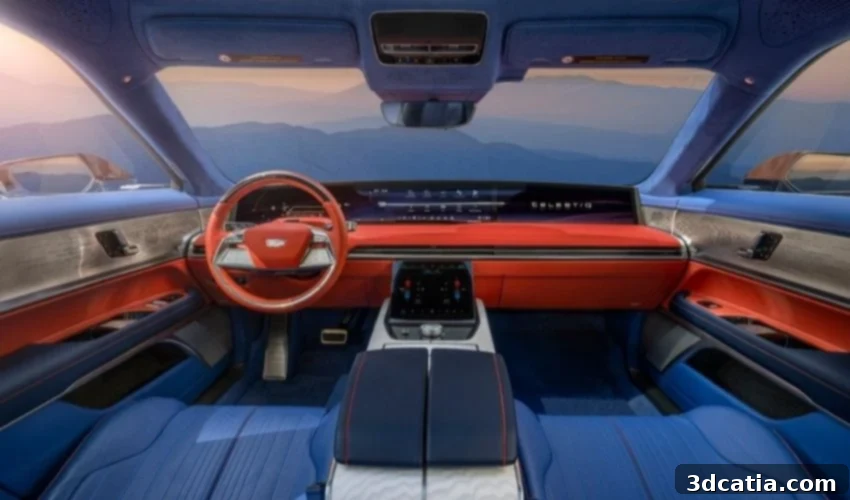
Cadillac CELESTIQ: Driving Automotive Innovation with Over 130 3D Printed Parts
General Motors (GM) has long been at the forefront of automotive innovation, utilizing advanced manufacturing techniques to push the boundaries of vehicle design and production. For decades, the company has leveraged additive manufacturing, commonly known as 3D printing, primarily to accelerate vehicle development through the creation of functional prototypes. This strategic application allowed engineers to quickly iterate designs, test components, and refine concepts with unprecedented speed and cost-efficiency. However, GM has now taken a monumental step forward, integrating 3D printing directly into automobile production, particularly for its most exclusive and technologically advanced low-volume models, such as the groundbreaking Cadillac CELESTIQ.
This pivotal shift from prototyping to full-scale production underscores a significant evolution in automotive manufacturing. A few years ago, GM cemented its commitment to this transformative technology with a substantial $81 million investment specifically targeted at enhancing additive manufacturing capabilities for the Cadillac CELESTIQ program. This bold financial commitment signaled GM’s intent to harness the full potential of 3D printing, moving beyond mere experimentation to establish it as a core pillar of its manufacturing strategy for luxury vehicles. Today, the world has witnessed the culmination of this investment with the grand unveiling of the Cadillac CELESTIQ, a vehicle that seamlessly integrates a remarkable array of 3D printed parts, redefining what is possible in automotive design and craftsmanship.
The Cadillac CELESTIQ is not merely a car; it is a statement—a handcrafted, ultra-luxury electric sedan meticulously designed to redefine the prestige and innovation associated with the Cadillac brand. Every aspect of this vehicle exudes exclusivity and advanced engineering. What truly sets the CELESTIQ apart is its unprecedented level of personalization and the sheer volume of bespoke components. It proudly stands as one of the most customized vehicles ever manufactured by GM, distinguishing itself by incorporating more than 130 3D printed components. The inherent precision, versatility, and design freedom offered by additive manufacturing make it an ideal tool for crafting these unique, high-quality, and often geometrically complex parts. This integration allows for a level of detail and optimization that would be virtually impossible or prohibitively expensive to achieve through traditional manufacturing methods. Let’s delve deeper into some of the outstanding and innovative applications of 3D printing found within this extraordinary vehicle.
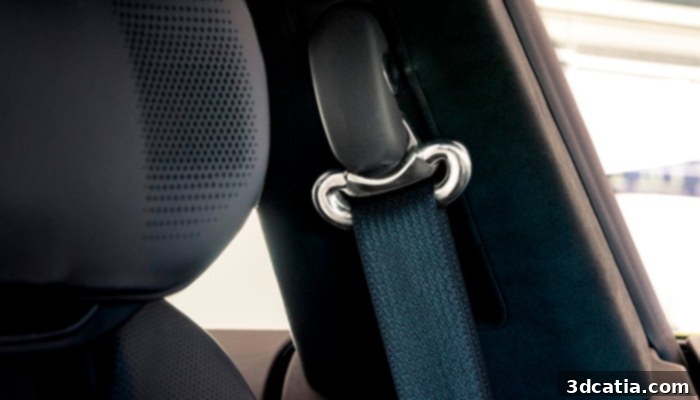
3D printed adjustable seat belt guide ring.
Revolutionizing Design and Functionality with 3D Printing on Cadillac CELESTIQ
Among the myriad of 3D printed components within the Cadillac CELESTIQ, one of the most representative and visually striking elements is the flywheel hub, an integral part of the steering wheel assembly. This sophisticated component is manufactured using laser powder bed fusion (L-PBF) technology. L-PBF is an advanced metal 3D printing process that uses a high-powered laser to selectively melt and fuse metallic powders layer by layer, creating highly dense and robust parts. This technique is particularly adept at producing complex and resistant metal parts with intricate internal geometries that would be impossible or exceedingly difficult to achieve with conventional manufacturing methods like casting or machining. The use of L-PBF not only enables superior structural integrity but also allows for unparalleled design freedom.
The steering wheel component, beyond its functional prowess, is a masterpiece of aesthetic refinement. Its design thoughtfully incorporates the integration of LED backlighting, which is visible directly through the material. This innovative feature reinforces the vehicle’s profound sense of sophistication and modernity, offering both functional illumination and an enhanced tactile experience. The ability to embed such intricate features directly into the component during the printing process significantly streamlines assembly and allows for cleaner, more integrated designs. Notably, this 3D printed flywheel hub has earned the distinction of becoming the largest metal part mass-produced by General Motors using additive manufacturing to date, marking a significant milestone in the company’s adoption of the technology for production-ready, critical components.
Another exceptionally significant component showcasing the transformative power of 3D printing in the CELESTIQ is the adjustable seat belt guide ring, prominently displayed in the image above. This part, also meticulously crafted using additive manufacturing, represents a groundbreaking achievement: it is the first application of a 3D printed metal safety component integrated into a GM production vehicle. The implications of this are immense, demonstrating the technology’s capability to meet stringent automotive safety standards while offering enhanced design possibilities. Traditional manufacturing of such safety-critical parts often involves complex tooling and assembly, limiting design flexibility. With 3D printing, GM can optimize the part’s geometry for both strength and occupant comfort, potentially even reducing its weight without compromising safety.
The manufacturing of these pioneering 3D printed components, particularly the metal parts, takes place primarily at GM’s state-of-the-art Additive Industrialization Center (AIC). Located on GM’s sprawling technology campus in Warren, Michigan, the AIC is a testament to the company’s commitment to in-house additive manufacturing expertise. Opened in December 2020, this cutting-edge facility spans an impressive area of 1,400 square meters (approximately 15,000 square feet) and houses more than 20 advanced machines capable of printing in both polymeric and metallic materials. The AIC serves as a vital hub for research, development, and industrial-scale production, allowing GM engineers to rapidly prototype, test, and validate complex designs, ensuring that every 3D printed part meets the highest standards of quality, performance, and safety for the CELESTIQ and future vehicles.
Brennon White, a respected technical specialist for advanced manufacturing production applications at GM, succinctly articulates the strategic thinking behind their additive manufacturing decisions. He explains, “When looking at whether to use additive manufacturing, we ask ‘can it meet the functional requirements, and does it make sense economically?’ If the answer is yes to both, we know we should target AM. That’s what we did with CELESTIQ – and additive gave us something that we never could have achieved otherwise.” This pragmatic approach highlights the dual criteria of technical feasibility and economic viability that guide GM’s adoption of 3D printing. The technology isn’t just about novelty; it’s about delivering superior functionality and value in applications where traditional methods fall short or are simply impossible. This philosophy allowed the design and engineering teams to unlock unprecedented design freedom, leading to the creation of truly unique and optimized components for the CELESTIQ.
While some critical components are produced in-house at the AIC, GM also strategically partners with specialized suppliers for the production of other 3D printed parts. This collaborative ecosystem ensures that GM can leverage external expertise and scalability for various applications. These externally produced parts include a range of interior elements such as intricate window switches, ergonomically designed handles, exquisite decorative console elements, and various internal structural components that contribute to the vehicle’s rigidity and acoustic performance. The distributed manufacturing approach, combining in-house capabilities with supplier partnerships, allows GM to efficiently scale its additive manufacturing efforts. Importantly, the Cadillac CELESTIQ proudly boasts the highest concentration of 3D-printed components across GM’s entire product lineup, solidifying its position as a beacon of advanced manufacturing in the automotive industry. For more in-depth information on GM’s broader use of additive manufacturing technology, interested readers can explore additional resources here.
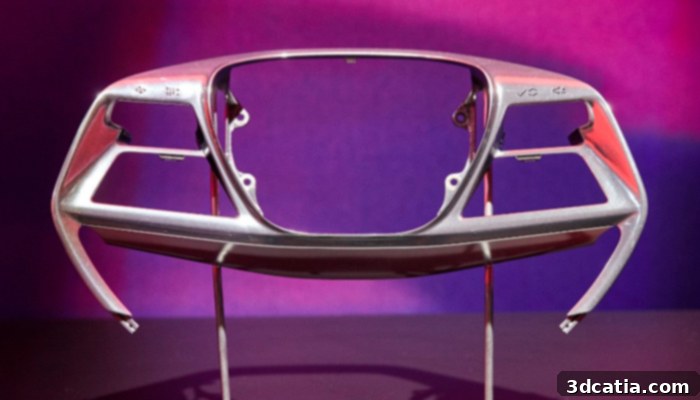
One of the company’s largest 3D printed metal parts.
The Future is Now: Additive Manufacturing’s Impact on Automotive Excellence
The integration of over 130 3D printed parts into the Cadillac CELESTIQ represents far more than just a technological showcase; it signifies a profound paradigm shift in automotive manufacturing. This strategic move by GM demonstrates how additive manufacturing can enable unparalleled customization, optimize performance, and accelerate the development cycle for high-end, low-volume vehicles. For luxury brands like Cadillac, the ability to produce bespoke components with intricate designs and superior material properties offers a distinct competitive advantage, allowing them to cater to individual customer preferences and deliver truly unique driving experiences. This level of personalization, combined with the structural benefits and weight reduction achievable through 3D printing, positions the CELESTIQ at the pinnacle of modern automotive engineering.
Looking beyond the CELESTIQ, GM’s extensive investment and successful implementation of 3D printing lay a robust foundation for future vehicle programs across its entire portfolio. The lessons learned from developing and producing parts for the CELESTIQ will undoubtedly inform and inspire the application of additive manufacturing in more mainstream models, leading to innovations in design, functionality, and efficiency. We can anticipate seeing more lightweight components, optimized internal structures for improved crash performance, and visually captivating interior elements, all enabled by the flexibility of 3D printing. This technology also plays a crucial role in enhancing supply chain resilience, allowing for on-demand production of parts and reducing reliance on traditional tooling and long lead times. Furthermore, 3D printing inherently supports more sustainable manufacturing practices by minimizing material waste and enabling the use of advanced, often recyclable, materials.
The successful deployment of 3D printing in the Cadillac CELESTIQ serves as a powerful testament to GM’s forward-thinking approach and its commitment to leveraging cutting-edge technology to redefine automotive excellence. It highlights a future where design constraints are minimized, customization is paramount, and performance is optimized through intelligent material usage and complex geometries. As the automotive industry continues its rapid evolution towards electric, autonomous, and highly connected vehicles, additive manufacturing will undoubtedly remain a key enabler, providing the flexibility and innovation necessary to meet tomorrow’s challenges. The CELESTIQ is not just a luxury electric vehicle; it is a tangible symbol of how 3D printing is driving the automotive world into an exciting new era of precision, personalization, and manufacturing prowess.
What are your thoughts on Cadillac’s pioneering use of 3D printing in the CELESTIQ? We invite you to share your insights in a comment below or join the conversation on our LinkedIn and Facebook pages! Don’t forget to sign up for our free weekly Newsletter here to receive the latest 3D printing news directly in your inbox. You can also explore all our videos and interviews on our YouTube channel for more in-depth content.
*All Photo Credits: General Motors