
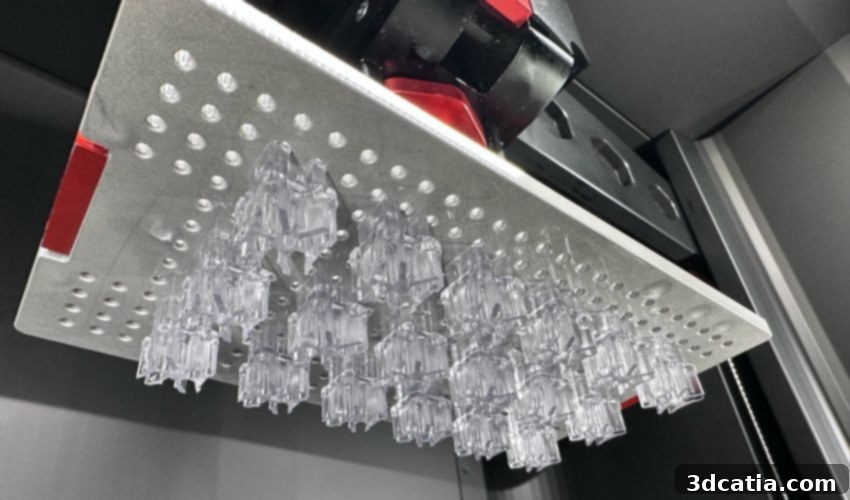
Axtra3D Lumia X1: Revolutionizing Resin 3D Printing with Hybrid PhotoSynthesis (HPS) Technology
Since the advent of stereolithography (SLA), the pioneering additive manufacturing technology introduced in the early 1980s, resin 3D printing has consistently held a vital position within the industry. Today, numerous variations of resin-based printing exist, but DLP (Digital Light Processing) and SLA remain the most prevalent methods. However, users frequently face a difficult choice between these two, often having to compromise. While SLA is renowned for its capacity to produce incredibly detailed and precise parts, its reliance on a laser to cure resin point by point makes it a relatively slow process. In contrast, DLP, which utilizes a projector or a light generator to cure an entire layer simultaneously, offers significantly faster printing speeds, but typically at the expense of intricate detail and surface accuracy, especially for larger prints where pixelation can become an issue. This persistent trade-off between speed and precision has long been a significant hurdle for advancing resin 3D printing into new applications.
What if it were possible to combine the strengths of these two leading technologies, thereby eliminating their individual limitations and allowing users to benefit from both unparalleled speed and exceptional accuracy? This aspiration has now become a reality, thanks to Axtra3D. With their innovative Lumia X1 3D printer, the company has integrated a groundbreaking new 3D printing process named Hybrid PhotoSynthesis (HPS). This revolutionary technology seamlessly blends the best attributes of both DLP and SLA, paving the way for more efficient and larger-scale resin 3D printing, pushing the boundaries of what’s possible in additive manufacturing.
This isn’t the first time we’ve highlighted the innovations from Axtra3D. Founded in 2021 by Gianni Zitelli and Praveen Tummala, this dynamic startup operates from two strategic locations: Charlotte, North Carolina, and Vicenza, Italy. Axtra3D is poised to redefine the landscape of the 3D printing industry through its pioneering Hybrid PhotoSynthesis (HPS) and TruLayer Technologies. The company’s vision promises to unlock a new realm of possibilities, addressing longstanding challenges in the sector. Their solutions boast a combination of features that have historically been mutually exclusive in resin 3D printing: a large build area, exceptionally high resolution, rapid print speeds, impressive surface quality, and truly continuous printing. These advancements are critical for accelerating industrial adoption and making resin printing more versatile.
Beyond technological prowess, Axtra3D stands out for its commitment to user freedom and transparency. In line with its core values, the company ensures that the Lumia X1 3D printer is completely open from both a parameter access and material perspective. This open approach grants users unprecedented flexibility to experiment with different resins and fine-tune printing parameters, fostering innovation and optimizing results for specific applications. Furthermore, Axtra3D is dedicated to disrupting the traditional norms of field service by offering 24/7 support request responses within an impressive 60 minutes. They leverage cutting-edge AR (Augmented Reality) technology to resolve a high percentage of technical issues remotely and quickly, minimizing downtime and maximizing operational efficiency for their customers. But what exactly are the transformative capabilities users can expect from the company’s flagship solution, the Lumia X1?
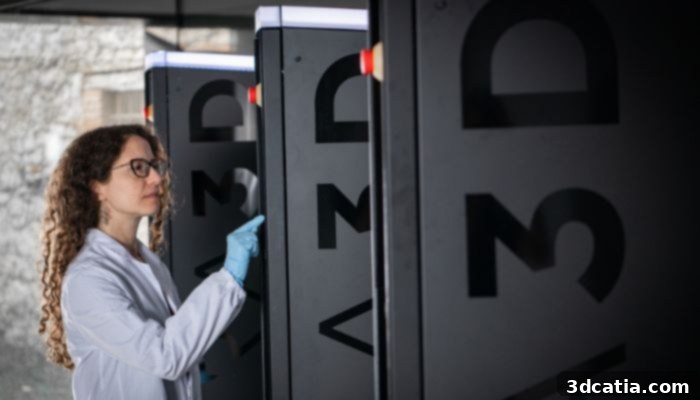
The Lumia X1 from Axtra3D combines SLA and DLP in an innovative, hybrid process
Combining Speed and Accuracy in One Revolutionary Process
Undoubtedly, one of the most compelling advantages of the Lumia X1 3D printer lies in its core 3D printing technology: Hybrid PhotoSynthesis (HPS). The long-standing dilemma faced by users when selecting a resin technology – constantly weighing precision against speed – has been a major barrier to widespread adoption in many industrial applications. HPS effectively renders this trade-off obsolete. At its heart, the HPS light engine technology masterfully integrates both DLP and SLA within a single, co-axial optical system. This ingenious design allows the system to harness the individual strengths of each technology in perfect synchronicity, overcoming their traditional limitations.
The operational principle of HPS is elegantly sophisticated. It features both an image generator (typical of DLP) and a precisely controlled laser (characteristic of SLA). Crucially, these two distinct light sources are engineered to work synchronously, operating at the exact same wavelength and maintaining perfect image plane planarity. The image generator is responsible for curing the bulk of the cross-section of each layer, a process Axtra3D terms “Flash Hatching.” This rapid, layer-wide curing action provides the phenomenal speed associated with DLP technology. Concurrently, the laser meticulously traces and cures the border contours of the part, ensuring superior surface quality and achieving an impressive accuracy of 50 microns. By intelligently leveraging both a broad-area image projection for speed and a focused laser for precision, Axtra3D has, in their own words, “unlock[ed] unparalleled print speed, quality, and accuracy.” This synergistic approach ensures that parts are printed not only rapidly but also with intricate details and smooth finishes previously unattainable at such speeds. Furthermore, HPS technology is inherently scalable, designed to accommodate large build platforms, a feature often a rarity among many resin 3D printing processes. This capacity for larger build volumes opens up new opportunities for manufacturing larger functional prototypes, end-use parts, and even batch production in industries such as automotive, aerospace, and consumer goods, where both speed and size are paramount.
Of course, Hybrid PhotoSynthesis isn’t the sole groundbreaking innovation integrated into the Lumia X1. The printer also incorporates another proprietary feature that Axtra3D claims will revolutionize resin 3D printing: TruLayer Technology. It’s a well-known challenge across all photopolymer resin processes that printed layers can sometimes adhere too strongly to the vat’s membrane, leading to printing failures, delays, and significant wear and tear on the consumable membrane itself. This issue often necessitates slower print speeds or complex peel mechanisms, which can limit part geometry and build volume. TruLayer has been meticulously designed to decisively overcome this persistent drawback, offering a more robust and efficient printing experience.
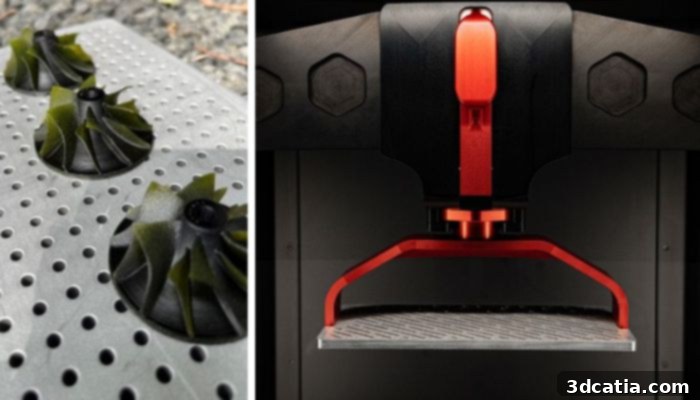
Impellers (left) made on the Lumia X1 whose build plate is shown on the right
At its core, the Lumia X1’s TruLayer technology integrates a sophisticated trio of sensors positioned strategically onto the glass plate beneath the printer’s vat membrane. This innovative sensor array constantly monitors the detachment process of each newly cured layer from the membrane. By providing real-time feedback, TruLayer ensures the swift and precise detachment of the print layer, thereby eradicating inter-layer delays that typically plague resin printers and amplifying the overall printing speed twofold. This active control over the detachment process removes traditional constraints on the size and bulk of cross-sections that can be printed, allowing for larger and more complex geometries. As a direct consequence of this optimized detachment, the vat membrane experiences significantly less stress and wear, resulting in an enduring quality and bolstered longevity, dramatically reducing consumable costs and maintenance. Furthermore, TruLayer’s robust detachment capabilities enable the Lumia X1 to print reliably even with highly viscous resins, which are often challenging for conventional resin printers due to their increased adhesion forces. This expands the material versatility of the printer, opening up possibilities for new applications with advanced engineering resins.
Paul Spolianksy, CRO of Axtra3D, further elaborated on the impact of this innovation: “Since implementing our TruLayer Technology, we’ve noticed a significant performance advantage over our competitors. We’re excited to provide our customers with top-notch resolution, unmatched accuracy, and fast print speeds that not only enhance production applications but also make them economically viable.” This statement underscores Axtra3D’s commitment not only to technical excellence but also to delivering tangible economic benefits to industrial users, making advanced resin 3D printing a more accessible and profitable solution.
Additional Features Enhancing the Lumia X1 Experience
Beyond the revolutionary integration of TruLayer technology and Hybrid PhotoSynthesis, the Lumia X1 3D printer is equipped with a comprehensive suite of features designed to make it highly attractive and functional for industrial users. Built to robust industrial standards, this solution is engineered for longevity, with an expected working life exceeding 10 years, ensuring a solid return on investment for businesses. Safety and user-friendliness are also paramount in its design. The Lumia X1 incorporates a number of critical safety features, including an advanced ventilation system to manage resin fumes, a secure magnetic interlock system to prevent operation when the enclosure is open, a UV shielded viewing window that allows users to monitor prints safely without exposure to harmful light, and, of course, a prominently placed emergency stop button for immediate shutdown in critical situations.
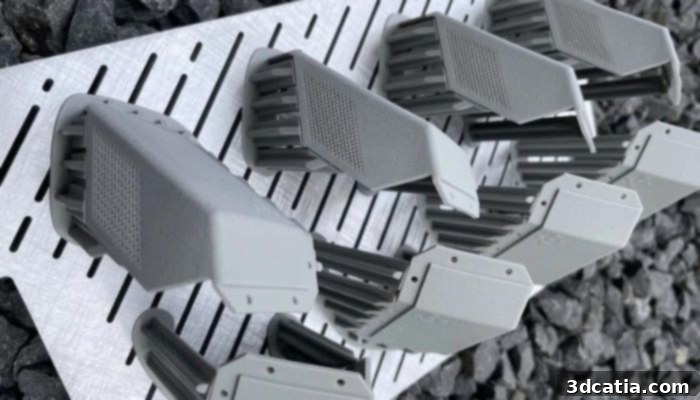
Parts made with the Lumia X1 are able to be made quickly while still being accurate
The printer also boasts a range of smart operational features that enhance efficiency and convenience. These include the Intelli-Cartridge system, a robust double Z-Axis for enhanced stability and precision, an integrated 4K chamber camera for remote monitoring and quality control, a large graphic user interface for intuitive operation, and both online and offline modes to suit various operational environments. Each of these features contributes to the Lumia X1’s status as a top-tier industrial 3D printing solution.
The Intelli-Cartridge system, in particular, has been highlighted by Axtra3D as a significant innovation. Its primary goal is to fundamentally simplify and automate the resin 3D printing process, drastically reducing manual intervention and potential errors. This intelligent system actively manages the resin within the printer by performing several crucial functions: it dispenses fresh material into the vat as needed, preventing interruptions during long prints; it efficiently collects excess material, minimizing waste and ensuring a clean printing environment; and it continuously stirs, heats, and filters the resin. This comprehensive management ensures optimal resin conditions throughout the printing process, maintaining consistency and preventing issues like pigment settling or viscosity changes. Furthermore, thanks to the Intelli-Cartridge, the total amount of resin available for printing is significantly increased to an impressive 8 liters, substantially reducing the frequency of refills and eliminating the need for tedious manual top-ups during extensive print jobs. This directly translates into greater operational autonomy and fewer interruptions for operators.
Beyond the immediate convenience, the Intelli-Cartridge system plays a crucial role in enhancing sustainability and cost-effectiveness. By meticulously taking out any unused or excess resin, filtering it to remove cured particles or impurities, and then safely returning it to the cartridge, it minimizes material waste, contributing to both environmental responsibility and lower operational costs. The integration of automatic mixing ensures a perfectly homogeneous resin mixture in each layer, which is vital for consistent mechanical properties and aesthetic quality. Concurrently, precisely controlled infrared heaters maintain the resin at its optimal temperature, further contributing to reliable and high-quality prints. Collectively, these advanced features of the Intelli-Cartridge system are instrumental in dramatically improving the efficiency and convenience of high-volume printing—key factors that are evident throughout the design and functionality of the Lumia X1 3D printer. To explore more about Axtra3D and the innovative Lumia X1 3D printer, you can visit Axtra3D’s official website HERE or connect with them on their LinkedIn page.
What are your thoughts on the groundbreaking Lumia X1 3D printer from Axtra3D? We invite you to share your insights in a comment below or join the conversation on our LinkedIn, Facebook, and Twitter pages! Don’t forget to sign up for our free weekly Newsletter here to receive the latest 3D printing news directly in your inbox! You can also discover all our videos and in-depth content on our YouTube channel.
*All Photo Credits: Axtra3D