
Exploring the Versatility of Resin 3D Printing and Leading US Manufacturers
Resins are undeniably central to a multitude of 3D printing technologies, serving as the foundational material for creating intricate and high-precision objects. The very first 3D printing method ever devised, Stereolithography (SLA), epitomizes this reliance. SLA technology depends on a specialized UV-sensitive liquid resin that undergoes a transformation, solidifying rapidly when exposed to focused ultraviolet light. This fundamental process, known as photopolymerization, is the defining characteristic and a cornerstone of all resin 3D printing methods.
Beyond SLA, other popular and advanced additive manufacturing techniques like Digital Light Processing (DLP) and Masked Stereolithography (mSLA or LCD-based printing) also leverage light to cure photopolymer resins. While each method operates with slightly different mechanisms for light exposure, their shared principle of light-induced material transformation is what unites them. These technologies are highly prized across industries for their exceptional capability to produce prints with outstanding detail, intricate geometries, and remarkably smooth surface finishes. This precision and aesthetic quality make resin 3D printing an ideal choice for a vast array of applications, ranging from the rapid creation of detailed prototypes to the manufacturing of high-performance, functional end-use parts.
Understanding Resin 3D Printing Technologies
At its core, resin 3D printing is built upon the principle of photopolymerization, a chemical reaction where liquid monomers and oligomers within a specially formulated resin rapidly polymerize (cure or harden) into a solid plastic structure upon exposure to specific wavelengths of light, typically ultraviolet (UV). This elegant process allows for the creation of incredibly detailed objects, layer by precise layer. Let’s delve into the most prevalent resin 3D printing technologies:
Stereolithography (SLA)
Pioneered in the 1980s, Stereolithography (SLA) stands as the original additive manufacturing method. In an SLA printer, a UV laser precisely traces the cross-section of a 3D model onto the surface of a vat containing liquid photopolymer resin. Where the laser beam touches the resin, it cures and solidifies. Once a layer is complete, the build platform descends (or ascends, depending on the printer’s design), and a recoater blade or wiper ensures a fresh layer of resin is uniformly spread across the previous layer. The laser then cures the next cross-section. This highly accurate, point-by-point curing mechanism enables SLA printers to achieve exceptional levels of detail and incredibly smooth surface finishes. Consequently, SLA is a preferred technology for high-fidelity prototypes, intricate jewelry designs, precise dental models, and master patterns for molding processes.
Digital Light Processing (DLP)
Digital Light Processing (DLP) operates on the same fundamental principle of photopolymerization as SLA but introduces a significant difference in its light source and exposure method. Instead of a laser tracing individual lines, a DLP projector flashes an entire image of each layer simultaneously across the entire build area. This is achieved using a digital micromirror device (DMD) chip, which contains millions of tiny, individually controllable mirrors. These mirrors reflect UV light from a powerful lamp, selectively curing a complete layer of resin in a single flash. This parallel curing capability often makes DLP printers substantially faster than SLA for producing larger parts or multiple parts in a single batch, while still maintaining excellent resolution and surface quality. DLP technology is widely utilized in demanding fields such as dentistry, small-batch manufacturing, and rapid prototyping where both speed and precision are critical.
Masked Stereolithography (mSLA) or LCD-based Printing
A more recent and rapidly expanding category in resin 3D printing is Masked Stereolithography (mSLA), commonly referred to as LCD-based printing. This technology employs an LCD screen as a dynamic mask, strategically blocking or allowing UV light from an array of LEDs to pass through and cure specific areas of resin. Similar to DLP, an entire layer is cured simultaneously. However, the resolution of an mSLA print is directly determined by the pixel density of the LCD screen. mSLA printers have gained immense popularity due to their relative affordability, user-friendly nature, and impressive print quality, making them highly accessible to hobbyists, educational institutions, and small to medium-sized businesses. They offer an excellent balance of speed, intricate detail, and cost-effectiveness, proving ideal for producing detailed miniatures, functional prototypes, and custom components across various sectors.
The Dynamic Landscape of 3D Printing Resins
The remarkable versatility and expansive applications of resin-based 3D printing are largely attributable to the immense variety of resin formulations available. Each type of resin is meticulously engineered to achieve specific material properties and performance characteristics, thereby unlocking countless possibilities across diverse industries.
Standard Resins: Prototypes and Visual Models
Standard resins represent the most common entry point for users into resin 3D printing. These general-purpose photopolymers are celebrated for their ease of use, excellent resolution capabilities, and the smooth surface finish they yield. They are primarily designed for creating visual prototypes, concept models, intricate figurines, design mock-ups, and educational tools where aesthetic appeal and fine details are paramount, but extreme mechanical properties or high durability are not the primary requirements. Offering an excellent balance of cost-effectiveness and print quality, standard resins remain a staple in design studios, art workshops, and for hobbyist projects.
Industrial-Grade Photopolymers: Engineering Excellence
For more rigorous and demanding applications, industrial-grade photopolymers are engineered with significantly enhanced mechanical, thermal, and chemical properties. These advanced resins are developed to meet stringent industry standards, providing robust solutions for not just functional prototyping but also for the production of durable, end-use parts. Key properties often integrated into industrial resins include:
- High Toughness and Impact Resistance: Essential for components that must withstand significant stress, repeated loading, or sudden impacts without fracturing. These are ideal for manufacturing jigs, fixtures, specialized tooling, and protective enclosures.
- Heat Resistance: Formulations designed to maintain their structural integrity, stiffness, and dimensional stability at elevated temperatures. This is crucial for applications in automotive under-the-hood components, aerospace parts, and high-temperature electrical connectors.
- Flexibility and Elasticity: Resins that can bend, compress, and deform without permanent damage, mimicking rubber-like materials. These are perfect for creating gaskets, seals, grips, wearable items, and prototypes of soft-touch components.
- Chemical Resistance: Materials specifically formulated to resist degradation, dissolution, or swelling when exposed to various chemicals, solvents, or aggressive industrial fluids. This is vital for laboratory equipment, industrial pump components, and certain medical devices.
- Biocompatibility: Specially certified resins that are safe for direct, prolonged contact with the human body. These are indispensable in the medical and dental fields for producing custom prosthetics, surgical guides, hearing aids, and highly accurate dental models.
These specialized, industrial-grade resins are critical enablers in sectors like engineering, dentistry, medical devices, and aerospace, allowing for the creation of high-performance components capable of enduring rigorous operational conditions and regulatory requirements.
Specialty and Custom Resins: Tailored Performance
Beyond standard and industrial grades, the vast landscape of resin 3D printing truly thrives on its inherent customizability. Manufacturers possess the capability to meticulously tailor resin formulations by incorporating specific additives, fillers, and advanced polymers, thereby unlocking targeted performance characteristics for niche applications. Examples of such specialty resins include:
- Ceramic-Filled Resins: These composite resins offer exceptional stiffness, high strength, and superior heat deflection temperatures, making them suitable for robust tooling, intricate molds, and parts requiring extreme rigidity and thermal stability.
- Castable Resins: Engineered to burn out cleanly and completely during the investment casting process, leaving minimal to no ash residue. This makes them indispensable for creating intricate patterns for jewelry manufacturing and highly precise dental restorations.
- Clear and Transparent Resins: Designed for producing optically clear parts, light guides, fluidic devices, and visual prototypes where transparency is a key functional or aesthetic requirement. Achieving optimal transparency often requires careful post-processing and polishing.
- Electrically Conductive Resins: Emerging formulations that incorporate conductive particles, enabling the 3D printing of functional electronic components or circuits directly into a part.
- High-Temperature Resins: Engineered to withstand even higher continuous operating temperatures than typical heat-resistant options, these are vital for demanding industrial applications such as engine components or electronic housing in extreme environments.
This unparalleled ability to customize and fine-tune resin properties ensures that resin-based 3D printing remains at the forefront of material innovation, continuously expanding its reach into increasingly complex and specialized applications across diverse sectors including consumer goods, medical devices, automotive, and advanced research.
Why Choose Resin 3D Printing? Unmatched Advantages
The widespread adoption and sustained popularity of resin 3D printing are primarily driven by its distinct advantages that cater to a comprehensive spectrum of needs. When attributes like precision, aesthetic quality, and material versatility are paramount, resin printers consistently stand out as the superior choice:
- Exceptional Detail and Resolution: Resin printers are unparalleled in their ability to reproduce incredibly intricate geometries and minute features, often achieving layer heights and XY resolutions down to tens of microns. This makes them the go-to technology for applications demanding the highest precision, such as miniature models, highly complex functional prototypes, and small, intricate components.
- Superior Surface Finish: Parts produced using resin 3D printing typically exhibit a remarkably smooth surface finish directly off the build platform. This significantly reduces or eliminates the need for extensive post-processing steps like sanding, polishing, or priming, which are often required with other 3D printing methods. This attribute is crucial for aesthetic parts, masters for molding, and components where surface quality directly impacts performance or appearance.
- Wide Range of Materials and Properties: As explored earlier, the chemical nature of photopolymer resins allows for an incredible breadth of material properties. From rigid and tough to flexible, heat-resistant, biocompatible, transparent, or even castable, the ability to formulate specific resins for particular applications provides immense design freedom and functional diversity.
- Isotropic Properties: Unlike some other additive manufacturing processes (e.g., Fused Deposition Modeling or FDM), resin prints tend to exhibit more uniform mechanical properties in all directions. The layers are chemically bonded during the curing process, which minimizes anisotropic weaknesses often found in layered parts. This results in stronger, more reliable components.
- Speed for Certain Applications (DLP/mSLA): While traditional SLA can be slower for large volumes, DLP and mSLA technologies offer significant speed advantages for batch production or larger components by curing entire layers simultaneously, providing a rapid turnaround for high-resolution parts.
Collectively, these advantages position resin 3D printing as an indispensable and powerful tool for innovators, engineers, designers, and manufacturers who require high-quality, precise, and functionally diverse 3D printed solutions to bring their most ambitious ideas to life.
The American Resin Manufacturing Ecosystem: A Hub of Innovation
The United States proudly hosts a dynamic and highly innovative ecosystem of 3D printing resin manufacturers. This thriving domestic industry plays an absolutely critical role in supporting and accelerating the global growth of additive manufacturing by developing and supplying an extensive array of high-quality photopolymer resins. American manufacturers are consistently at the forefront of cutting-edge research and development, continuously pushing the boundaries of material science to engineer resins with improved mechanical properties, enhanced performance characteristics, and novel functionalities.
This robust, localized production base not only ensures a resilient and reliable supply chain for domestic industries but also vigorously fosters rapid innovation. It allows US-based companies to respond quickly to evolving market demands, develop highly specialized solutions for diverse industrial requirements, and contribute significantly to global material science advancements. From established chemical giants with decades of expertise to agile startups pioneering new formulations, companies across the US are contributing to every facet of the resin market. This includes everything from general-purpose prototyping resins to highly specialized, industrial-grade materials meticulously designed for extreme operating environments or mission-critical applications. This powerful manufacturing capability empowers businesses across the nation to fully leverage the transformative potential of resin 3D printing, driving advancements in medical devices, advanced automotive components, intricate consumer electronics, and countless other vital sectors. To help you navigate this dynamic and expanding landscape, we have diligently compiled a comprehensive map highlighting many of these leading American resin manufacturers.
Choosing the Right Resin for Your 3D Printing Needs
Selecting the appropriate resin is a critical decision that profoundly impacts the success and performance of any resin 3D printing project. Given the vast number of options available, carefully considering several key factors will effectively guide you toward the optimal choice for your specific application:
- Application Requirements: Clearly define the primary purpose and functional demands of your printed part. Does it need to be exceptionally rigid, highly flexible, resistant to elevated temperatures, optically transparent, chemically inert, or biocompatible for medical use? A thorough understanding of these functional necessities will significantly narrow down your potential resin options.
- Printer Compatibility: It is crucial to remember that not all resins are compatible with all resin 3D printers. Always check your specific printer’s technical specifications and the manufacturer’s recommendations. This includes verifying compatibility with the resin’s curing wavelength (e.g., 405nm), optimal exposure times, and recommended resin types. Using an incompatible resin can lead to print failures, damage to your printer, or suboptimal part properties.
- Post-Processing Requirements: Most resin prints require specific post-processing steps to achieve their final properties and appearance. These may include washing the print in isopropyl alcohol (IPA) or other cleaning agents to remove uncured resin, followed by post-curing under UV light to fully harden the material. Factor in the necessary equipment (wash and cure stations), time, and ventilation required for these essential steps.
- Safety Considerations: Resins are chemical compounds and must be handled with care. Always review the Material Safety Data Sheet (MSDS) or Safety Data Sheet (SDS) provided for any resin you plan to use. Ensure you have proper personal protective equipment (PPE), including appropriate gloves, eye protection, and work in a well-ventilated area to minimize exposure to fumes and skin contact.
- Cost-Effectiveness: While cost is an important consideration, it should not be the sole determinant. Evaluate the overall value proposition, taking into account the resin’s performance characteristics, print success rates, and its ultimate impact on the final product’s quality and functionality. Investing in a higher-quality or more specialized resin might initially seem more expensive but can ultimately save time and money by reducing print failures, minimizing post-processing efforts, and delivering superior end-use parts.
By meticulously assessing these critical factors, you can make a well-informed decision that maximizes the potential of your resin 3D printing endeavors and consistently yields optimal results for your specific and unique applications.
The Future of Resin 3D Printing: Innovation on the Horizon
The field of resin 3D printing is in a state of continuous and rapid evolution, propelled by relentless innovation from both material scientists and equipment manufacturers globally. We can anticipate even more groundbreaking advancements in several key areas that will further solidify this technology’s impact:
- Sustainable and Eco-Friendly Resins: With a growing global focus on environmental impact, there is an increasing drive towards the development of bio-based resins derived from renewable resources, recyclable materials, and formulations with significantly reduced environmental footprints and safer compositions.
- Faster Printing Processes: Ongoing research and engineering efforts are dedicated to dramatically accelerating printing speeds without compromising resolution or part quality. This may involve novel light sources, more efficient curing mechanisms, or advanced chemical enhancements to resin reactivity.
- Expanded Material Properties: Expect to see an even broader spectrum of specialized resins emerge, offering unprecedented combinations of mechanical, electrical, thermal, and optical properties designed to meet the highly specific demands of increasingly advanced industrial and research applications.
- Smart Resins and Multi-Material Capabilities: The horizon includes resins with embedded functionalities, such as inherent electrical conductivity, self-healing properties, or responsive characteristics (e.g., changing color or shape under specific stimuli). Furthermore, advancements in multi-material resin printing could allow for the creation of components with varying properties within a single print.
These exciting developments promise to further solidify resin 3D printing’s indispensable position as a cornerstone technology within the additive manufacturing landscape, continuously enabling new possibilities for design innovation, complex engineering solutions, and transformative product development across every sector imaginable.
The innovation fostered by these American resin manufacturers is truly impressive, contributing significantly to the global advancement of additive manufacturing. To explore the diverse range of companies driving this progress, we invite you to consult our comprehensive map of US 3D printing resin manufacturers below!
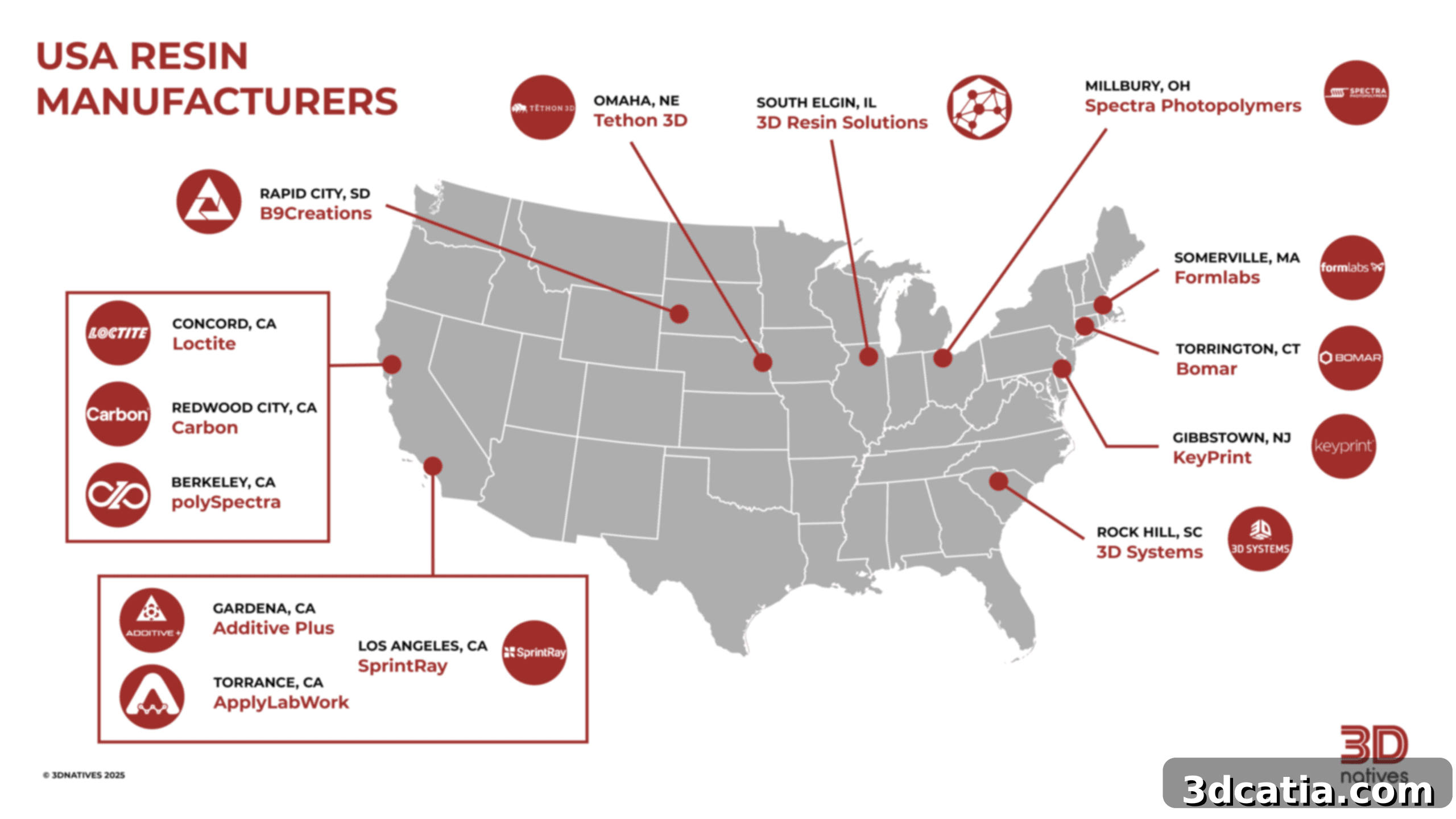
Image Credit: 3Dnatives
To view and download this invaluable map as a PDF for convenient offline reference, simply click HERE.
We’re eager to hear from you! Which of these American resin manufacturers do you recognize, and are there any we might have inadvertently missed from our comprehensive list? Please share your valuable thoughts and insights in the comments section below, or connect with us on our LinkedIn or Facebook pages. Don’t forget to subscribe to our free weekly Newsletter to receive the very latest updates and essential news from the dynamic world of 3D printing directly in your inbox. For more engaging visual content and in-depth discussions, explore all our videos on our dedicated YouTube channel.