
Top 5 Must-Watch 3D Printing Videos This Week: Innovation, Exploration, and Breakthroughs in Additive Manufacturing
Welcome to our weekly Sunday roundup, where we dive into the most compelling and insightful videos from the dynamic world of 3D printing. This week’s selection promises to take you on a journey from fundamental additive manufacturing processes to interstellar exploration, ground-breaking construction, and creative applications. We’ve curated a list that highlights the incredible versatility and ongoing evolution of 3D printing technology, offering something for enthusiasts, professionals, and curious minds alike. From understanding complex metal printing techniques to witnessing the future of human habitation on Mars, and exploring the latest advancements in consumer-grade printers, these videos provide a captivating glimpse into the cutting edge of this transformative industry. So, grab your favorite beverage, sit back, and prepare to be inspired by the limitless possibilities of additive manufacturing. Happy watching!
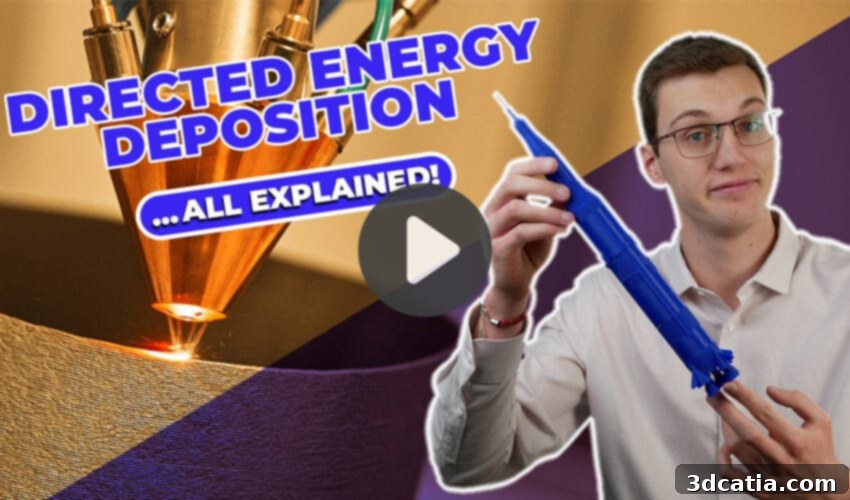
1. Directed Energy Deposition (DED) Explained: A Deep Dive into Metal 3D Printing
Kicking off our top five is an essential educational piece from our very own 3D Explained series, featuring Elliot Saldukaite. This week, Elliot tackles the intricate world of Directed Energy Deposition (DED), a critical metal additive manufacturing technology. DED stands out in the additive manufacturing landscape for its unique ability to build, repair, and coat large metal components with precision and efficiency. Unlike powder bed fusion (PBF) methods, DED typically uses a focused energy source—such as a laser, electron beam, or plasma arc—to melt material as it is simultaneously deposited, often in wire or powder form, onto a substrate. This allows for superior material deposition rates and the creation of larger parts, making it invaluable in industries requiring robust, high-performance metal components. Elliot’s concise yet comprehensive explanation covers the fundamental principles of how DED functions, delves into its significant advantages such as material flexibility and the capacity for multi-material printing, and candidly discusses its challenges, like achieving fine surface finishes. Furthermore, he illuminates the diverse range of materials compatible with DED, predominantly various metal alloys, and highlights the key industries where DED is most prevalent—including aerospace, defense, and oil & gas, where component repair and custom part fabrication are paramount. Though DED can appear complex at first glance, Elliot’s two-minute, information-packed video serves as an excellent primer, designed to demystify the technology and help you grasp its core concepts in no time. If you’re looking to become well-versed in advanced metal 3D printing, this video is an indispensable resource.
2. Experience Mars on Earth: NASA’s 3D Printed Habitat Simulation for Future Space Missions
Have you ever dreamed of walking on the Red Planet? While actual interplanetary travel for civilians might still be a distant future, NASA is bringing us remarkably close with their groundbreaking Mars habitat simulation. This week, we invite you to virtually step onto Mars by exploring an impressive 3D-printed structure at NASA’s Johnson Space Center in Houston, Texas. Designed to replicate a realistic Martian living environment, this habitat features four compact bedrooms and various functional spaces, all created using advanced additive manufacturing technologies. The initiative is a cornerstone of NASA’s ambitious plans to send astronauts to Mars sometime in the 2030s, necessitating rigorous preparation and testing here on Earth. Known as the Crew Health and Performance Exploration Analog (CHAPEA), this preliminary study is crucial for understanding the complexities of long-duration space missions. A four-person crew will reside in this compact, simulated Mars habitat for approximately one year, allowing the space agency to meticulously observe the physiological and psychological effects of isolation, resource limitations, and living in an extraterrestrial-like environment. The insights gained from CHAPEA will inform everything from habitat design and waste management to crew dynamics and overall mission success strategies. 3D printing plays a vital role here, showcasing its potential for on-site construction on Mars, using local regolith to build shelters and infrastructure, thereby reducing the immense payload requirements for deep-space missions. This video offers an exclusive tour inside this visionary structure and reveals the significant steps NASA is taking to prepare humanity for its next giant leap. Watch the video to get an exciting preview of the crew members who will embark on this unprecedented year-long journey – their names are set to be announced this summer!
3. Creality’s K1 Series: A New Era for High-Speed Desktop FDM 3D Printing?
The desktop FDM 3D printing market has been experiencing an exhilarating period of innovation and fierce competition, largely driven by disruptors like Bambu Lab and Voron. These manufacturers have pushed the boundaries of speed, reliability, and user-friendliness, effectively “lighting a fire” under established players. This week, the spotlight shifts to Creality, a giant in the 3D printer manufacturing space, as they officially unveil their much-anticipated K1 Series. This new FDM (Fused Deposition Modeling) printer is poised to make a significant impact on the market, potentially reshaping expectations for high-speed desktop 3D printing. The K1 Series comes packed with a host of intriguing features designed to deliver both unprecedented speed and enhanced user experience. Key specifications include a remarkable print speed of 600mm/s and an acceleration speed of 20000mm/s², which are figures typically associated with much higher-end or custom-built machines. Beyond raw speed, Creality has integrated smart features such as an AI camera for monitoring print progress and detecting potential failures, alongside a dual-hand auto-leveling system that promises effortless bed calibration. These innovations aim to address common pain points for users, from ensuring successful prints to simplifying setup. While these specifications are undoubtedly impressive on paper, the true test lies in real-world performance. The market is eagerly awaiting to see how the K1 Series performs in action, particularly concerning print quality at high speeds, reliability, and overall user experience, before drawing definitive conclusions. The potential for Creality to offer high-performance features at an accessible price point could democratize rapid FDM printing, making it available to a broader audience of hobbyists, prosumers, and small businesses. Are you convinced by the hype surrounding Creality’s K1 Series? Watch the video to delve deeper into its capabilities and decide for yourself.
4. Bengaluru’s Architectural Marvel: India’s First 3D Printed Post Office Building
In a testament to the transformative power of additive manufacturing in construction, India is making headlines with its first-ever 3D printed post office building, located near the Cambridge Layout in Bengaluru. This project is not just a structural achievement but a significant milestone, showcasing the viability and efficiency of 3D printing for public infrastructure. While still under construction, the project’s senior executive, MV Satish, has confidently stated that the entire building will be completed in an astonishingly short timeframe—no more than 45 days. This rapid construction pace is one of the primary advantages of 3D concrete printing, drastically cutting down on traditional building timelines and labor costs. The printing process itself involves a carefully calibrated mixture: sand, cement, specialized waterproof chemicals, and water are fed into a churner, transforming into a viscous paste. This material is then precisely extruded layer by layer by robotic arms to form the walls of the office building. This method not only accelerates construction but also minimizes material waste and allows for complex geometries that would be difficult or costly to achieve with conventional building techniques. The project is backed by Larsen & Toubro, a prominent Indian business and engineering company, which has invested nearly two and a half million dollars, underscoring the confidence in 3D printing as a sustainable and efficient construction solution. Satish emphasizes that the main advantage of 3D printing in this context is its unparalleled design freedom, allowing architects to conceive and execute virtually any shape or structural form, opening up new possibilities for architectural innovation and aesthetic appeal. This pioneering post office is a tangible example of how advanced manufacturing is revolutionizing the construction industry, promising faster, more cost-effective, and environmentally friendly building practices. Discover more about this impressive feat of engineering by watching the video below!
5. Unveiling the Best of 2022: Top 3D Printed Woodworking Projects for Craft and Utility
Rounding out our fantastic five is a special compilation that brings you a “top five within a top five” – highlighting the best 3D printed projects from 2022, specifically those that complement and enhance the traditional craft of woodworking. This video celebrates the innovative fusion of additive manufacturing with classic craftsmanship, demonstrating how 3D printing can add immense value to woodworking. From ingenious polymer shelves designed for optimal storage and organization to multi-functional benches that blend structural integrity with custom features, these projects exemplify the impressive capabilities of 3D printing technology when applied to practical and artistic endeavors. Woodworking enthusiasts will particularly appreciate how 3D printing enables the creation of custom jigs, specialized clamps, organizational inserts for toolboxes, and unique decorative elements that would be difficult or impossible to produce with traditional methods. The video showcases a variety of applications, illustrating the versatility of desktop FDM printers in creating functional prototypes and end-use parts. Various popular printers were utilized in the realization of these projects, including the high-speed FLsun Super Racer, known for its delta kinematics and rapid printing capabilities, and the reliable Artillery Sidewinder X1 and X2, celebrated for their large build volumes and stable performance. These printers, accessible to hobbyists and small workshops, demonstrate that sophisticated additive manufacturing isn’t limited to industrial settings. By exploring these unique gadgets and tools, we collectively admire how 3D printing fosters creativity, accelerates prototyping, and offers bespoke solutions that elevate the art and practicality of woodworking. Whether you’re a seasoned carpenter or a novice maker, this compilation provides ample inspiration for integrating 3D printing into your next project. Check out the video below to see these remarkable tools and creations being used in action!
We hope this week’s selection of 3D printing videos has provided valuable insights and sparked your imagination. The advancements in additive manufacturing, from deep space exploration and industrial applications to everyday innovations and artistic crafts, continue to astound and inspire. What do you think of NASA’s Mars habitat simulation? Are you excited about Creality’s push into high-speed FDM? Or perhaps you’re planning your next 3D printed woodworking project? We’d love to hear your thoughts and engage in a discussion! Let us know your opinions in a comment below, or join the conversation on our LinkedIn, Facebook, and Twitter pages! Don’t miss out on the latest developments in the additive manufacturing world – be sure to sign up for our free weekly Newsletter here, delivering the freshest 3D printing news straight to your inbox every week! You can also find an extensive library of all our captivating videos on our YouTube channel. Stay connected for more groundbreaking updates and innovative content from the world of 3D printing!