
Revolutionizing Construction: Vertico’s Sustainable 3D Printed Concrete Bridge Project with Ghent University
The landscape of modern construction is undergoing a profound transformation, driven by innovative technologies like 3D additive manufacturing. In the vanguard of this revolution stands Vertico, a pioneering Dutch startup that has recently unveiled a remarkable 3D printed concrete bridge, a collaborative effort with the esteemed University of Ghent. This groundbreaking project is not merely an engineering feat; it’s a powerful statement about the future of sustainable infrastructure. Vertico is vigorously exploring the immense potential of concrete additive manufacturing, convinced that this technology holds the key to dramatically reducing CO2 emissions by optimizing material usage and significantly boosting productivity within the construction sector. A core component of this strategy involves leveraging topology optimization, a sophisticated design methodology that ensures structural integrity with minimal material. The Netherlands, in particular, has emerged as a global leader in 3D construction technologies, consistently multiplying innovative projects month after month. Notable examples include MX3D, renowned for creating a 3D printed steel bridge using the Wire Arc Additive Manufacturing (WAAM) method, further solidifying the nation’s position at the forefront of this exciting domain.
Vertico: Pioneering Large-Format Additive Manufacturing and Sustainable Solutions
Founded in 2017, Vertico quickly established itself as a formidable player in the realm of large-format 3D printing solutions. From its inception, the company has offered a versatile range of printing capabilities, adapting to diverse project needs. Their innovative fleet includes mobile 3D printers expertly mounted on robotic arms, providing unparalleled flexibility for on-site construction, alongside robust Rohaco machines integrated onto wide gantry systems. This latter setup boasts an impressive printing volume of 8 x 5 x 2.2 meters, enabling the creation of exceptionally large and complex structures with precision and efficiency. Vertico’s technological prowess has already been demonstrated through a series of iconic projects. For instance, they successfully engineered a functional concrete canoe, pushing the boundaries of what’s possible with printed concrete. Another significant achievement was the fabrication of an intricate wall façade, composed of 50 unique, custom-designed elements, collectively weighing 2.5 tons. These early projects showcased Vertico’s ability to not only create large-scale structures but also to produce aesthetically complex and structurally sound components, highlighting the design freedom offered by additive manufacturing. Each endeavor reinforced their commitment to exploring and expanding the applications of 3D concrete printing in the architectural and engineering fields, laying the groundwork for more ambitious undertakings like the pedestrian bridge.
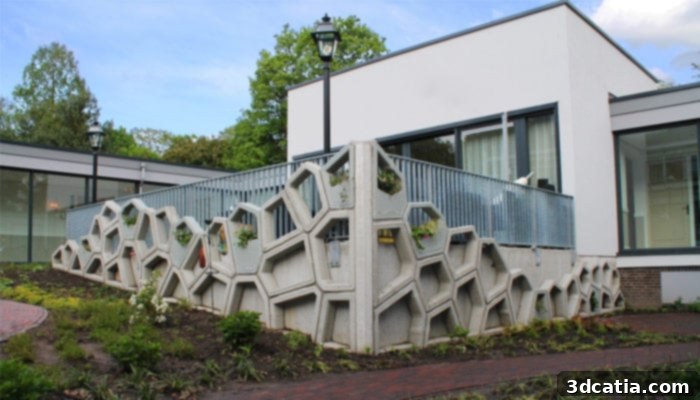
The wall façade designed by Vertico, a prime example of their innovative approach to architectural construction using 3D printing.
A Bridge to the Future: The Vertico-Ghent University Collaboration
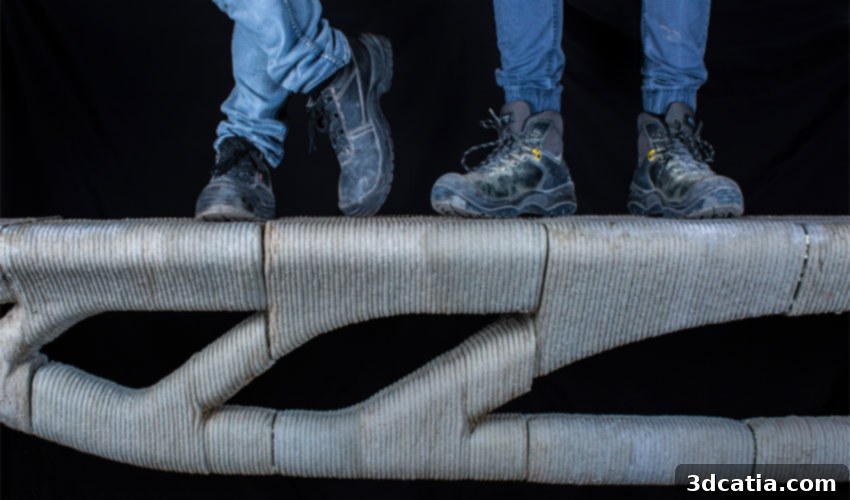
The latest project, a collaboration with the University of Ghent, marks a significant milestone: the design and fabrication of a pedestrian bridge. While not massive in physical dimensions, this bridge is profoundly imposing in its implications for sustainable and intelligent construction. It stands out not only for its aesthetic appeal but, more importantly, for its ingenious use of materials. Both Vertico and the University of Ghent emphasize that this project was underpinned by extensive and meticulous topology optimization. This advanced design process involves simulating and analyzing structural stresses to identify and remove unnecessary material from the design, resulting in highly efficient and lightweight structures that retain their full load-bearing capacity. The collaboration represents a synergy between industrial expertise and academic research, pushing the boundaries of what is achievable in 3D concrete printing. By focusing on material efficiency from the earliest design stages, the partners aimed to create a structure that is not only robust and visually striking but also environmentally responsible, setting a new benchmark for future infrastructure projects. This bridge serves as a tangible prototype for how digital fabrication, combined with smart design, can lead to more resource-efficient and sustainable building practices.
The Environmental Imperative: Reducing Construction’s Carbon Footprint
Volker Ruitinga, the visionary founder of Vertico, articulates the core philosophy behind their work: “This bridge showcases the range of possibilities that 3D concrete printing offers. At Vertico, we believe that this technology is the key to unlocking material optimisation in structures, reducing CO2 emissions whilst simultaneously increasing productivity in the construction industry.” His statement underscores a critical challenge facing the global construction sector today. Currently, the construction industry is estimated to be responsible for a staggering 23% of global CO2 emissions, a figure that highlights an urgent need for more sustainable practices. Vertico’s innovative concrete 3D printing solution offers a compelling answer to this challenge, promising to save up to 60% of concrete material compared to traditional construction methods. This substantial reduction in material usage directly translates into a significant decrease in the carbon footprint associated with concrete production, transport, and waste. The environmental benefits are profound: fewer raw materials consumed, less energy expended in manufacturing, and reduced transportation emissions. It is easy to envision how such an impactful technology can play a pivotal role in fostering a cleaner, more sustainable environment, paving the way for a greener future in building and infrastructure development.
Technical Innovations and Design Philosophy of the 3D Printed Bridge
While Vertico and the University of Ghent have maintained a degree of discretion regarding the precise dimensions of this innovative pedestrian bridge and the exact printing time involved, some key technical details have been shared, offering insight into its creation. Vertico utilized one of its advanced robotic 3D printers for this project, a machine renowned for its substantial printing volume of 4.5 x 2 x 2.5 meters. This capability allows for considerable design freedom and the creation of large-scale, intricate concrete structures. Central to the bridge’s success was the development of a specialized concrete mix, meticulously formulated to meet the unique demands of 3D printing. This bespoke concrete boasts properties essential for additive manufacturing, including optimal flow characteristics for extrusion, rapid hardening to support subsequent layers, and enhanced durability for structural integrity. The Dutch company drew significant inspiration from organic forms found in nature when designing the bridge. This approach is not merely for aesthetic appeal; organic designs often embody inherent structural efficiencies and material optimization, mirroring natural processes that achieve strength with minimal resources. Consequently, the resulting structure is not only visually appealing but also engineered to withstand the same rigorous constraints and loads as a conventionally built bridge, ensuring safety and longevity. The exact installation location of the bridge remains undisclosed, raising anticipation as to whether it will grace a Dutch landscape or find a home elsewhere. Nevertheless, its capacity to safely accommodate multiple individuals is a testament to its robust design and the reliability of 3D concrete printing technology.
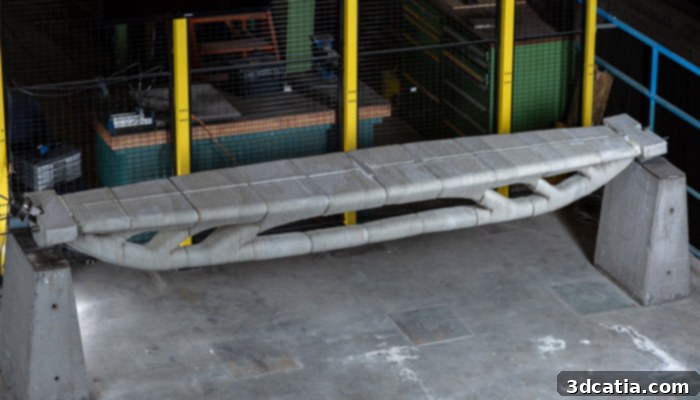
The elegantly designed 3D printed bridge, a symbol of innovation in sustainable construction.
The Netherlands: A Hub for 3D Construction Innovation
The success of Vertico’s bridge project further solidifies the Netherlands’ reputation as a global hotbed for innovation in 3D construction. The proactive stance of Dutch companies and research institutions towards embracing and advancing additive manufacturing for large-scale applications is truly commendable. This environment fosters rapid development and adoption of cutting-edge techniques, positioning the country as a leader in digital fabrication. From bespoke architectural elements to critical infrastructure, the integration of 3D printing is transforming how structures are conceived, designed, and brought to life. The emphasis on sustainability, coupled with a drive for efficiency and aesthetic freedom, resonates deeply within the Dutch construction ecosystem, making it fertile ground for companies like Vertico to thrive and set new global standards.
Vertico’s Vision and the Future of Digital Fabrication
The 3D printed bridge is just one example of Vertico’s ambitious trajectory in the 3D concrete printing space. Looking ahead, the company is already embarking on another significant undertaking: the 3D printing of a concrete dome. This project, slated to commence production in February 2020, promises to further demonstrate the versatility and structural capabilities of additive manufacturing for complex geometries and large enclosures. Such projects are not merely about erecting structures; they are about redefining the very processes of construction, offering unparalleled design flexibility, reducing waste, and accelerating project timelines. Vertico’s continuous pursuit of innovation positions them as a key player in shaping the future of the construction industry, moving it towards a more automated, efficient, and environmentally responsible paradigm. For those eager to delve deeper into Vertico’s pioneering work and explore their extensive portfolio of projects, more information can be found HERE.
What are your thoughts on Vertico’s groundbreaking 3D printed concrete bridge and the broader implications of 3D printing in construction? We invite you to share your insights and engage with our community by leaving a comment below or by connecting with us on our Facebook and Twitter pages! Don’t miss out on the latest advancements and news in the world of 3D printing – be sure to sign up for our free weekly Newsletter, delivering all the essential updates straight to your inbox!