
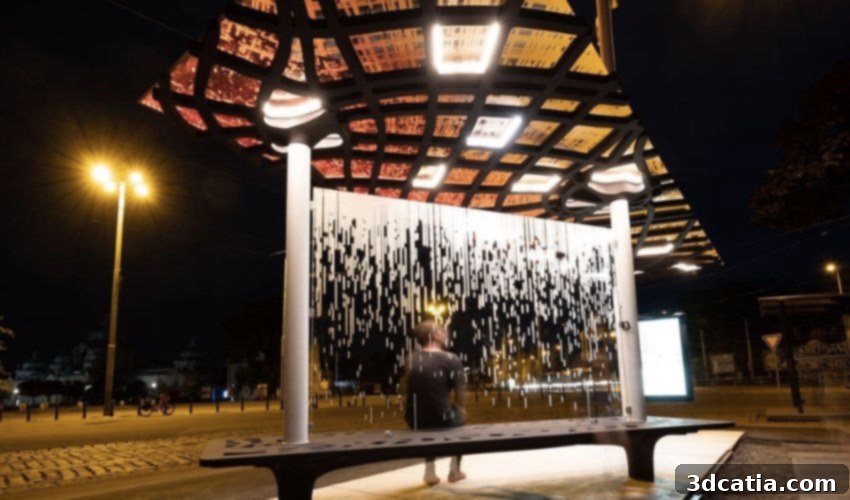
Prague Unveils Czech Republic’s First 3D Printed Tram Stop: A Landmark in Sustainable Urban Infrastructure
Prague, the picturesque capital of the Czech Republic, is renowned for its rich history, stunning architecture, and a highly efficient public transport network. This extensive infrastructure spans an impressive 142 kilometers, facilitating the daily movement of approximately 991 vehicles. These trams and metro lines serve millions of residents and countless tourists each year, making the city’s transport company a pivotal entity responsible for maintaining all stations and stops. In a groundbreaking move that signifies a leap into the future of urban development, the city recently unveiled an innovative new tram stop. Located in Prague 7, specifically at the bustling Stromovka stop, this facility features a revolutionary 3D printed bench and lining, which were brought to life in an astonishingly short 36 hours. What truly sets this project apart is its pioneering nature: it is the very first tram shelter in the Czech Republic to be constructed using advanced additive manufacturing techniques, marking a significant milestone in sustainable and efficient construction.
This visionary and fully functional tram stop shelter was conceived, manufactured, and installed by So Concrete, a forward-thinking Prague-based company specializing in innovative construction solutions. Demonstrating their commitment to urban innovation and community well-being, So Concrete generously provided the entire bench and shelter structure to the city of Prague free of charge. This prototype, now welcoming passers-by and offering a comfortable, covered space to await their next tram, showcases a truly remarkable material: an ultra-strong concrete that boasts properties ten times superior to those of conventional concrete. This material’s exceptional durability and resilience are key to the project’s long-term sustainability. Adam Scheinherr, Prague’s influential politician overseeing transport, expressed immense enthusiasm for the transformative potential that 3D printing brings to the capital. He articulated his vision, stating, “Combining this kind of concrete with 3D printing is a way to use concrete only where it is absolutely necessary. This is a significant paradigm shift in our approach to urban projects and sets a clear course for sustainable development. It embodies a commitment to not waste energy and precious resources, which are becoming increasingly scarce in our modern world.” This project, therefore, is not merely about a new tram stop; it is a powerful statement about Prague’s dedication to embracing cutting-edge technology for a more sustainable and resource-efficient future.
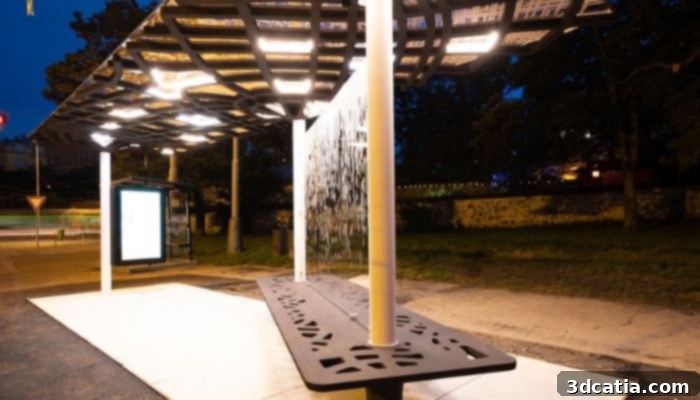
Passers-by can sit under cover at the additively manufactured tram station, enjoying comfort and protection from the elements.
Details About Prague’s Innovative 3D Printed Streetcar Station
The implementation of advanced 3D printing technology for the Stromovka tram stop offers Prague a multitude of advantages beyond mere novelty. This method ushers in a new era of sustainable construction, significantly enhancing efficiency from both environmental and economic perspectives. A core benefit lies in resource optimization: the construction of this tram stop utilized merely 60% of the materials typically required for similar structures. This drastic reduction in material consumption not only lowers costs but also minimizes the environmental footprint associated with manufacturing and transport. Furthermore, the human labor component was dramatically reduced to a minimum, primarily focusing on final assembly and fine-tuning, thanks to the automated nature of additive manufacturing. Once the 3D printing process was complete, So Concrete expertly managed the transport of the individually printed concrete parts to the Stromovka site. There, these components were meticulously assembled to form a cohesive and entirely novel type of streetcar stop, seamlessly integrating into Prague’s urban fabric.
Interestingly, while 3D printing formed the backbone of the construction process, the entire design was intelligently optimized with the powerful assistance of artificial intelligence (AI). This sophisticated integration of AI ensured that the structural integrity was maximized while material usage was minimized, creating an incredibly robust yet lightweight design. Human intervention was then strategically employed at the final stages for necessary modifications and quality assurance, ensuring perfection in the finished product. This synergistic approach, combining the speed and precision of 3D printing with the analytical power of AI, represents a paradigm shift in architectural and urban planning, paving the way for more intelligent and resource-efficient infrastructure.
Unparalleled Durability and Minimal Maintenance
One of the most compelling aspects of Prague’s new 3D printed tram shelter is its projected longevity and minimal maintenance requirements. So Concrete proudly asserts that the roofing and structural elements will demand virtually no maintenance for an exceptionally long period. Federico Diaz, the managing director of So Concrete, provided further insights into the extraordinary properties of the material used, estimating its lifespan to be an impressive 100 years or even longer. He elaborated on its robustness, stating, “The lifetime of the material is extreme; it is used, for example, for water dams.” This comparison underscores the material’s ability to withstand extreme conditions, including constant exposure to weather elements, heavy usage, and potential vandalism, making it an ideal choice for public infrastructure. The inherent durability translates into significant long-term economic savings for the city, as costly repairs and regular upkeep are drastically reduced. Furthermore, the environmental benefits are substantial, as a longer lifespan means less frequent replacement and, consequently, a reduced demand for new materials and energy-intensive production processes.
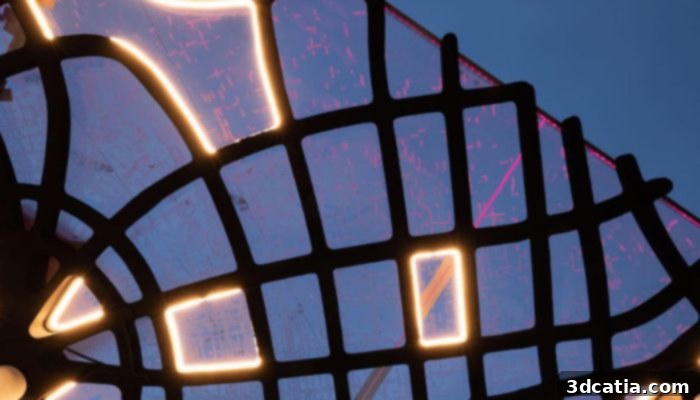
The innovative tram house, a product of 3D printing and AI-driven design, demonstrates the future of sustainable urban infrastructure.
Since its inauguration, the Stromovka tram shelter has already welcomed countless commuters and visitors, quickly becoming a symbol of Prague’s innovative spirit. The overwhelming positive reception and the undeniable success of this pilot project have instilled confidence in the city’s authorities. They are now convinced that this will not be the last construction produced using state-of-the-art 3D printing technology within Prague. Indeed, the city is already actively planning and exploring other ambitious projects that leverage additive manufacturing. These include the proposed construction of the Štvanická pedestrian bridge, a vital link for pedestrians and cyclists, as well as the reconstruction of significant existing infrastructure like the Barrandov Bridge and the Libeň Bridge. These upcoming initiatives highlight Prague’s strategic vision to integrate 3D printing into various facets of its urban development, positioning itself as a leading smart city embracing technological innovation for a more resilient, efficient, and aesthetically pleasing future.
Prague’s Vision: Leading the Way with Smart and Sustainable Urban Development
The launch of the 3D printed tram stop in Stromovka represents far more than just a new public amenity; it symbolizes Prague’s strong commitment to pioneering sustainable urban development and embracing smart city solutions. By demonstrating the practical applications and tangible benefits of additive manufacturing in public infrastructure, Prague is setting a new benchmark not just for the Czech Republic, but for cities across Europe and beyond. This project underscores how technology can be harnessed to address contemporary urban challenges, from resource scarcity and environmental impact to the need for durable and cost-effective infrastructure.
The integration of Artificial Intelligence in optimizing the design process further exemplifies a forward-thinking approach, ensuring that structures are not only aesthetically pleasing but also maximally efficient in terms of material use and structural integrity. This harmonious blend of 3D printing and AI in the construction sector promises a future where urban landscapes can evolve rapidly, sustainably, and with unparalleled design freedom. The success of the Stromovka tram stop is a powerful testament to what can be achieved when innovation is prioritized, showcasing how cities can adapt and thrive in an era of rapid technological advancement while maintaining a deep respect for environmental stewardship. Prague is clearly demonstrating that the future of construction is not just about building faster or cheaper, but about building smarter, more sustainably, and with a lasting impact.
What do you think of the additively manufactured tramway waiting house in Prague? We invite you to share your thoughts and opinions in a comment below or engage with us on our LinkedIn, Facebook, and Twitter pages! Don’t forget to sign up for our free weekly Newsletter here, to get the very latest 3D printing news delivered straight to your inbox! You can also find all our compelling videos on our YouTube channel, offering a visual journey into the world of additive manufacturing.