
Transforming Construction: Besix 3D’s Vision for Concrete 3D Printing and Additive Manufacturing
The landscape of industrial sectors is rapidly evolving, with 3D printing emerging as a pivotal technology. Its impact is particularly profound in the construction industry, where it offers distinct advantages over conventional building methods. Leading manufacturers of concrete 3D printers are pioneering innovative and highly promising projects that are set to redefine the future of houses, buildings, and architectural designs. These advanced machines typically operate by extruding successive layers of a specialized concrete mixture, enabling the creation of intricate and complex geometric shapes directly on construction sites. To delve deeper into this exciting field, we had the opportunity to speak with Besix 3D, a dedicated division of the renowned Belgian Besix Group. This pioneering division is focused on advancing additive manufacturing technologies and is actively working to industrialize the construction market by making concrete 3D printing widely accessible and efficient. Jonas Vandeven, the esteemed director of Besix 3D, provided us with invaluable insights into the company’s groundbreaking projects and the extensive benefits of this transformative construction methodology.
BESIX Group: A Legacy of Innovation and Global Construction Leadership
BESIX stands as a pre-eminent Belgian group with a formidable global presence, operating across five continents in key sectors including construction, real estate development, and concessions. The group’s portfolio boasts an impressive array of iconic achievements that underscore its unparalleled expertise and commitment to engineering excellence. These include monumental structures such as the Burj Khalifa in Dubai, recognized globally as the world’s tallest tower, and the ambitious Grand Egyptian Museum situated on the historic plateau of the pyramids of Giza. In the bustling Parisian business district of La Défense, BESIX has contributed to the striking Carpe Diem and CBX skyscrapers. Furthermore, their extensive work encompasses vital port and airport infrastructures worldwide, from the major international hub of Paris-Charles-de-Gaulle to the strategic Tangier Med port in Morocco. This global footprint firmly establishes BESIX as an international benchmark in construction, maritime works, environmental projects, sports and leisure facilities, industrial installations, and critical infrastructure. The Group’s operations span nearly 25 countries, engaging in dozens of complex projects across five continents, consistently demonstrating a commitment to quality and innovation.
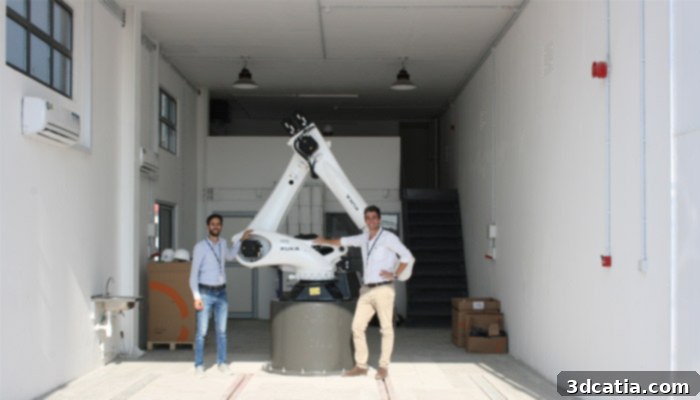
Jonas Vandeven, Director of Besix 3D, discussing innovation | Credits: BESIX
A cornerstone of BESIX’s distinguished expertise is its internal Engineering department, which remains at the forefront of contemporary technological advancements. This department thrives on the exceptional know-how of its experts, many of whom are recognized academic authorities in their respective fields. The profound capabilities of the Engineering department empower BESIX to undertake and successfully execute unique and highly complex projects, especially those presenting significant technical and environmental challenges. Their holistic approach ensures that every project not only meets but often exceeds industry standards, pushing the boundaries of what is traditionally thought possible in construction.
The journey into 3D printing for BESIX commenced in 2017. During an intensive internal ideation campaign, the concept of exploring and applying 3D printing technology within the construction sector was identified as a priority and subsequently selected for the company’s internal innovation program. This strategic move was driven by a clear understanding that 3D printing is an integral component of the ongoing industrialization dynamic sweeping across the construction sector. BESIX, with its forward-thinking vision, was determined not just to observe this trend but to actively lead and shape it, positioning itself as a key player in revolutionizing building practices. By investing in additive manufacturing, BESIX aims to foster greater efficiency, sustainability, and design flexibility in its projects, reinforcing its legacy of pioneering advancement.
Understanding Concrete 3D Printing Technologies: A Game Changer for Construction
Concrete 3D printing technology represents a paradigm shift in the construction industry, leveraging advanced additive manufacturing processes to produce structural and architectural components on an unprecedented scale. Unlike traditional construction methods, which often involve extensive formwork, manual labor, and lengthy curing times, 3D concrete printing offers a streamlined, automated approach. This innovative technology deposits concrete mixtures layer by layer, meticulously following digital designs to create complex structures with unparalleled precision. The distinct advantages of this method are numerous and impactful, making it a powerful tool for modern construction.
Firstly, it significantly reduces construction time. Automated printing processes can operate continuously, dramatically accelerating project timelines compared to conventional techniques. This speed not only brings projects to completion faster but also reduces overall labor costs and site management complexities. Secondly, it fosters a safer working environment by minimizing the need for manual labor in potentially hazardous conditions. Robots and automated systems handle the repetitive and strenuous tasks, thereby reducing the risk of accidents and injuries. Thirdly, concrete 3D printing offers an extraordinary degree of freedom of form. Architects and designers are no longer constrained by the limitations of traditional molds or the difficulty of constructing curved or organic shapes. This allows for the creation of intricate, custom-designed structures that were previously economically or logistically unfeasible, opening new avenues for architectural expression and functional optimization.
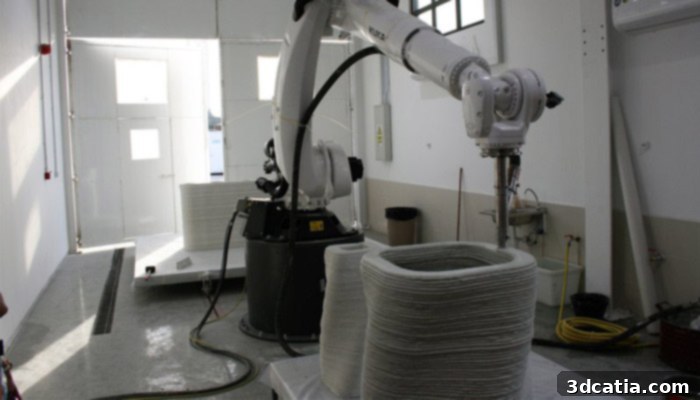
Advanced concrete 3D printing by Besix | Credits: Besix
Moreover, the precision of additive manufacturing leads to less waste. Materials are deposited exactly where needed, reducing off-cuts, surplus concrete, and the logistical burden of waste disposal. This efficiency contributes directly to lower material consumption and a more sustainable construction process. Coupled with optimized material usage, 3D concrete printing can also lead to lower CO2 emissions. This reduction stems from several factors, including decreased transportation of materials (especially when printing on-site), more efficient use of resources, and the potential for incorporating sustainable and recycled aggregates into printable concrete mixtures. In essence, concrete 3D printing is not just an alternative method; it is a revolutionary approach that enhances efficiency, safety, design capabilities, and environmental sustainability, truly making it a powerful tool for the future of construction.
Achieving High-Speed Construction with Robotic 3D Printing
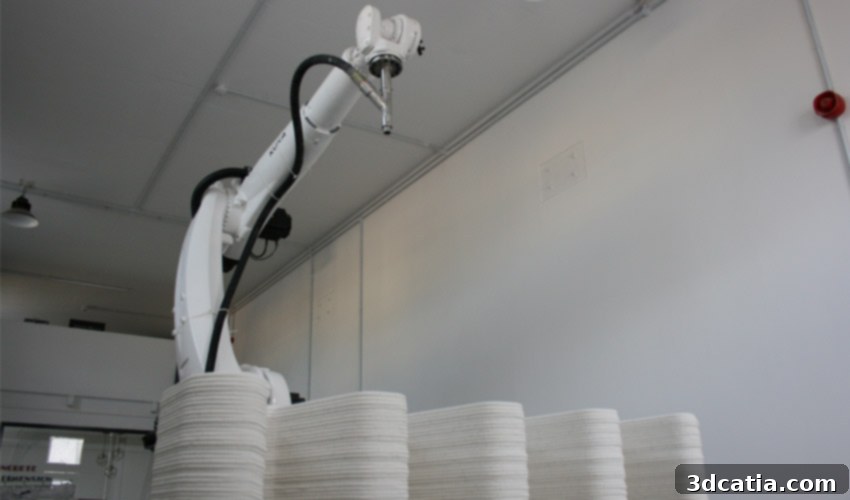
One of the primary objectives of BESIX’s innovation program was to significantly enhance construction speed and efficiency through advanced technology. This goal has been robustly realized in their state-of-the-art 3D Lab located in Dubai. Here, structures are printed with remarkable velocity using a sophisticated KUKA industrial robotic arm, a testament to the power of automation in modern construction. The capability to print objects very quickly is a significant differentiator. While the exact printing speed varies depending on the specific object’s complexity and dimensions, the overall efficiency gains are substantial. For instance, smaller architectural elements can be completed in an incredibly short timeframe, with some objects taking as little as 30 minutes from start to finish. A prime example demonstrating this efficiency is the printing of a 2-meter high architectural column, which can be accomplished in less than an hour. This rapid production rate has profound implications for project timelines, allowing for faster turnaround on bespoke elements and accelerating overall construction schedules. Such speed not only reduces labor costs but also minimizes the time workers spend on-site, further contributing to project economy and safety. The ability to quickly iterate and produce complex designs on demand also provides unparalleled flexibility for architects and builders, enabling dynamic adjustments and bespoke solutions without significant delays.
Diverse Applications and Pioneering Future Projects of Besix 3D
The Besix 3D Lab is not merely a production facility; it is a dynamic hub where techniques and tools are under constant improvement and refinement. Beyond its role in research and development, the Lab effectively serves as a crucial showroom, playing a vital part in convincing potential clients to embrace these cutting-edge technologies for their upcoming projects. By demonstrating the tangible benefits and capabilities of concrete 3D printing in a controlled environment, Besix 3D fosters confidence and accelerates the adoption of additive manufacturing in the broader construction sector.
A significant area of focus for Besix 3D lies in marine works, particularly the innovative printing of breakwater elements. Traditional breakwater construction often incurs substantial costs, largely due to the extensive logistical resources required to transport these massive structures from their manufacturing sites to distant marine construction locations. The transformative potential of 3D printing in this context is immense: the ability to print breakwaters directly on-site, and potentially even in water, would yield substantial economic and environmental benefits. On-site fabrication eliminates the need for costly and carbon-intensive transportation, streamlining the entire construction process. Furthermore, 3D printing allows for the creation of custom-made breakwaters with more complex and optimized shapes. These tailored designs can be precisely engineered to interact more effectively with specific wave patterns and marine currents, leading to superior erosion control, enhanced coastal protection, and better ecological integration. This precision engineering could also facilitate the creation of artificial reefs with complex geometries, fostering marine biodiversity. Beyond breakwaters, the technology could be applied to other marine infrastructure such as sea walls, tidal energy components, and underwater foundations, offering unprecedented design freedom and efficiency in challenging maritime environments.
Custom 3D printed breakwater elements by Besix | Credits: Besix
Looking ahead, Besix 3D envisions expanding its application portfolio to address various other specialized construction needs. This includes developing solutions for rapid deployment housing in disaster relief scenarios, creating bespoke architectural facades that offer both aesthetic appeal and enhanced performance, and producing customized infrastructure components for urban development, such as intricate pedestrian bridges or specialized drainage systems. The ability to print on demand, coupled with the freedom of design, positions Besix 3D at the forefront of providing innovative, efficient, and sustainable solutions across a wide spectrum of construction challenges, truly embodying the future of building.
Navigating Technical Challenges in Concrete 3D Printing
While concrete 3D printing offers a myriad of advantages, it also presents significant technical challenges that require innovative solutions. In the specialized maritime sector, for instance, printing exceptionally large parts like breakwater elements poses a real engineering hurdle. The sheer scale demands rigorous structural integrity, consistent material flow over extended periods, and reliable performance under harsh environmental conditions. Ensuring the structural stability of such massive printed components, both during and after the printing process, is a complex task that pushes the boundaries of current material science and robotics.
A critical challenge also lies in material development, specifically addressing the properties of current printable concrete mixtures. Many existing formulations feature a high binder content, which, while necessary for initial printability and strength, can unfortunately lead to issues such as thermal cracking and drying cracks. Thermal cracks occur due to temperature differentials within the large mass of concrete as it cures, while drying cracks appear as moisture evaporates unevenly from the surface. Both types of cracks can compromise the long-term durability and structural integrity of the printed part, a concern amplified when these structures are destined for aggressive marine environments. To mitigate these issues and ensure the longevity of their creations in corrosive saltwater conditions, Besix 3D is actively collaborating with specialized partners. Together, they are developing advanced printable mixtures that are specifically engineered to satisfy all the stringent requirements for marine applications. These new formulations must exhibit optimal rheology for precise extrusion, controlled setting times to prevent layer collapse, and enhanced resistance to cracking, salt ingress, and biological degradation. This intensive material research extends to developing mixtures suitable for printing not only the outer contour but also the internal filling patterns of breakwaters, ensuring comprehensive structural performance and environmental resilience. This commitment to overcoming material science challenges underscores Besix 3D’s dedication to industrializing concrete 3D printing for even the most demanding applications.
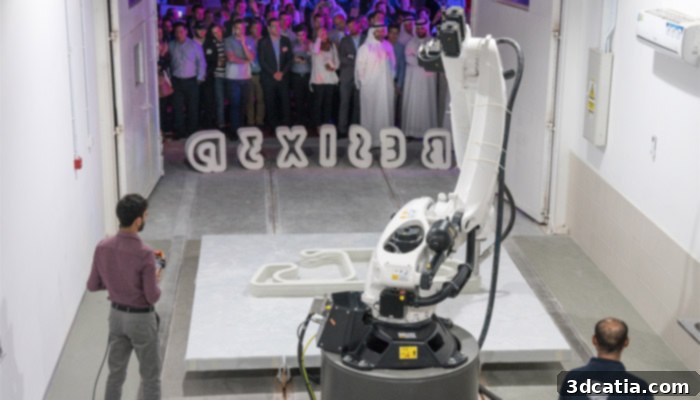
Innovating at the Besix 3D Lab in Dubai | Credits: Besix
The Future of Construction: Bricks & Bytes
The construction sector has been undergoing a profound transformation for several years, driven by a dynamic shift towards digitization and the integration of innovative tools. This evolution is fundamentally reshaping how we plan, design, and execute building projects. With the strategic adoption of 3D printing technology, the BESIX Group is confidently taking the next significant step towards the full industrialization of the sector. This pivotal move signifies a commitment to leveraging advanced manufacturing processes to enhance efficiency, reduce waste, and unlock new architectural possibilities.
The synergy of traditional construction principles with cutting-edge digital technology can be encapsulated by the phrase: Bricks & Bytes. This concept represents the harmonious integration of physical building materials (“Bricks”) with digital intelligence, automation, and data-driven design (“Bytes”). It signifies a future where construction is smarter, faster, more sustainable, and capable of delivering unprecedented levels of customization and complexity. BESIX Group’s embrace of 3D printing is a testament to this vision, paving the way for more resilient, environmentally friendly, and aesthetically rich structures. This digital transformation is not just about new machines; it’s about a new mindset that embraces innovation at every stage of the construction lifecycle, from initial concept to final execution. For more comprehensive information on BESIX Group’s pioneering work and their vision for the future, we invite you to visit their official website HERE.
We hope this deep dive into Besix 3D’s work has offered valuable insights into the exciting advancements in concrete 3D printing. What are your thoughts on Besix 3D’s contributions to additive manufacturing in construction? We encourage you to share your perspectives in a comment below or join the conversation on our Facebook and Twitter pages! Don’t miss out on the latest news and innovations in 3D printing – sign up for our free weekly Newsletter and have all the breaking updates delivered straight to your inbox!