
The Evolving Landscape of 3D Printer Sales: Navigating Pre-Pandemic Challenges and COVID-19’s Transformative Impact
The global additive manufacturing industry, often heralded for its innovative potential, encountered significant headwinds even before the unprecedented health crisis of 2020. A recent report published by the reputable research firm CONTEXT illuminated a challenging period for 3D printer sales. While the full impact of the COVID-19 pandemic became a dominant narrative in 2020, CONTEXT’s findings revealed that the decline in shipments had already begun in the final quarter of 2019, painting a more complex picture of the market’s trajectory. This report is crucial for understanding the underlying dynamics of the 3D printing sector, offering insights into how both existing market conditions and sudden global events shaped its performance.
As the world grappled with the rapidly unfolding health crisis, the additive manufacturing community demonstrated remarkable agility. Many machine manufacturers and distributors swiftly reoriented their operations, focusing on the urgent production of solutions to combat COVID-19. This collective effort showcased the industry’s immense capacity for rapid response and innovation, producing everything from personal protective equipment (PPE) to ventilator components and testing swabs. However, this crucial redirection of resources, while vital for public health, also influenced the commercial landscape. According to CONTEXT’s projections, the global shipments of 3D printers were anticipated to drop by approximately 4% in 2020, even with the hopeful prospect of a market recovery in the latter half of the year. This forecast underscored the dual challenge faced by the industry: addressing a global emergency while also navigating commercial pressures.
Understanding the Pre-Existing Market Slowdown in 2019
While the COVID-19 pandemic undoubtedly exacerbated market challenges, CONTEXT’s study made it unequivocally clear that the downturn in 3D printer sales was not solely attributable to the health crisis. The latter part of 2019 already exhibited a discernible decline across all segments of the 3D printing market. This pre-existing slowdown signals deeper systemic issues that were affecting investment and demand within the industry. To provide a granular view, CONTEXT categorizes 3D printers into four distinct segments based on their price points and intended applications: industrial (printers costing over $100K), design (ranging between $20K and $100K), professional (priced between $2.5K and $20K), and finally personal (those less than $2.5K, excluding 3D printer kits). This segmentation is vital for understanding the varying dynamics and specific challenges faced by different parts of the market.
Chris Connery, Vice President of Global Analysis at CONTEXT, offered critical insights into these findings. He explained, “While COVID-19 had not yet had an impact, global shipments of 3D printers were already unusually low in the fourth quarter of 2019. For many manufacturers – particularly those focusing on industrial or design printers – this slowdown was associated with a weak automotive market, a generally fragile manufacturing sector and sluggish Asian and European economies.” This statement highlights that macro-economic factors played a significant role in dampening demand for higher-end 3D printing solutions. A weak automotive market, for instance, directly impacts demand for advanced prototyping, tooling, and small-batch production applications where industrial 3D printers are often deployed. Similarly, a fragile manufacturing sector globally signals reduced capital expenditure and reluctance to invest in new technologies, while sluggish economies in key regions like Asia and Europe limit market expansion and sales opportunities for 3D printer manufacturers.
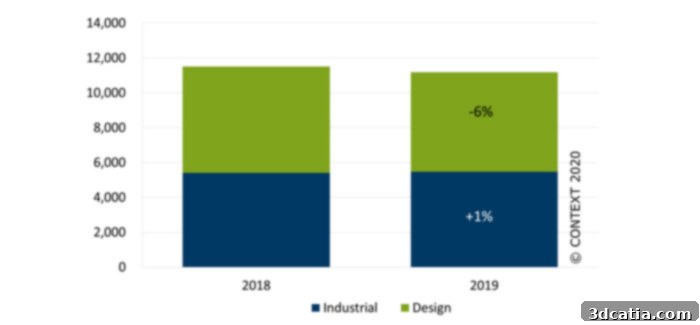
3D printer sales declined in 2019 | Credits: CONTEXT
2019 Market Performance: A Segment-by-Segment Analysis
Delving deeper into CONTEXT’s 2019 results reveals a nuanced picture across the various 3D printer categories. The personal 3D printer segment experienced an 11% decrease in shipments during the fourth quarter of 2019. This decline, however, was largely offset by a notable surge in the popularity of 3D printer kits. This trend suggests a shift in consumer preference within the entry-level market, with hobbyists and enthusiasts increasingly opting for more affordable, self-assembled solutions. The design segment also saw a decrease, with shipments dropping by 6%. In contrast, the industrial solutions segment managed a slight increase of 1%, indicating a degree of resilience despite broader economic concerns. The most robust growth was observed in the professional solutions category, which impressively increased by 16%, signifying growing adoption of mid-range machines for various business and educational applications.
The Rise of Personal 3D Printer Kits and the Decline of Plug&Play
One of the most striking findings from the report was the significant rise in sales of DIY 3D printer kits. In 2019, the number of kits shipped was almost twice as high as that of ready-to-use “Plug&Play” printers. This trend can be largely attributed to their highly accessible price points, typically ranging from $200 to $500, making 3D printing technology available to a much broader audience. The affordability of these kits has fueled a thriving community of makers, educators, and small businesses. The market leader in this burgeoning segment is Creality, which has successfully captured a significant share through its competitively priced and feature-rich kits. Other prominent manufacturers like XYZPrinting, Prusa Research, Monoprice, Anycubic, and Flashforge are also actively competing for market share in the personal segment, continually pushing the boundaries of affordability and performance. This growth in DIY kits reflects a strong DIY culture and the increasing desire for customizable and cost-effective entry points into additive manufacturing.
Industrial and Design Segments: Metal Solutions Offer a Glimmer of Hope
While the industrial and design segments collectively account for more than 78% of all 3D printer sales revenue, their unit shipments experienced an overall plunge in 2019. This trend underscores the impact of the aforementioned macroeconomic factors on high-value capital equipment investments. However, within this challenging environment, there was a significant positive outlier: an increase in the sales of metal additive manufacturing solutions. This growth was largely driven by new processes inspired by Metal Injection Molding (MIM) techniques, which contributed to a 4% increase in this specific sub-segment. These MIM-inspired processes often offer more accessible and cost-effective ways to produce metal parts compared to traditional powder bed fusion methods, making metal 3D printing viable for a wider range of industrial applications.
This innovation allowed companies such as Desktop Metal and Markforged to capture a substantial share of the market, propelling them to become leaders in the industrial and design sectors, particularly for metal printing. Their advancements democratized access to metal additive manufacturing, moving it from highly specialized environments to more mainstream industrial production floors. This trend highlights the ongoing evolution and diversification within the 3D printing industry, where new technologies and applications can carve out growth even when overall market conditions are challenging. The continued demand for metal solutions indicates the increasing readiness of industries to adopt additive manufacturing for functional end-use parts, tooling, and specialized components.
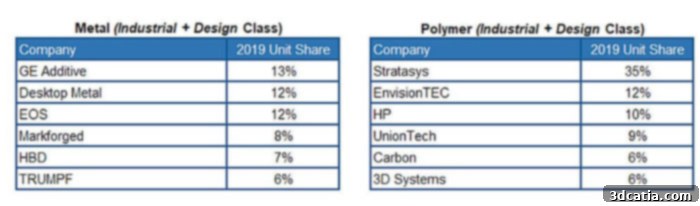
Desktop Metal and Markforged are now among the largest manufacturers of metal 3D printers in terms of market share (in the industrial and design segments).
The Unforeseen Impact of COVID-19 on 2020 Forecasts
The global health crisis that emerged in early 2020 fundamentally reshaped economies and traditional working paradigms. Players in additive manufacturing quickly recognized the imperative to adapt, making their machines, expertise, and materials readily available to address the emergency. This period saw an unprecedented mobilization of 3D printing resources for critical medical supply production. Chris Connery elaborated on the consequences of this strategic pivot: “By concentrating efforts on the production of essential medical supplies, we have moved away from the production and sale of printers. This refocus – the supply and demand constraints expected in the coming weeks and low shipments in the fourth quarter of 2019 – appears to make 2020 a difficult year for 3D printer shipments.”
This insight underscores the dual nature of the pandemic’s impact on the industry. On one hand, it showcased the incredible agility and humanitarian potential of additive manufacturing, drawing significant positive attention and proving its worth in a crisis. Companies and individuals globally utilized 3D printers to produce much-needed PPE, ventilator parts, face shields, and other crucial medical devices, directly contributing to public health efforts. This surge in crisis-driven manufacturing also accelerated the adoption of 3D printing in new applications and sectors, demonstrating its capabilities under pressure. On the other hand, the diversion of manufacturing capabilities towards emergency supplies inevitably reduced the focus on new printer sales and development of non-essential products. Furthermore, global supply chain disruptions led to shortages of components necessary for printer manufacturing, while economic uncertainties resulted in deferred investments by businesses.
Despite these challenges, the news was not entirely negative. The remarkable ability of additive manufacturing to provide concrete help during this difficult period highlighted its inherent value and resilience. The forecast declines for 2020, while significant, were not anticipated to be as catastrophic as might have been feared given the severity of the global economic shock, partly due to the industry’s critical role in the pandemic response and the potential for recovery in the latter part of the year. The crisis, while disruptive, also served as a powerful validation of additive manufacturing’s flexibility, speed, and localized production capabilities, potentially accelerating its long-term adoption in various sectors seeking more robust and agile supply chains. For a more detailed breakdown of these findings, the full study is available HERE.
The Future Trajectory of Additive Manufacturing
The CONTEXT report offers a crucial snapshot of an industry at a crossroads, navigating both pre-existing market adjustments and unprecedented global disruptions. The data from 2019 clearly indicated a period of introspection and realignment for 3D printer manufacturers, particularly in higher-end segments, while the personal and professional categories showed diverse trends. The subsequent arrival of COVID-19 then thrust the entire sector into a new reality, demonstrating its vital capacity for crisis response while simultaneously impacting traditional sales pipelines. The insights from Chris Connery and the overall findings underscore that the 3D printing industry, while experiencing short-term turbulence, possesses inherent strengths that could pave the way for future growth.
Looking ahead, the lessons learned from 2020, particularly regarding supply chain vulnerabilities and the need for localized, on-demand manufacturing, are likely to accelerate the adoption of additive manufacturing in the long term. Industries may increasingly invest in 3D printing technologies to build more resilient supply chains, facilitate rapid prototyping for innovative solutions, and enable agile production processes. While the immediate aftermath of the pandemic presented a challenging environment for printer shipments, the demonstrated utility of 3D printing during the crisis could foster greater confidence and investment in the technology in the years to come. The industry’s ability to adapt, innovate, and contribute meaningfully during a global emergency speaks volumes about its potential to redefine manufacturing in the 21st century.
We value your perspective on these compelling study results from CONTEXT. What are your thoughts on the market trends and the impact of recent global events on 3D printer sales? Share your insights in a comment below or join the conversation on our Facebook and Twitter pages! Don’t miss out on the latest developments in the world of 3D printing; sign up for our free weekly Newsletter to receive all the essential updates directly in your inbox!