
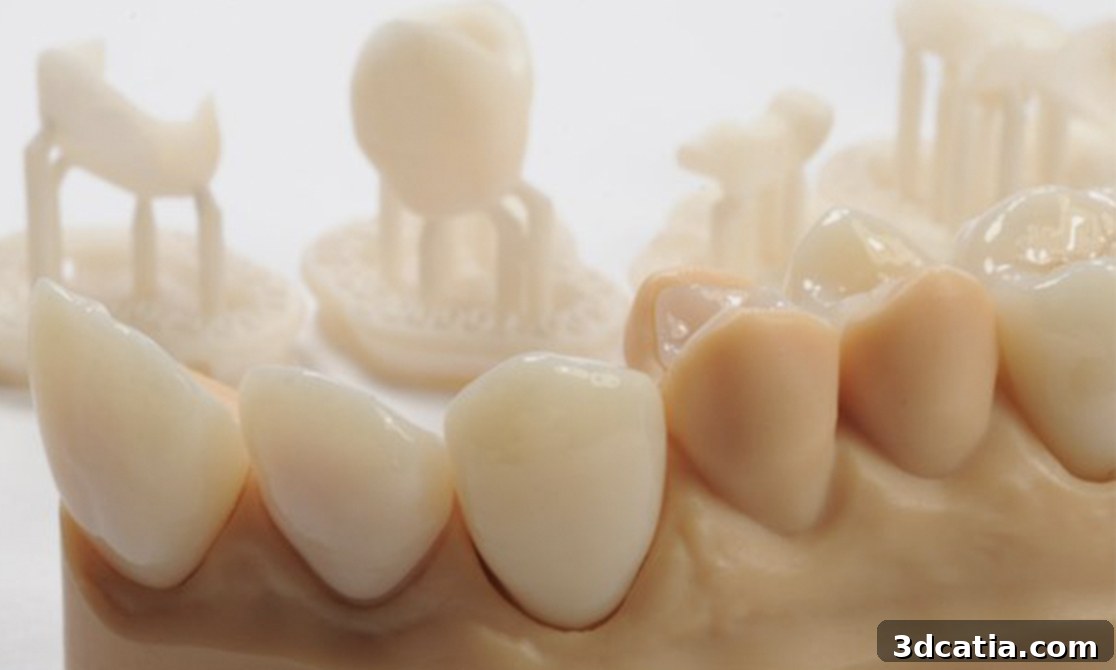
Revolutionizing Dental Care: The Unmatched Accuracy of 3D Printed Crowns
The integration of advanced manufacturing techniques has steadily transformed various industries, and dentistry is certainly no exception. For years, the potential of 3D printing in dental applications has been a subject of much discussion and theoretical exploration. Now, robust scientific research is providing the tangible evidence needed to validate its profound benefits over conventional methods. A groundbreaking study conducted by scientists at the Tohoku University Graduate School of Dentistry in Japan has recently delivered quantifiable proof, meticulously comparing the precision of dental crowns produced via DLP (Digital Light Processing) 3D printing against those manufactured through traditional wet milling processes. Their findings were compelling: the 3D-printed versions demonstrated significantly higher dimensional accuracy, firmly indicating that this additive manufacturing method yields technically superior products for dental restoration. This revelation marks a pivotal moment, affirming 3D printing’s role as a precision tool set to redefine standards in dental prosthetics.
The Evolving Landscape of Dental Technology: Innovation Meets Tradition
Within the medical and dental fields, there can often be a natural inclination towards established practices. Familiarity with tried-and-tested methods provides comfort and a sense of reliability for practitioners. While the efficacy of conventional techniques is undeniable and forms the bedrock of modern dentistry, the continuous pursuit of excellence often necessitates the adoption of newer, more innovative technologies to address persistent challenges and elevate patient care. Researchers worldwide are tirelessly working to develop and refine treatments that not only meet stringent medical requirements but also satisfy increasingly sophisticated aesthetic demands.
In this context, 3D printing technology has emerged as a powerful solution to several long-standing problems in dental practice. Its versatility allows dentists and dental laboratories to produce a wide array of customized items, including highly accurate implants, custom-fit orthodontic retainers, precise surgical guides, and detailed models of the dental arch for diagnostics and treatment planning. This digital fabrication approach ensures a level of personalization and precision previously unattainable with manual or traditional methods. The roots of this digital revolution in dentistry can be traced back decades; for instance, prior to the widespread advent of 3D printing, CAD/CAM (Computer-Aided Design/Computer-Aided Manufacturing) technology specifically for dental applications was patented in France by Dr. Francois Duret as early as 1975. Dr. Duret was a visionary pioneer, whose early work laid the foundational groundwork for integrating computerized methods to enhance dental treatments, paving the way for the sophisticated digital workflows we see today, including 3D printing.
A Deep Dive into the Tohoku University Study: Methodology and Key Findings
The recent study from Tohoku University provided crucial empirical data supporting the superiority of 3D printing. The research design was meticulous, beginning with the creation of abutments—the essential support structures upon which dental crowns are securely placed. Following this, advanced CAD software was utilized to generate precise digital models of the crowns themselves. To compare manufacturing accuracy, two distinct methods were employed to produce these physical crown models: the well-established traditional wet milling technique, an exemplary form of subtractive manufacturing, and the innovative DLP 3D printing method, which represents additive manufacturing.
The fundamental difference between these two approaches is significant. Subtractive manufacturing, like wet milling, involves starting with a solid block of material and systematically removing (milling away) unwanted portions to achieve the desired shape. This method can be efficient for certain geometries but may struggle with intricate details and can lead to material waste. In contrast, additive manufacturing, or 3D printing, builds up an object layer by layer from a digital design, adding material only where it is needed. This process is inherently suited for producing complex and highly individualized geometries with minimal material waste.
Upon production, the resulting physical crowns from both methods were meticulously superimposed onto their original digital design data using specialized software. The objective was to identify and quantify any discrepancies between the intended design and the actual manufactured product. The results unequivocally demonstrated that the DLP 3D printing method produced significantly more accurate models, exhibiting fewer and smaller minor discrepancies when compared to the milled crowns. This higher dimensional accuracy is critical in dentistry; it translates directly to a better-fitting crown that requires fewer chairside adjustments, enhances patient comfort, and potentially extends the longevity of the restoration by reducing stress points and improving marginal integrity. The visual representation in the image below vividly illustrates these discrepancies, highlighting the superior precision achieved through 3D printing.
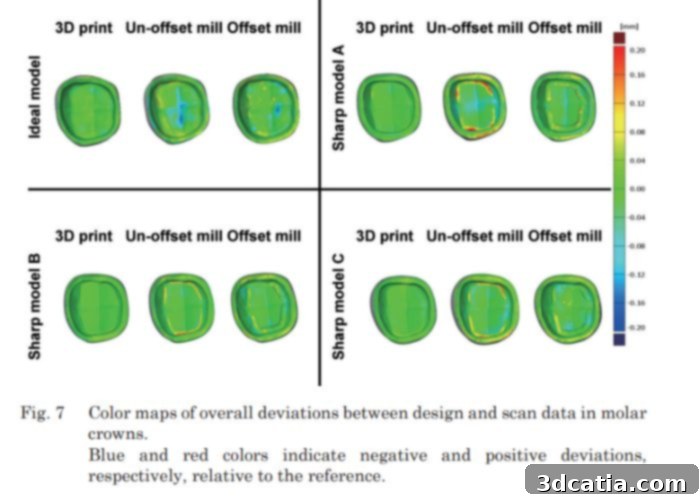
Photo credit: Dental Materials Journal 2022
Understanding 3D Printing Technologies in Dental Applications
The world of 3D printing encompasses a variety of technologies, each with its unique advantages and suitability for different dental applications. The Tohoku University study specifically focused on DLP 3D printing, but it’s important to recognize that other additive manufacturing methods also play significant roles in the dental sector.
Digital Light Processing (DLP): This technology uses a digital light projector to flash an image of each layer across the entire build platform at once, rapidly curing liquid resin into a solid object. DLP printers are known for their speed, high resolution, and smooth surface finishes, making them ideal for producing highly detailed dental crowns, temporary restorations, surgical guides, and orthodontic models. The speed comes from curing an entire layer simultaneously, rather than tracing it with a laser.
Stereolithography (SLA): Similar to DLP, SLA also uses a liquid resin that is cured by light. However, instead of a projector, an SLA printer employs a UV laser to draw each layer onto the surface of the resin vat. SLA is renowned for its exceptional precision and fine detail capabilities, making it a preferred choice for intricate dental models, patterns for casting, and even some aligners and retainers where ultra-fine features are paramount. The meticulous laser tracing allows for incredibly smooth surfaces and tight tolerances.
Selective Laser Sintering (SLS): Unlike DLP and SLA, which use liquid resins, SLS technology utilizes a high-power laser to selectively fuse small particles of powdered material (such as polymers, ceramics, or even metals) into a solid structure. The unfused powder acts as support for the printed part, allowing for complex geometries without the need for additional support structures. While less common for direct chairside crown fabrication than resin-based methods, SLS holds immense potential for producing highly durable and biocompatible metal frameworks for bridges and dentures, or specialized components with high mechanical strength.
Each of these technologies offers distinct benefits in terms of speed, resolution, material compatibility, and mechanical properties of the final product. The choice of 3D printing method in a dental lab or clinic often depends on the specific application, the desired material characteristics, and the required level of precision and detail. This diverse ecosystem of additive manufacturing tools ensures that digital dentistry can address a wide spectrum of patient needs with tailored solutions.
Navigating the Limitations and Glimpsing the Future of Digital Dentistry
While the findings from Tohoku University are undeniably encouraging and provide substantial support for the superior accuracy of 3D-printed dental crowns, it is equally important to acknowledge the inherent limitations of any scientific study and the broader challenges facing the widespread adoption of new technologies.
Firstly, the researchers in this specific study tested only one form of 3D printing (DLP) and one specific form of traditional manufacturing (wet milling). It is entirely plausible that variations within each category, such as different types of milling machines or other additive manufacturing technologies like SLA or SLS, could yield different levels of accuracy and performance. Each method boasts its own set of advantages and disadvantages, and comprehensive comparative studies spanning a broader range of techniques are essential to build a more complete understanding of their relative merits.
Beyond mere dimensional accuracy, the long-term viability of 3D printing in the dental sector hinges on several other critical factors. Extensive further research is imperative in areas such as ‘fracture resistance’ and ‘biocompatibility’. A dental crown, no matter how perfectly shaped, must withstand the immense chewing forces in the oral cavity over many years without breaking or degrading. Its ‘fracture resistance’ directly impacts its durability and longevity. Similarly, ‘biocompatibility’ is non-negotiable; any material placed inside a patient’s mouth must be safe, non-toxic, and not provoke adverse reactions from surrounding tissues. Dental materials specifically formulated for 3D printing are continuously being developed and rigorously tested to meet these stringent requirements, but this remains an active area of innovation.
Furthermore, the practical implementation of 3D printing on a larger scale faces operational hurdles. The high initial investment costs for acquiring advanced 3D printers, specialized resins, and associated software can be a significant barrier for many dental practices and labs. However, it’s worth noting that these initial costs can often be offset over time by reduced material waste, faster production cycles, and the ability to bring production in-house, leading to greater control and efficiency. Another considerable challenge is the shortage of adequately trained staff. Integrating 3D printing into daily workflows requires dentists, dental technicians, and support staff to acquire new skills in digital design, printer operation, and post-processing techniques. Developing comprehensive training programs and educational pathways is crucial to bridging this knowledge gap and facilitating broader adoption.
Nevertheless, the evidence for the superior accuracy of these 3D-printed dental crowns is profoundly encouraging. It underscores the immense potential of additive manufacturing to elevate precision, improve patient outcomes, and streamline dental workflows. The future of dentistry is undoubtedly digital, with 3D printing poised to play an increasingly central role in creating personalized, high-quality, and efficient dental restorations and appliances. This exciting progress points towards a future where digital dentistry not only meets but exceeds the demands of modern patient care, offering unparalleled customization and comfort. You can learn more about the study HERE.
What are your thoughts on this pivotal study and the ongoing advancements in dental 3D printing? We’d love to hear your perspective! Please share your insights in a comment below or connect with us on ourLinkedIn,Facebook, andTwitter pages! Don’t forget to sign up for our free weeklyNewsletter here, ensuring you receive the latest 3D printing news directly to your inbox! You can also explore all our informative videos and engaging content on our dedicatedYouTube channel.