
Preserving Maritime History: The Silentworld Foundation’s Pioneering Use of Artec 3D Scanning for the Barangaroo Boat
Additive manufacturing and advanced 3D technologies are increasingly recognized as powerful tools, not just for creating new components or repairing existing ones, but also for the meticulous and precise reconstruction of historical artifacts. This revolutionary approach is particularly vital in fields like marine archaeology, where delicate, centuries-old relics demand the utmost care and accuracy during documentation and preservation. The Silentworld Foundation, a distinguished Australian non-profit organization dedicated to marine archaeology and heritage, stands at the forefront of this technological adoption. Understanding the immense potential of 3D scanning, Silentworld has embraced these innovative methods to digitally preserve and reconstruct numerous historical vessels, safeguarding invaluable insights into our maritime past.
Among their most notable and groundbreaking projects is the detailed 3D modeling of the “Barangaroo Boat.” This significant 19th-century vessel was unearthed in Sydney during critical excavation work, presenting both an invaluable historical discovery and a considerable challenge for traditional preservation methods. The boat, a fascinating glimpse into Australia’s colonial maritime activities, required a sophisticated approach to ensure its legacy could be thoroughly documented and shared. To accurately capture and reproduce every intricate detail of this fragile ship, the Silentworld team strategically partnered with leading 3D scanner manufacturer Artec 3D. This collaboration marked a pivotal step in demonstrating how high-precision 3D scanning could transform the landscape of maritime heritage conservation, offering an unprecedented level of detail and a non-invasive documentation process for priceless artifacts.
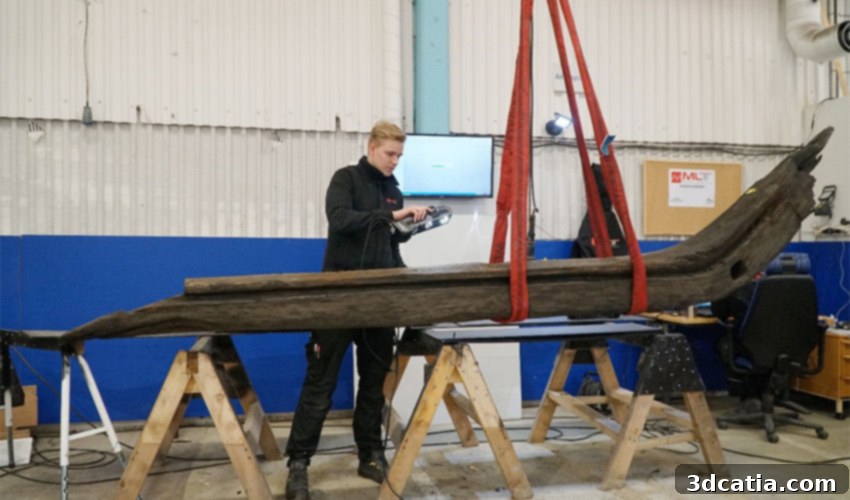
The process of digitally documenting the Barangaroo Boat was an undertaking that required exceptional precision and careful planning, far from a simple task. Given the vessel’s advanced age and the inherent fragility of its 19th-century wooden components, meticulous handling was paramount to prevent any further deterioration or damage. Each individual part comprising the Barangaroo Boat, believed to date back to the 1820s, was painstakingly removed and prepared before being subjected to the advanced scanning process. This systematic approach ensured that the structural integrity of every piece was maintained throughout the entire operation, highlighting the delicate balance between archaeological recovery and modern preservation techniques.
The application of 3D scanning technologies, exemplified by the Artec 3D scanner, yielded remarkable efficiencies that are simply unattainable through conventional archaeological documentation methods. For projects involving delicate historical artifacts like the Barangaroo Boat, and indeed other vessels Silentworld has since worked on, these technologies offer significant time savings. In the case of the Barangaroo Boat, the comprehensive data acquisition for its numerous parts was completed in an astonishingly short period of just three months. This rapid turnaround stands in stark contrast to the estimated timeframe of over a year that would have been required to gather comparable data using traditional manual methods such as hand-drawing, precise measurement, and extensive photographic documentation. The ability to capture vast amounts of accurate data quickly not only accelerates the research and preservation process but also minimizes the exposure time for fragile artifacts, thereby significantly reducing risks associated with prolonged handling and environmental exposure.
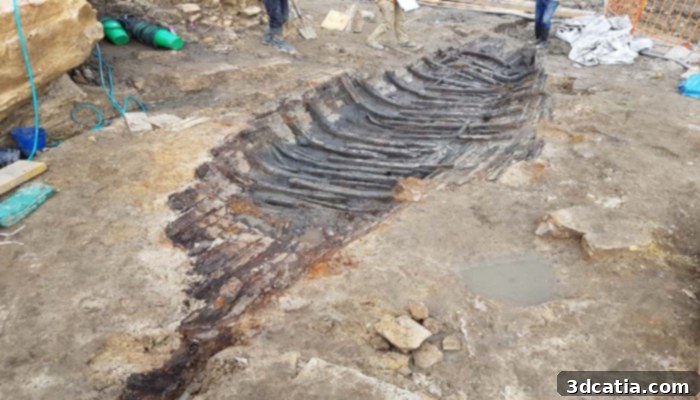
The Barangaroo Boat which was discovered during excavations (photo credits: Silentworld)
The Artec Eva 3D Scanner: A Pillar of Heritage Preservation
For the critical task of scanning the old boat, the collaborative teams specifically deployed the Artec Eva 3D scanner, a device widely regarded as one of the most versatile and efficient professional 3D scanners available on the market today. Its reputation for excellence stems from a combination of robust features perfectly suited for heritage preservation projects. According to Artec 3D, the Eva boasts a lightweight design, enabling easy portability and maneuverability around complex objects, which is crucial when working on archaeological sites or in conservation laboratories. Its operational speed significantly accelerates data capture, while its inherent versatility allows it to handle a wide array of object sizes and materials, making it ideal for the diverse and often irregular components of a historical shipwreck.
A cornerstone of the Artec Eva’s capability, and a key factor in its selection for this project, is its impressive accuracy, offering precision down to 0.1 mm. This minute level of detail is crucial for archaeologists and conservators who rely on the exact reproduction of an artifact’s form for analysis, scientific study, and potential physical reconstruction. Furthermore, the Eva operates without the need for targets or markers, simplifying the scanning process and making it truly non-contact. This feature is particularly beneficial when dealing with extremely delicate or fragile surfaces, as it eliminates any risk of inadvertent damage that could arise from applying reference points. The ability to scan directly and seamlessly ensures the integrity of the original artifact remains uncompromised, adhering to the highest standards of archaeological ethics.
During the Barangaroo Boat project, the Artec Eva demonstrated its superior performance by successfully scanning as many as 300 individual parts of the vessel. The scanner not only captured the precise geometry of each wooden component but also accurately recorded its color and texture. This dual capability is invaluable for historical wooden artifacts, as the grain patterns, natural discoloration, and remnants of historical finishes are as significant as the shape itself, providing clues about the wood type, age, and environmental exposure. Ultimately, the Eva’s exceptional accuracy proved instrumental in highlighting subtle yet critical details such as tool marks, distinctive wood grain patterns, and even individual nail marks – features that provide invaluable clues about the ship’s construction techniques, its origins, and its operational history. According to the Silentworld Foundation, these fine details constitute “crucial data” for thorough archaeological interpretation and scholarly research, allowing for a deeper and more nuanced understanding of the vessel’s past and the lives of those who built and sailed it.
The success of the Barangaroo Boat project underscores the powerful synergy between innovative technology providers and dedicated heritage organizations. Ben Myers, Director of 3D Scanning at Thinglab, a key Australian partner of Artec 3D, expressed his enthusiasm for the ongoing collaboration. He affirmed, “We look forward to growing our relationship and helping the Foundation explore how they can further utilize the Artec portfolio. We are very honored to have contributed, in a small way, to helping the Silentworld Foundation record and use 3D data.” This statement highlights Thinglab’s commitment not only to providing cutting-edge scanning solutions but also to fostering long-term partnerships that empower organizations like Silentworld in their critical mission of safeguarding global cultural heritage.
Indeed, the digitization of the Barangaroo Boat represents far more than a single successful project; it signifies a strategic shift in heritage preservation. This pioneering endeavor is by no means an isolated case for the Silentworld Foundation. Inspired by the remarkable outcomes achieved with the Barangaroo Boat, the Foundation has since expanded its application of 3D technologies to numerous other significant maritime discoveries. Their ongoing commitment has led to the successful scanning and documentation of three additional shipwrecks, each presenting its unique challenges and historical narratives. Silentworld continues to leverage these advanced tools to meticulously reconstruct ancient boat parts and create detailed 3D models of entire vessels, enriching our understanding of Australia’s maritime past and contributing significantly to the global body of archaeological knowledge.
The enduring value of these 3D digital assets extends beyond mere documentation. They create invaluable digital archives that can be studied remotely by researchers worldwide, shared globally for collaborative projects, and used to create stunning virtual and physical reconstructions for public display and educational purposes. This ensures that even the most fragile artifacts, which might never withstand extensive physical handling or transport, can be thoroughly analyzed and appreciated by future generations. The partnership between Silentworld Foundation and Artec 3D through Thinglab exemplifies a forward-thinking approach to safeguarding our shared cultural heritage, setting a new benchmark for archaeological practice. For those interested in delving deeper into the specifics of Australia’s oldest colonial boat and its revolutionary reconstruction, further details are available HERE.
The transformative power of 3D technologies in preserving and reconstructing historical ship models is undeniable. We invite you to share your thoughts on this innovative approach to heritage conservation. Let us know what you think in a comment below or connect with us on our Facebook and Twitter pages. For the latest news and advancements in 3D printing and additive manufacturing delivered straight to your inbox, don’t forget to sign up for our free weekly newsletter!
*Thumbnail Photo Credits: Creaform