
Revolutionizing Post-Mastectomy Care: Personalized 3D Printed Breast Prostheses for Enhanced Comfort and Accessibility
Breast cancer remains a formidable challenge in global healthcare. Apart from various skin cancers, it stands as the most prevalent cancer among women in the United States, with projections indicating an estimated 42,170 fatalities in 2025 alone. Despite these sobering statistics, continuous advancements in screening techniques, prevention strategies, and treatment modalities offer significant hope for reducing this number and improving patient outcomes over time. Addressing this critical need, researchers at the Carle Illinois College of Medicine (CI MED), a part of the esteemed University of Illinois Urbana-Champaign, are pioneering the use of cutting-edge technology to provide invaluable support for women who have undergone a mastectomy.
A mastectomy is a profound surgical procedure involving the removal of one or both breasts, typically performed to treat existing breast cancer or to proactively prevent its development in high-risk individuals. This life-saving operation, while crucial, often leaves patients grappling with significant physical and emotional changes. In response, the innovative team at CI MED is leveraging advanced scanning and 3D printing techniques to develop personalized breast prostheses. These custom-designed prostheses are meticulously tailored to each patient’s unique anatomical contours, promising a level of fit and comfort previously unattainable for many. The ambitious goal of this project is to enable the production of these bespoke prostheses directly within a doctor’s office, thereby significantly enhancing their accessibility, dramatically reducing procurement times, and making them substantially more affordable than the conventional options currently available on the market.
Addressing the Post-Mastectomy Landscape: Challenges and Current Solutions
For many women, the period following a mastectomy involves a complex journey towards physical and emotional recovery. While breast reconstruction surgery is an option for some, it is not always feasible or desired, whether due to medical contraindications, personal preference, or financial constraints. Consequently, a significant number of women opt for external breast prostheses to restore the natural silhouette of their chest beneath their clothing. These conventional prostheses, however, often come with a host of limitations. Standard off-the-shelf options may offer a poor fit, leading to discomfort, shifting, and a less natural appearance. Custom-made prostheses, while offering improved aesthetics and fit, are typically very expensive, placing them out of reach for many patients.
Dr. Victor Stams, a distinguished plastic surgeon and professor at CI MED, highlights the stark reality that many patients unfortunately forgo prostheses altogether. This decision often stems from a lack of adequate insurance coverage, the prohibitively high costs associated with quality prosthetics, or simply an unawareness of the available solutions and how to access them. Recognizing these significant barriers, Dr. Stams, in collaboration with Rand Kittani, a diligent internal medicine student, has spearheaded a groundbreaking initiative. Together, they are developing an ingenious method to manufacture high-quality, 3D printed breast prostheses directly on-site at a substantially lower cost, aiming to democratize access to this essential post-operative support.
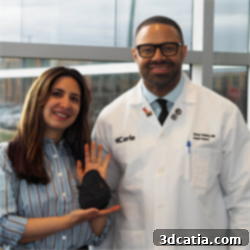
Rand Kittani (left) and Dr. Victor Stams (right) develop an affordable 3D breast prosthesis (Photo credits: University of Illinois)
The Power of Personalization: Accessibility and Comfort Through 3D Printing
The innovative solution pioneered by the CI MED team, as emphasized by Rand Kittani, offers a swift and remarkably affordable alternative to the more invasive and often cost-prohibitive conventional breast reconstruction surgeries or expensive traditional prostheses. This advancement is poised to dismantle the persistent financial and social barriers that frequently prevent patients from accessing crucial post-mastectomy care. By leveraging additive manufacturing, the team is developing prostheses that are projected to cost between $50 and $200 – a stark contrast to typical market prices that can run into hundreds or even thousands of dollars for customized options. Furthermore, the ability to manufacture these prostheses directly by the doctor’s office effectively eliminates the often-frustratingly long delays associated with ordering and receiving custom medical devices. This direct, point-of-care manufacturing model not only streamlines the process but also empowers patients with quicker access to vital support.
Dr. Victor Stams eloquently articulated the profound impact of this project, stating, “Beyond cost and convenience, what excites me most is the opportunity to give patients a sense of dignity and control during a vulnerable time.” This sentiment underscores the deeper, human-centric aspect of their work. The psychological and emotional toll of a mastectomy can be immense, impacting body image, self-esteem, and overall quality of life. Providing a comfortable, well-fitting, and aesthetically pleasing prosthesis can play a crucial role in restoring a sense of normalcy and empowering women as they navigate their recovery journey.
Inspired Design and Advanced Scanning Techniques
The foundational inspiration for the Illinois team’s groundbreaking work originated from Julien Montenero, a renowned French anatomist who has mastered the art of creating incredibly realistic breast prostheses using intricate 3D body imaging. Adapting this principle, the CI MED team utilizes readily available and affordable 3D scanners to capture precise digital models. Prior to a mastectomy, they scan the patient’s healthy breast, generating a detailed digital file that serves as the blueprint for the custom prosthesis. This digital blueprint allows for the rapid and precise manufacturing of a prosthesis that is perfectly adapted to the individual patient’s anatomy, ensuring a symmetrical and natural appearance. According to Dr. Victor Stams, this bespoke approach significantly enhances aesthetics, which plays a pivotal role in improving a patient’s self-perception and overall well-being in the sensitive period following surgery. The ability to achieve such a high degree of customization means that the prostheses seamlessly integrate with the patient’s body shape, minimizing discomfort and maximizing confidence.
Traditional and even some customized prostheses are often crafted from materials like medical-grade silicone or other soft polymers. The more intricate, personalized, and lifelike these conventional prostheses are, the higher their cost typically becomes. The CI MED team is meticulously testing a diverse range of materials to identify the optimal combination of attributes. Their research involves exploring various options, including 3D printed plastic, thermoplastic polyurethane (TPU), and even venturing into the cutting-edge field of bioprinting. The selection criteria are rigorous, focusing on finding materials that excel in comfort, provide an impeccable fit, ensure durability, and most importantly, remain within an affordable price range. This comprehensive material exploration is crucial for delivering a product that not only meets medical standards but also remains economically accessible to a wider patient demographic. Their commitment to exploring bioprinting, in particular, suggests a future where prostheses could potentially offer even greater biocompatibility and a more integrated feel, blurring the lines between device and natural tissue.
The Broader Impact and Future Outlook of 3D Printed Prosthetics
The implications of the Carle Illinois College of Medicine’s research extend far beyond individual patient care. This pioneering work has the potential to fundamentally transform the landscape of post-mastectomy support globally. By making personalized, high-quality breast prostheses accessible and affordable, the project addresses a critical unmet need in women’s health. It offers a tangible solution to health disparities, ensuring that financial status or geographical location does not dictate access to dignified and comfortable recovery options. The “point-of-care” manufacturing model, wherein prostheses can be produced directly in a doctor’s office, drastically reduces logistical hurdles and wait times, which can be particularly stressful for patients recovering from major surgery.
Furthermore, the integration of 3D scanning and additive manufacturing into clinical practice for prosthetics opens doors for similar innovations across various medical fields. Imagine customized orthopedic braces, personalized surgical guides, or even patient-specific implants becoming standard, readily available treatments. The expertise gained from this breast prosthesis project could pave the way for a new era of personalized medicine, where individual patient needs are met with unparalleled precision and efficiency. As 3D printing technology continues to advance, becoming faster, more precise, and capable of handling a broader spectrum of materials, the possibilities for medical applications are virtually limitless.
The team’s dedication to optimizing materials for comfort, fit, and affordability is particularly noteworthy. The exploration of materials like TPU offers flexibility and a natural feel, while the interest in bioprinting hints at a future where prostheses might even incorporate biological elements for improved integration with the body. Such developments could lead to prostheses that are not only indistinguishable from natural tissue but also potentially lighter, more breathable, and less prone to irritation than current options. The collaborative spirit between a plastic surgeon and an internal medicine student also highlights the interdisciplinary nature of modern medical innovation, where diverse perspectives converge to solve complex healthcare challenges.
Ultimately, the work being done at the Carle Illinois College of Medicine represents a beacon of hope for thousands of women confronting the aftermath of breast cancer. By harnessing the power of 3D printed breast prostheses, the team is not just creating physical devices; they are restoring confidence, promoting emotional healing, and empowering survivors to reclaim their sense of self. This innovative approach promises to deliver truly personalized care, fostering a future where every woman has access to the comfort, dignity, and control she deserves during one of life’s most vulnerable periods.
To delve deeper into the specifics of this transformative project and the ongoing research, you can click HERE for more information directly from the University of Illinois.
What are your thoughts on the revolutionary potential of 3D printed breast prostheses in post-mastectomy care? We encourage you to share your perspectives and engage with our community by leaving a comment below or by connecting with us on our LinkedIn and Facebook pages. Furthermore, stay abreast of the latest developments in additive manufacturing by signing up for our free weekly Newsletter, delivering the most current 3D printing news directly to your inbox. For those keen on visual content, all our insightful videos are available on our YouTube channel. If your interests lie specifically in the dynamic world of medical and dental 3D printing news, we invite you to explore our dedicated page HERE for more specialized content.
*Cover Photo Credits: Freepik