
The RepRap Journey: Building Your Own Open-Source 3D Printer and Beyond
The RepRap movement, short for “Replicating Rapid Prototyper,” traces its origins back to 2004 with its visionary founder, Adrian Bowyer. This groundbreaking initiative emerged shortly after key commercial 3D printing patents expired, opening the floodgates for innovation and democratizing additive manufacturing. At its core, the RepRap project is built on the revolutionary concept of self-replication: these machines are designed with the unique ability to 3D print many of their own components. This means a single RepRap printer can produce the necessary parts to assemble another, identical or improved, RepRap machine. This ingenious design laid the foundation for an open-source hardware revolution, significantly influencing the landscape of personal and affordable 3D printing. Over the years, this initial blueprint has evolved into countless variations and improvements, with perhaps the most renowned being the Prusa i3. For those keen on embarking on their own fabrication journey, exploring the numerous options available for self-assembly is a must. You can delve deeper into various kits by checking out our comprehensive list of the Top 14 DIY and self-assemble 3D printers, alongside our selection of the Best Low-Cost 3D Printers, offering solutions for every budget and skill level.
The RepRap Philosophy: Build, Don’t Buy – How Does It Work?
The fundamental principle behind RepRap is not merely to own a 3D printer, but to understand and build it yourself. This philosophy promotes education, experimentation, and a deep understanding of the technology. Most RepRap 3D printer designs are meticulously crafted to be constructed using readily available, off-the-shelf components. Imagine sourcing items like standard threaded rods, an assortment of nuts and bolts, common skateboard bearings for smooth linear motion, cost-effective Arduino-based electronics for control, and reliable NEMA 17 stepper motors for precise movement. These components form the structural and operational backbone of a RepRap machine, making it accessible to hobbyists and makers worldwide. But there’s a crucial element that brings all these disparate parts together—a touch of manufacturing “magic.”
What exactly is this “magic”? It lies in the custom 3D printed mechanical parts. These unique plastic components serve as the connectors, brackets, and structural elements that integrate all the aforementioned standard parts into a cohesive, functional 3D printer. The brilliance of the RepRap concept is that these essential structural parts are themselves capable of being 3D printed on a similar RepRap machine. This means if a friend already owns a RepRap, they can effortlessly print the crucial parts required for you to assemble your very own RepRap. This circular, self-sustaining ecosystem is nothing short of genius, fostering a collaborative community where knowledge and physical components are freely shared, enabling more individuals to participate in the revolution of personal manufacturing.
The Evolution of RepRap: From Printing Parts to Convenient Kits
While the initial spirit of RepRap centered around printing your own components, the landscape has significantly evolved over the past decade. The vibrant RepRap community, which represents not just a machine but a global network of 3D printing enthusiasts, has driven innovation and created a thriving ecosystem. As a result, specific and optimized 3D printer parts are now widely available from numerous suppliers. You no longer necessarily need to print every single mechanical piece from scratch. Dedicated components like high-performance extruders, advanced motherboards, heated build platforms for better adhesion, precision laser-cut frames, and pre-cut screws and linear axes can be purchased with ease. These specialized parts often offer improved performance, durability, and aesthetics compared to early printed versions. The global marketplace, particularly online shops from regions like China, provides an incredible array of options, making it simpler than ever to source high-quality components for your build.
This market maturation has led to another significant development: the proliferation of complete RepRap kits. A growing number of sellers now offer “magic boxes” containing everything you need to assemble your own 3D printer. This eliminates the often time-consuming process of sourcing individual components from various suppliers. These kits come complete with all necessary parts, tools, and crucially, a detailed step-by-step build manual. The assembly process has become remarkably streamlined, drawing parallels to putting together flat-pack furniture from a well-known Swedish retailer. This convenience has made RepRap-style 3D printing accessible to a much wider audience, including those without extensive technical expertise but with a desire to understand their machines from the ground up.
To Build or Not to Build: Navigating the 3D Printer Landscape
The progression didn’t stop at build-it-yourself kits. Recognizing the demand for even greater convenience, sellers took yet another step forward, introducing working, pre-built 3D printers that still embody the open-source spirit of RepRap in their design. With these machines, the process is incredibly straightforward: simply unbox it, connect it to a power outlet, switch it on, load your chosen filament, and immediately dive into the exciting world of 3D printing. This “plug-and-play” experience might sound very familiar, as it mirrors the operational simplicity of many commercial 3D printers on the market. The key differences, however, lie beneath the surface, particularly in the philosophy of design and user interaction.
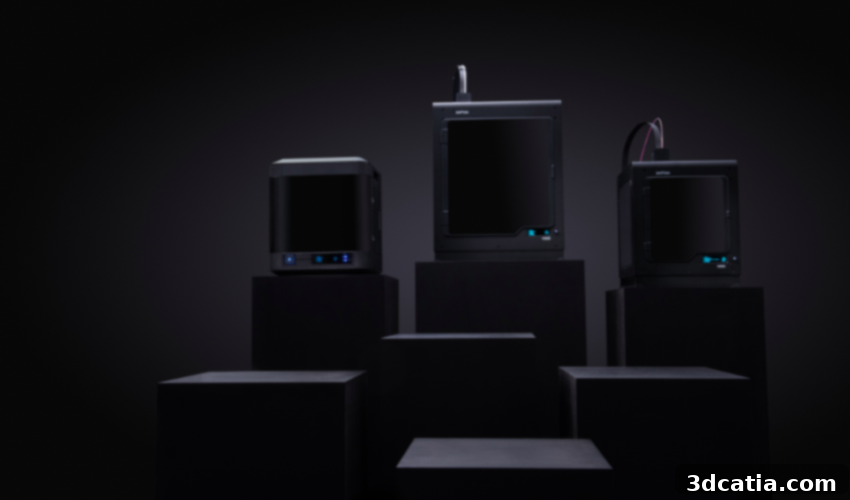
To illustrate this distinction, consider the analogy of computers. A “normal” computer running an open-source operating system like Linux offers immense personalization and flexibility. You can tweak almost every aspect, install a vast array of software, and modify it to suit your precise needs. However, it might not always feel as seamlessly optimized as a computer sporting a fruit in its logo, which often boasts a highly integrated hardware-software ecosystem. Similarly, commercial 3D printers, such as those from brands like Zortrax, typically represent closed-source machines. These printers are the culmination of extensive long-term research and development, featuring perfectly matched components, sophisticated industrial design, and, critically, dedicated proprietary software. This integrated approach ensures users can extract maximum performance and consistent results from their hardware. Commercial printers are often praised for their superior stability, repeatability, and precision, making them ideal for professional applications. Furthermore, many companies, like Zortrax, provide a complete ecosystem, including specially formulated materials, to guarantee even greater stability and print quality, though the flexibility to use external materials is often also available.
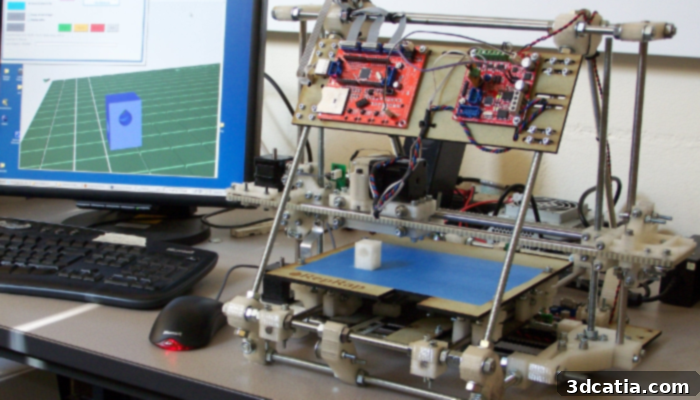
A RepRap printer in action, embodying the spirit of accessible fabrication.
Conversely, open-source RepRap printers champion user freedom and modification. Their open design means you have full access to their blueprints, allowing you to edit the design files, swap out components, upgrade various modules, rescale the machine for different build volumes, and even make direct changes to the firmware. The ability to choose from a wide array of universal slicer software and fine-tune every printing parameter empowers users with unparalleled control. With sufficient time, dedication, and creativity, a RepRap printer can be adapted to print with an incredible range of materials, extending far beyond standard plastics like PLA and ABS. Enthusiasts have successfully experimented with materials as diverse as chocolate, sugar pastes for food applications, and even solder paste for electronics manufacturing, demonstrating the true versatility of the open-source platform.
A Compromise Between Investment, Time, and Skill
The journey into 3D printing often involves weighing a critical compromise between financial investment, the time you’re willing to commit, and the technical skills you possess or wish to acquire. The most economical route to owning a 3D printer is undoubtedly to build it entirely on your own, sourcing individual parts. By leveraging affordable components, searching for bargains, and even reusing motors from discarded electronics, the total cost can potentially dip below $100. More commonly, a self-sourced build might range from $300 to $600. However, this path demands a significant time investment; gathering all the necessary parts can take months, or even longer if you approach it at a leisurely pace. Crucially, it requires a solid foundation of technical skills to understand mechanical assembly, electronics wiring, and fundamental troubleshooting. Even with the incredible support of the RepRap community, you’ll need to develop your own firmware configuration, which involves a degree of programming knowledge and a steep learning curve.
A popular middle ground is purchasing a RepRap kit. These kits consolidate all the necessary components into a single package, making the parts acquisition process effortless. Prices for these kits typically start around $180 and can go up to $1000, depending on the quality of components and features included. It’s important to recognize that a lower price often corresponds to a lower quality of parts, which might impact print consistency and machine longevity. While you’ll still need some technical aptitude for assembly, the included step-by-step instructions greatly simplify the process. Furthermore, most kits come with a pre-configured firmware build, eliminating the need for complex programming and allowing you to get to printing much faster.
For those seeking even greater convenience without fully committing to a commercial brand, an assembled RepRap-style printer offers a compelling option, typically priced between $400 and $1200. With these machines, the construction phase is entirely bypassed. However, while you don’t need to know how to build it, a certain level of technical understanding is still beneficial for maintenance tasks like repairs, calibration, and adjusting printing parameters for optimal results. At the higher end of the spectrum, starting from $1200 and upwards, you can invest in a fully functional, pre-assembled commercial 3D printer. These machines are designed for maximum ease of use, often embodying a “plug and play” philosophy. No specialized skills or prior technical know-how are typically required for basic operation. You simply connect it to power, turn it on, and load your material – often, sample filaments are even included to get you started immediately.
Making Your Informed Decision: The Right 3D Printer for You
Considering all these factors, the decision to acquire a RepRap 3D printer, or any 3D printer for that matter, ultimately hinges on a confluence of personal attributes and specific requirements. Your existing technical skills, the amount of free time you can dedicate to learning and tinkering, and the desired quality and consistency of your 3D prints are paramount. Technically skilled enthusiasts, those who relish the process of learning, building, and customizing, will often gravitate towards constructing their own 3D printer from scratch or assembling a kit. For them, the journey is as rewarding as the destination, offering a profound understanding of the technology and immense satisfaction from a truly personalized machine.
Conversely, professional users, businesses, or individuals who prioritize reliability, consistency, and minimal downtime will likely prefer investing in a commercial 3D printer. For these users, time is often a critical factor, and they are less inclined to spend it troubleshooting unexpected issues or fine-tuning parameters. The stability, ease of use, and dedicated support offered by commercial brands are significant advantages in these contexts. The RepRap project, however, continues to be a driving force in making 3D printing technology accessible and understandable to everyone, fostering innovation and a vibrant community of makers. Its enduring legacy ensures that the spirit of open-source creation remains at the forefront of additive manufacturing.
What are your thoughts on the current state and future direction of the RepRap project? We invite you to share your insights and experiences in the comments section below, or connect with us on our Facebook and Twitter pages! Don’t miss out on the latest advancements and news in the world of 3D printing; remember to sign up for our free weekly Newsletter, delivered straight to your inbox.