
Unveiling the Future: Top 5 Groundbreaking 3D Printing Innovations This Week
Welcome to our weekly showcase of the most exciting advancements in additive manufacturing! This week, we’ve curated five exceptional videos that highlight how 3D printing technology is not just changing production, but revolutionizing entire industries. From transforming construction and electronics to empowering personalized products, fostering educational innovation, and even playing a crucial role in global health crises, 3D printing continues to push boundaries.
The versatility of additive manufacturing has allowed it to deeply infiltrate numerous sectors. Whether it’s the precision required in medical applications, the structural integrity needed in automotive design, or innovative solutions in housing and education, this technology is redefining what’s possible. Our selection offers a glimpse into these cutting-edge developments, ensuring you stay up-to-date with the latest trends and breakthroughs. If you find these insights captivating, remember you can explore an even wider array of compelling 3D printing videos on our Youtube channel. Dive in and discover the incredible power of 3D printing!
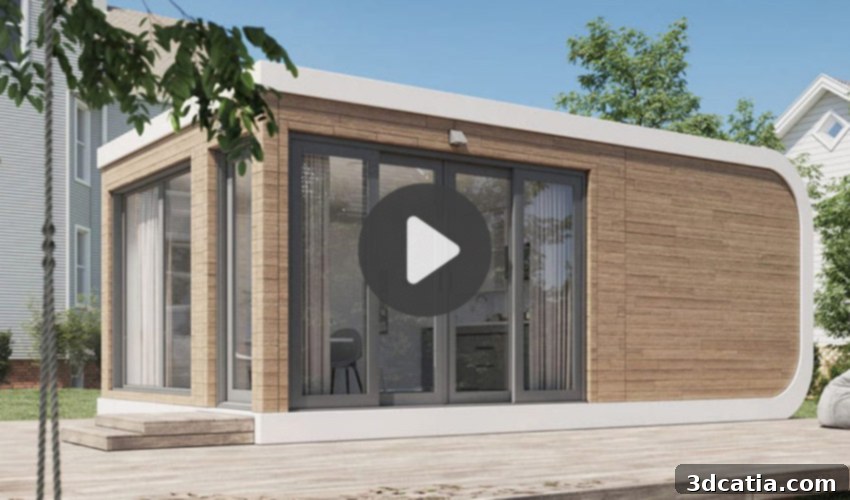
Top 1: Mighty Buildings Pioneers 3D Printed ADU Construction
A few months ago, we had the privilege of connecting with Mighty Buildings, a visionary startup committed to constructing the homes of tomorrow through innovative concrete 3D printing. Their mission addresses critical challenges in modern housing, including affordability, sustainability, and construction speed. Rather than traditional stick-built homes, Mighty Buildings focuses on creating modular structures known as Accessory Dwelling Units (ADUs).
These sophisticated units are fully equipped with essential amenities, including a kitchen and bathroom, making them perfect as primary residences, guest houses, or versatile extensions for your garden. The true marvel of Mighty Buildings’ approach lies in its efficiency and environmental impact. By leveraging advanced concrete 3D printing technology, the company proudly asserts that it uses an astonishing 90% less material compared to conventional construction methods. This reduction not only minimizes waste but also significantly decreases the carbon footprint associated with building. This innovation represents a monumental leap forward in sustainable construction, promising faster, more affordable, and eco-friendlier housing solutions. Witness their revolutionary process in action by watching the video below!
Top 2: Unlocking the Full Potential of Electronic 3D Printing
For decades, microfabrication has been the cornerstone of the electronics sector, instrumental in the relentless drive to miniaturize devices while boosting performance. However, traditional subtractive manufacturing methods often face limitations in creating highly complex, three-dimensional electronic structures. Today, micro 3D printing technologies are stepping into this arena, offering unprecedented capabilities to further enhance functionality, improve performance, and achieve even greater levels of miniaturization in electronic components.
The following video from Nano Dimension, a global leader in the manufacturing of 3D printed electronic components, provides a fascinating insight into the capabilities of additive manufacturing in the electronics industry. Nano Dimension has developed a proprietary inkjet technology that utilizes specialized nanoinks, enabling the creation of intricate electronic circuits layer by layer. This advanced process is based on photopolymerization: a precision printhead accurately deposits different types of nanoinks – including dielectric nanoparticles for insulation, conductive nanoparticles for electrical pathways, and polymers for structural integrity – onto a build plate. After each successive deposition, these materials are rapidly cured by UV light, precisely fusing them to create both highly conductive and insulating structures. This groundbreaking method paves the way for the development of smaller, more powerful, and more complex electronic devices than ever before, promising a new era for advanced electronics.
Top 3: Is 3D Printing Revolutionizing Mass Customization?
In an increasingly personalized world, the traditional definition of customization – merely offering a product in a few different colors or sizes – is no longer adequate for discerning consumers. Today’s customers demand products that are truly unique, specifically designed to meet their individual needs, preferences, and even their physical dimensions. This shift in consumer expectation has posed significant challenges for conventional mass production methods, which are inherently designed for uniformity and efficiency over individual tailoring.
However, with the advent of additive manufacturing, genuine mass customization has transitioned from a niche luxury to an accessible reality. 3D printing excels at producing complex, one-off, or small-batch items cost-effectively, making it the perfect enabler for personalized products across a multitude of sectors. The video vividly demonstrates various applications where custom additive manufacturing production is thriving. In fashion, this could mean bespoke footwear perfectly contoured to an individual’s foot or intricate jewelry pieces designed to a customer’s exact specifications. In the medical field, the impact is even more profound, enabling patient-specific prosthetics, custom surgical guides, and dental aligners tailored for optimal fit and comfort. By eliminating the need for expensive tooling and lengthy production lines, 3D printing allows manufacturers to create products specifically for individuals, not just for the masses. So, is additive manufacturing fundamentally altering the meaning of customization? Watch the video and see for yourself how it’s creating a new paradigm for consumer products and personalized experiences!
Top 4: Empowering Future Innovators: Additive Manufacturing for Architecture Students
In an era where digital tools are becoming indispensable, the integration of 3D printing technologies into educational curricula is increasingly vital, especially for students across all ages and disciplines. For aspiring architects and designers, understanding and mastering additive manufacturing from an early stage is crucial. This foundational knowledge allows them to quickly become familiar with a production method that offers unparalleled freedom in design, rapid prototyping capabilities, and the potential to revolutionize construction.
Institutions like the University of Plymouth are at the forefront of this educational shift. They have established cutting-edge facilities such as the Digital Fabrication Lab, a dedicated space equipped with an array of advanced manufacturing technologies. This includes not only additive manufacturing machines but also CNC milling, laser engraving, and robotics. Within this dynamic environment, students gain hands-on experience with various “office machines” – ranging from desktop 3D printers to industrial-grade systems. This direct access enables them to produce high-fidelity prototypes of their architectural models, test complex structural components, and even create end-use parts for their innovative projects. Learning 3D printing allows architecture students to explore intricate geometries that would be impossible with traditional methods, accelerate their design iterations, understand material properties more deeply, and ultimately prepare them for a future where digital fabrication will play an even more prominent role in constructing the built environment. Check out the video below to see how these future architects are harnessing the power of digital fabrication!
Top 5: 3D Printing on the Front Lines: Fighting Against COVID-19
The global COVID-19 pandemic presented an unprecedented challenge, placing immense strain on healthcare systems and creating an urgent, critical demand for personal protective equipment (PPE) and essential medical devices. During this crisis, 3D printing emerged as a powerful and agile tool, demonstrating its capacity for rapid response and localized production when traditional supply chains faltered.
At the Pacific Northwest National Laboratory, mechanical engineer Michelle Fenn exemplifies the ingenuity and dedication that characterized the 3D printing community’s response. Utilizing the diverse range of 3D printers available at the lab, Michelle spearheaded efforts to create vital PPE and medical devices for hospitals. Her work included designing and producing adapters for respirators, protective masks, and supports for fabric masks, all essential items for safeguarding frontline medical staff and patients. A key advantage of 3D printing in this context was its ability to facilitate rapid design iterations and material testing. Michelle could quickly test different designs, adapt them based on feedback, and compare the performance of various materials, ensuring that the produced equipment was effective and safe under urgent circumstances. The Pacific Northwest National Laboratory’s contributions were part of a larger, collaborative initiative involving 16 national laboratories, all united in the common goal of developing solutions to protect against COVID-19 and alleviate the immense burden on medical personnel. This effort showcased 3D printing’s critical role not just as an industrial tool, but as a humanitarian resource capable of making a tangible difference during global emergencies.
What an incredible journey through the world of 3D printing this week! From constructing sustainable homes and revolutionizing electronics to enabling deep personalization, educating future architects, and heroically aiding in a global health crisis, additive manufacturing continues to demonstrate its unparalleled versatility and transformative power. Each video offered a unique perspective on how this technology is not just evolving but actively shaping our future.
Which of these groundbreaking innovations captured your imagination the most? We’d love to hear your thoughts! Share your favorite video and why it resonated with you in a comment below, or join the conversation on our Facebook and Twitter pages! And to ensure you never miss out on the latest news, trends, and breakthroughs in the dynamic 3D printing industry, don’t forget to sign up for our free weekly Newsletter. Get all the essential updates delivered straight to your inbox and stay at the forefront of innovation!