
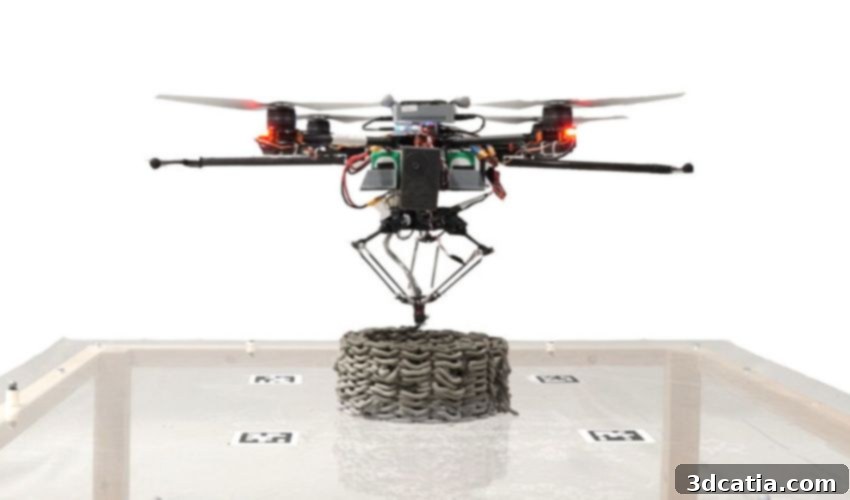
Revolutionizing Construction: BuilDrones and Aerial Additive Manufacturing Propel the Future of Building
The construction industry, a cornerstone of global development, has consistently sought innovative solutions to enhance efficiency, safety, and sustainability. In recent years, additive manufacturing, more commonly known as 3D printing, has emerged as a transformative force, moving from prototyping to large-scale structural applications. This evolution has paved the way for unprecedented advancements, culminating in a groundbreaking development from a collaborative team of researchers at Imperial College London and Empa, the Swiss Federal Laboratories of Materials Science and Technology.
This pioneering team has engineered a specialized class of drones designed for collective building and repair: the ‘BuilDrones’. Inspired by the intricate and efficient swarm construction methods observed in nature – particularly how bees and wasps construct their nests – these drones employ in-flight 3D printing. The novel system, termed Aerial Additive Manufacturing (Aerial-AM), utilizes a fleet of multiple drones working cohesively from a single digital blueprint. This innovative approach promises to redefine traditional construction paradigms, offering solutions to long-standing challenges within the sector.
The integration of additive manufacturing into the construction sector has seen remarkable growth. Just a few years ago, the concept of 3D-printed houses seemed futuristic; today, numerous projects are demonstrating the viability and benefits of these technologies. As more companies recognize the immense potential of additive manufacturing, scientists and engineers are pushing its boundaries further, seeking to maximize its capabilities. The Aerial-AM system is a prime example of this relentless pursuit of innovation. By developing autonomous BuilDrones capable of constructing and repairing structures, the research aims to significantly reduce reliance on human labor in hazardous environments, thereby saving time, cutting costs, and drastically minimizing the risk of work-related injuries.
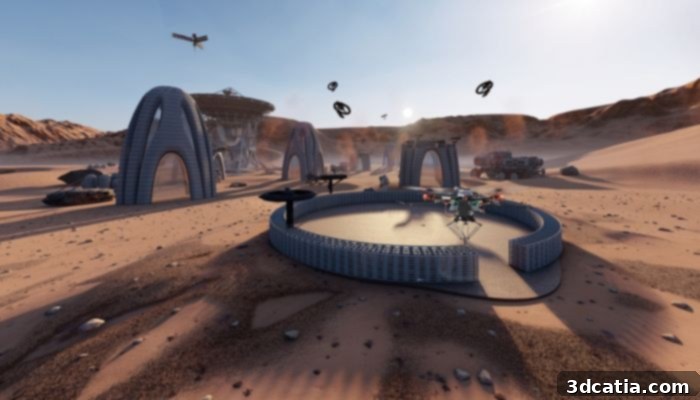
In the future drones could also be used for construction in space (photo credits: Yusuf Furkan KAYA, Aerial Robotics Laboratory, Imperial College London / Empa)
How Aerial-AM and BuilDrones Work: A Biomimetic Approach to Construction
The sophisticated Aerial-AM system is built upon the synergy of two distinct types of flying robots: BuilDrones and ScanDrones. Each plays a crucial role in the collective construction process, mirroring the specialized tasks within a natural insect colony.
The Role of BuilDrones: Precision Material Deposition
BuilDrones are the primary builders. These specialized drones are equipped to deposit building materials directly during flight, employing advanced in-flight 3D printing techniques. Their design focuses on precision, stability, and the ability to carry and extrude various cement-like mixtures. This direct deposition capability allows for the creation of complex geometries and the incremental construction of structures layer by layer, much like traditional 3D printers, but with the added dimension of aerial mobility. The materials developed for these drones are specifically formulated to cure quickly and provide structural integrity as the build progresses, ensuring the stability of the growing structure.
The Role of ScanDrones: Monitoring, Measurement, and Adaptive Control
Complementing the BuilDrones are the ScanDrones. These intelligent monitoring units are responsible for continuously assessing the ongoing construction. Equipped with high-precision sensors, scanners, and cameras, ScanDrones measure the BuilDrones’ output in real-time, cross-referencing it against the initial digital blueprint. This data is critical for ensuring accuracy and quality. More importantly, the ScanDrones feed this information back into the system, enabling the BuilDrones to adapt their manufacturing steps and adjust their flight paths and material deposition in response to the changing geometry of the structure as it develops. This closed-loop feedback mechanism is central to the system’s ability to maintain high precision, with demonstrated accuracy down to five millimeters.
Inspired by Nature, Guided by Humans
As mentioned, the operational concept of these drones draws heavily from biomimicry, specifically the collective intelligence and self-organizing behaviors of bees and wasps. While the drones function autonomously in flight, performing complex tasks with minimal direct human intervention, they operate under the overarching supervision of a human controller. This supervisor monitors their movements, progress, and overall system health, ready to intervene if necessary. This hybrid approach – autonomous operation with human oversight – ensures both efficiency and the highest quality of construction, combining the strengths of robotic precision with human judgment and problem-solving capabilities.
Furthermore, the Aerial-AM technology integrates a sophisticated 3D printing and path-planning framework. This framework is not static; it dynamically adapts to the evolving geometry of the structure. As layers are added and the building takes shape, the drones’ flight paths and printing parameters are continuously recalculated and optimized, ensuring seamless and accurate construction from the ground up. This adaptive intelligence allows for the creation of intricate and robust structures, even in challenging environments.
Rigorous Testing and Promising Results
To validate the capabilities of the Aerial-AM system, the research team developed and tested the drones with four different cement-like mixtures. These experiments demonstrated the drones’ ability to assess the printed geometry in real-time and adapt their behavior dynamically, achieving an impressive printing accuracy of five millimeters. This level of precision is crucial for structural integrity and meeting engineering standards, making the technology viable for practical applications in the construction sector.
Professor Mirko Kovac, who spearheaded this ambitious project from Imperial’s Department of Aeronautics and Empa’s Materials and Technology Center of Robotics, articulated the team’s vision and achievements: “We’ve proved the concept that drones can work autonomously and in tandem to construct and repair buildings, at least in the lab. This scalable solution could help construction and repair in difficult-to-reach areas, like tall buildings. We believe our fleet of drones could help reduce the costs and risks of construction in the future, compared to traditional manual methods.” His statement underscores the significant potential of this technology to transform the construction landscape, especially in scenarios where human intervention is hazardous or logistically challenging.
Transforming the Construction Landscape: Benefits and Future Applications
The implications of Aerial-AM technology extend far beyond incremental improvements; it represents a fundamental shift in how we approach building and infrastructure maintenance. The benefits are multi-faceted and compelling.
Enhanced Safety and Risk Reduction
One of the most immediate and impactful advantages is the dramatic improvement in safety. Traditional construction often places human workers in dangerous situations, particularly at heights, in confined spaces, or during repairs of compromised structures. By deploying autonomous drones, the need for human presence in these high-risk areas is significantly reduced, leading to a substantial decrease in work-related injuries and fatalities. This not only protects human lives but also lowers insurance costs and legal liabilities for construction companies.
Unprecedented Efficiency and Cost Savings
The ability of drones to operate continuously, without breaks or fatigue, translates into unparalleled efficiency. Faster construction timelines mean projects can be completed more quickly, reducing overall labor costs and accelerating return on investment. Furthermore, the precision of additive manufacturing minimizes material waste, contributing to cost savings and environmental sustainability. The optimization of material deposition also means that structures can potentially be designed with less material while maintaining structural integrity, further driving down costs.
Access to Difficult and Hazardous Locations
Perhaps one of the most revolutionary aspects of this technology is its capacity to enable building and repair in locations previously deemed impossible or prohibitively expensive for human workers. This includes extremely tall buildings, complex architectural designs, damaged structures in disaster zones, and even remote or inaccessible geographical areas. The image caption notably suggests the future possibility of using these drones for construction in space, opening up entirely new frontiers for human expansion and resource utilization. Imagine repairing wind turbines at dizzying heights or constructing emergency shelters in war-torn regions without endangering human lives – these are just some of the applications this technology makes feasible.
Scalability and Adaptability for Diverse Projects
The Aerial-AM system is designed with scalability in mind. A single blueprint can guide an entire fleet of drones, allowing for larger and more complex projects to be undertaken with coordinated effort. The adaptive path-planning framework ensures that the drones can handle evolving structural geometries, making them suitable for both new construction and the intricate repair of existing infrastructure. This adaptability positions the technology as a versatile tool for a wide array of construction and maintenance tasks.
The Road Ahead: Challenges and the Future of Drone Construction
While the promise of Aerial-AM is immense, challenges remain to be addressed for widespread adoption. Regulatory frameworks for autonomous aerial vehicles in urban construction zones are still evolving. Factors like drone battery life, payload capacity for large-scale material transport, and performance under adverse weather conditions (wind, rain, extreme temperatures) require further optimization. Ensuring absolute precision and structural integrity on massive projects will also demand continuous refinement of algorithms and materials.
Nevertheless, the trajectory for drone-based construction is exceptionally bright. We can anticipate future developments where these drones integrate seamlessly with Building Information Modeling (BIM) systems, enabling fully automated design-to-construction workflows. The development of new, high-performance construction materials specifically tailored for aerial additive manufacturing will unlock even greater design freedom and structural capabilities. The vision of fully autonomous construction sites, where human roles shift from manual labor to supervision, planning, and maintenance of robotic fleets, is no longer a distant dream but an achievable reality thanks to pioneering research like that from Imperial College London and Empa.
To delve deeper into this exciting development, the original press release offers additional insights and can be accessed HERE.
What are your thoughts on the revolutionary potential of drones in the construction sector? Share your opinions in the comments section below or join the conversation on our LinkedIn, Facebook, and Twitter pages! Don’t miss out on the latest advancements in 3D printing and additive manufacturing; sign up for our free weekly Newsletter here to get the news delivered straight to your inbox. You can also explore all our fascinating videos on our YouTube channel.
*Cover Photo Credits: Imperial College London