
Revolutionizing Food: MeaTech Secures Patent for Advanced 3D Bioprinting of Cultured Meat
In a significant stride for the sustainable food industry, MeaTech has announced the filing of a provisional patent application with the United States Patent Office. This crucial patent pertains to their innovative bioprinting method, designed specifically for the creation of cell-based chicken and steak products. MeaTech has positioned itself at the forefront of the clean farming movement, meticulously developing an industrial process that leverages cutting-edge 3D printing technology to cultivate meat directly from cells. This novel bioprinting technique, according to MeaTech, promises unprecedented levels of control over bioink printing throughout the intricate multi-layered manufacturing process. Such precision is expected to enable the production of premium, thick meat-emulating products, while simultaneously boosting printing speeds and accommodating bioinks with a wider range of viscosities. This development underscores MeaTech’s commitment to transforming the future of meat consumption, making it more sustainable, ethical, and efficient.
While bioprinting is frequently associated with advancements in the medical sector, such as the creation of organs and tissues for therapeutic purposes, its application in food technology has seen a remarkable surge in popularity over recent years. This growing interest is primarily driven by an escalating global demand for more sustainable and cruelty-free alternatives to conventionally farmed meat. The environmental footprint of traditional livestock agriculture is a well-documented and pressing concern. As highlighted by the World Wildlife Fund (WWF), beef production alone accounts for a staggering 25% of global land use, land-use change, and forestry emissions. This includes the devastating conversion of vital ecosystems, such as forests in the Brazilian Amazon, into agricultural land for grazing or feed cultivation. The imperative to find viable, scalable solutions that mitigate these impacts has never been greater, propelling companies like MeaTech into the spotlight of food innovation.
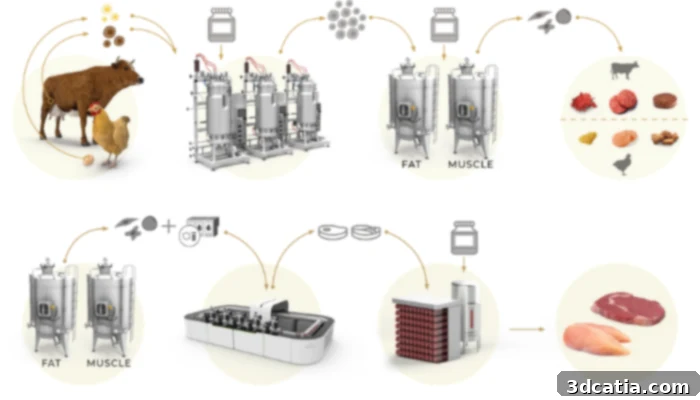
MeaTech’s process for bioprinting. The top shows the cell-based process vision wherein cell collection is followed by cell growth then differentiating between fat and muscle to get ground products. On the bottom is the process for cultured steak with bioinks being used for bioprinting, before the printed product is incubated to mature and form tissue. The result is structure meat in a fraction of the time. (Photo Credits: MeaTech)
The environmental crisis linked to conventional meat production serves as a primary motivator for MeaTech’s mission. The company explicitly states on its website its dedication to addressing the highly pollutive nature of the meat industry. Current statistics paint a stark picture: 8% of the world’s freshwater resources are consumed by livestock farming for meat and leather production. Furthermore, the livestock sector is responsible for at least 18% of all greenhouse gas emissions entering the atmosphere, a significant contributor to climate change. Adding to these concerns, an astounding 33% of the world’s croplands are dedicated to producing animal feed, diverting vast tracts of land that could otherwise be used for human food production or reforestation. By cultivating meat directly from animal cells, MeaTech offers a revolutionary pathway for people to continue enjoying meat – a deeply ingrained part of countless cultures and culinary traditions worldwide – but in a profoundly more sustainable and environmentally conscious manner. This cell-based approach drastically reduces the need for extensive land, water, and feed, offering a cleaner, greener alternative without compromising on the taste or texture that consumers expect.
Driven by these critical environmental and ethical considerations, MeaTech is actively developing advanced manufacturing technologies to produce a new generation of alternative protein products. Their primary focus includes cell-based beef and chicken, alongside innovative methods to enhance plant-based foods with real meat components. The company’s ambition extends beyond merely making the meat industry more sustainable; it aims to produce premium, thicker cuts of cell-based meat that can genuinely compete with, and potentially surpass, traditional cuts in quality and culinary appeal. This recently filed patent is a cornerstone of their strategy, designed to protect MeaTech’s proprietary technologies, groundbreaking inventions, and significant improvements upon existing bioprinting methods. Securing intellectual property is vital in this rapidly evolving field, ensuring MeaTech maintains its competitive edge and can continue to invest in research and development without undue risk.
The core of this innovation lies in a novel bioprinting method that MeaTech believes will deliver unparalleled control over the printing of bioinks. This advanced technique draws parallels with material jetting, a precision manufacturing process, but with the critical distinction of utilizing living cells as the “ink.” MeaTech explains that their method allows for remarkable control during the in-situ inkjet printing of each individual droplet. This includes meticulous regulation of droplet size, volume, and crucially, the precise placement of each droplet onto a substrate layer. The advantages of such exacting control are multifaceted. It introduces a significant degree of flexibility into the bioprinting process, enabling not only increased printing speeds – a key factor for scalability – but also the successful use of bioinks with varied viscosities. Traditionally, bioprinting with highly viscous inks has presented substantial challenges, limiting the types of cells and matrices that could be incorporated. MeaTech’s breakthrough effectively overcomes this hurdle, opening up new possibilities for creating complex meat structures. Ultimately, this technology is designed to produce premium, cruelty-free, and sustainable cell-based cuts of meat, offering consumers a guilt-free gourmet experience.
The implications of this precise control are vast for the future of cultured meat. By dictating the exact arrangement of fat and muscle cells, MeaTech can engineer meat products with desired textures, marbling, and flavor profiles, moving beyond simple ground meat to complex, structured cuts like steak and chicken breasts. This level of biological and architectural engineering is what will ultimately distinguish high-quality cultured meat products in the market. The ability to increase printing speeds is also critical for transitioning from laboratory-scale prototypes to industrial-scale production. This patented method represents a significant leap towards making cell-based meat a mainstream reality, addressing not only the environmental and ethical concerns but also the practical challenges of mass production and consumer acceptance.
Commenting on this groundbreaking development, Sharon Fima, the esteemed CEO of MeaTech, emphasized the significance of the patent. “This novel technique for achieving more controlled, higher resolution printing may prove to be a promising path forward towards achieving high-throughput, large-scale cultivated meat production. As a 20-year veteran of the printing industry, I recognize the significant potential this patent application holds, as it directly addresses key challenges currently facing the bioprinting industry,” Fima stated. Her insights underscore the dual importance of this patent: not only does it signify a leap in food technology, but it also represents a crucial advancement in the broader bioprinting landscape, potentially influencing other applications beyond food. The ability to overcome challenges related to resolution, speed, and material versatility positions MeaTech as a key innovator in the field. This patent is a testament to the rigorous research and development undertaken by the company, solidifying its intellectual property and paving the way for future commercialization. The journey from lab-grown cells to consumer-ready, ethically produced, and environmentally friendly meat products is long, but MeaTech’s latest patent marks a substantial and exciting step forward. You can delve deeper into MeaTech’s vision and technological advancements by visiting the company’s website HERE.
The advent of cell-based meat, facilitated by technologies like MeaTech’s bioprinting method, promises a future where food production is not only more sustainable and humane but also more resilient to global challenges like resource scarcity and pandemics. This shift could free up vast tracts of land, reduce greenhouse gas emissions, and significantly alleviate animal suffering. While challenges remain in terms of scaling production, reducing costs, and navigating regulatory pathways, patents like this provide the necessary framework for innovation and investment in the cultivated meat sector. As consumers increasingly seek ethical and environmentally responsible food choices, companies like MeaTech are poised to lead a fundamental transformation in how we produce and consume meat.
What are your thoughts on MeaTech’s patent application for this revolutionary bioprinting method? Do you believe cell-based meat will become a staple in our diets? Let us know your perspective in a comment below or join the conversation on ourFacebook,Twitter andLinkedIn pages! Don’t miss out on the latest advancements in 3D printing and food technology – sign up for our free weeklyNewsletter here, delivering all the breaking news straight to your inbox!
Thumbnail Photo Credits: MeaTech