
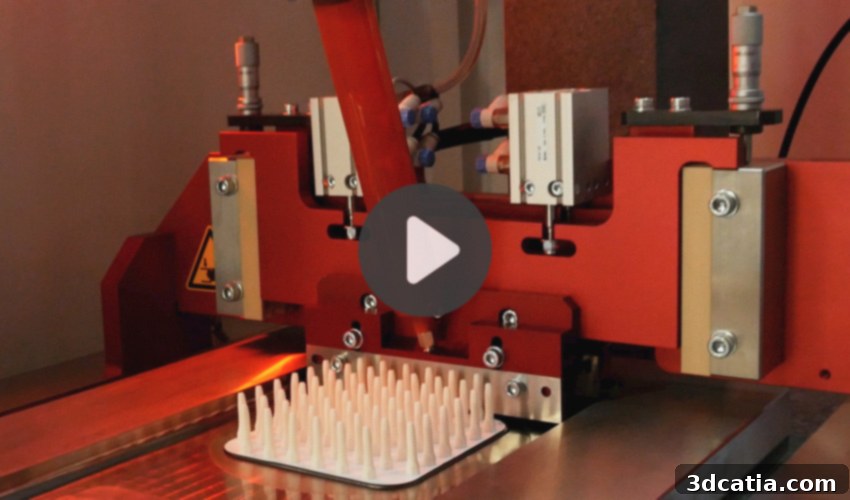
3DCeram: Leading the Industrialization of Ceramic Additive Manufacturing with Advanced Solutions
In the rapidly evolving landscape of advanced manufacturing, 3DCeram stands out as a pioneering force, specializing in the development and production of industrial 3D printers dedicated to ceramics. With a particular focus on stereolithography (SLA) technology, this innovative French company has spent several years engineering sophisticated solutions designed to meet the rigorous demands of high-performance industries. From critical defense applications to life-saving biomedical devices and cutting-edge aerospace components, 3DCeram’s offerings enable the creation of complex, high-precision ceramic parts that were previously challenging or impossible to produce. Their commitment to innovation has resulted in a robust portfolio of machines, including the acclaimed C1000 FLEXMATIC, specifically engineered for semi-automated industrial production. This comprehensive range is now fully compatible with a diverse array of advanced technical ceramics, such as zirconium, aluminum oxide, and silicon carbide, opening new avenues for material innovation and product development across various sectors.
Ceramic additive manufacturing, often referred to as ceramic 3D printing, represents a paradigm shift in how high-performance ceramic components are designed and produced. Unlike traditional ceramic manufacturing processes that involve extensive tooling and complex machining for intricate geometries, 3D printing allows for unprecedented design freedom, enabling the creation of parts with internal structures, lightweight lattices, and highly customized forms. 3DCeram leverages the precision of stereolithography, a process where a photosensitive ceramic slurry is selectively cured layer by layer using a UV laser. This method ensures exceptional resolution, excellent surface finish, and tight dimensional tolerances, which are critical for demanding applications where performance and reliability are paramount. The ability to produce functional ceramic parts directly from digital designs significantly accelerates prototyping, reduces material waste, and shortens lead times, providing a competitive edge for industries seeking advanced material solutions.
The C1000 FLEXMATIC exemplifies 3DCeram’s dedication to bringing industrial-scale production capabilities to ceramic additive manufacturing. Designed with the modern manufacturing environment in mind, this machine offers a semi-automated workflow that streamlines the production process, from material preparation to post-processing. Its robust architecture and advanced control systems ensure high repeatability and reliability, which are essential for batch production and quality consistency. The C1000 FLEXMATIC’s flexibility allows manufacturers to switch between different ceramic materials with relative ease, making it a versatile tool for diverse industrial needs. Whether producing dental implants from biocompatible zirconium, heat shields for aerospace engines from silicon carbide, or wear-resistant components from aluminum oxide, this printer provides the precision and throughput necessary for demanding applications. Its intelligent design minimizes manual intervention, thereby reducing the potential for human error and increasing overall operational efficiency, pushing the boundaries of what is achievable in ceramic component fabrication.
A cornerstone of 3DCeram’s integrated solution is its advanced software suite, CPS 2.0. Recognizing that hardware is only one part of the equation, the company has invested heavily in developing intelligent software that complements its printers and optimizes the entire additive manufacturing workflow. CPS 2.0 is designed to facilitate seamless integration from CAD model to final printed part, offering extensive customization capabilities that empower users to fine-tune printing parameters for optimal results. This includes features for build plate preparation, support structure generation, slicing algorithms, and real-time print monitoring. The software’s intuitive interface and powerful functionalities help users gain significant efficiencies, reducing setup times, minimizing trial-and-error, and improving the success rate of complex prints. By providing precise control over the printing process, CPS 2.0 ensures that manufacturers can consistently achieve the desired mechanical properties and dimensional accuracy for their high-value ceramic components, enhancing the overall reliability and performance of their industrial operations.
3DCeram’s commitment to advancing ceramic additive manufacturing was prominently showcased at Formnext 2023, one of the world’s leading trade shows for additive manufacturing and industrial production. At this prestigious event, the manufacturer unveiled its cutting-edge automatic production line for ceramic additive manufacturing, signaling a significant leap towards fully industrialized ceramic part fabrication. This integrated production line demonstrates how 3DCeram’s technology can facilitate the scaling up of part production to truly industrial levels, addressing the growing demand for high-volume, high-performance ceramic components. The automated line minimizes human interaction, from material handling and printing to cleaning and debinding, ensuring consistent quality, higher throughput, and reduced labor costs. This holistic approach to automation is crucial for realizing the full potential of ceramic 3D printing in applications requiring mass customization or serial production, transforming concept into high-volume reality.
Arnaud Roux, Sales Area Manager at 3DCeram, provided insightful perspectives on these advancements during Formnext 2023. In the video presentation, he elaborated on the innovative technologies and comprehensive solutions developed by the company to bring ceramic additive manufacturing to an unprecedented industrial scale. His discussion likely covered the unique challenges associated with printing technical ceramics, such as managing material shrinkage, ensuring homogeneity, and achieving optimal mechanical properties. Furthermore, he would have highlighted how 3DCeram’s proprietary processes and materials overcome these hurdles, delivering robust, reliable, and high-performance ceramic parts. The insights shared by Roux underscored 3DCeram’s leadership in the field, emphasizing their role in enabling industries to harness the full potential of advanced ceramics for mission-critical applications where traditional manufacturing methods often fall short. The discussion would have also touched upon the economic benefits of adopting such automated production lines, including faster time-to-market, cost-efficiency through optimized material usage, and greater flexibility in design and production.
The range of technical ceramics compatible with 3DCeram’s systems is a testament to their material science expertise. Zirconium, for example, is highly valued for its exceptional strength, toughness, and biocompatibility, making it ideal for medical and dental implants, as well as wear-resistant industrial components. Aluminum oxide, known for its hardness, chemical resistance, and electrical insulation properties, finds applications in electronic substrates, cutting tools, and aerospace sensors. Silicon carbide offers outstanding thermal shock resistance, high strength at elevated temperatures, and excellent corrosion resistance, making it suitable for aerospace engine components, high-temperature furnace parts, and heat exchangers. By providing solutions compatible with such a diverse and high-performance material palette, 3DCeram empowers engineers and designers to create components that withstand extreme environments and perform under the most demanding conditions, pushing the boundaries of material science and engineering.
In essence, 3DCeram is not just selling 3D printers; they are offering a complete ecosystem for industrial ceramic additive manufacturing. This ecosystem includes advanced hardware, intelligent software, a wide range of high-performance ceramic materials, and the expert support necessary to integrate these solutions into existing production workflows. The benefits for manufacturers are manifold: unparalleled design freedom, enabling complex geometries and optimized structures; superior material properties, leveraging the inherent advantages of advanced ceramics; accelerated product development cycles, from prototyping to final production; and significant cost efficiencies through reduced material waste and streamlined processes. As industries continue to seek innovative ways to improve performance, reduce weight, and enhance durability, 3DCeram’s industrial solutions for ceramic 3D printing are poised to play a pivotal role in shaping the future of high-tech manufacturing.
What are your thoughts on 3DCeram’s industrial solutions and the future of ceramic additive manufacturing? We invite you to share your insights and engage with our community. Let us know in a comment below or connect with us on our LinkedIn, Facebook, and Twitter pages! Don’t forget to sign up for our free weekly Newsletter here, ensuring you receive the latest 3D printing news straight to your inbox! You can also find all our compelling videos and further discussions on our YouTube channel, offering a visual dive into the world of additive manufacturing innovation.